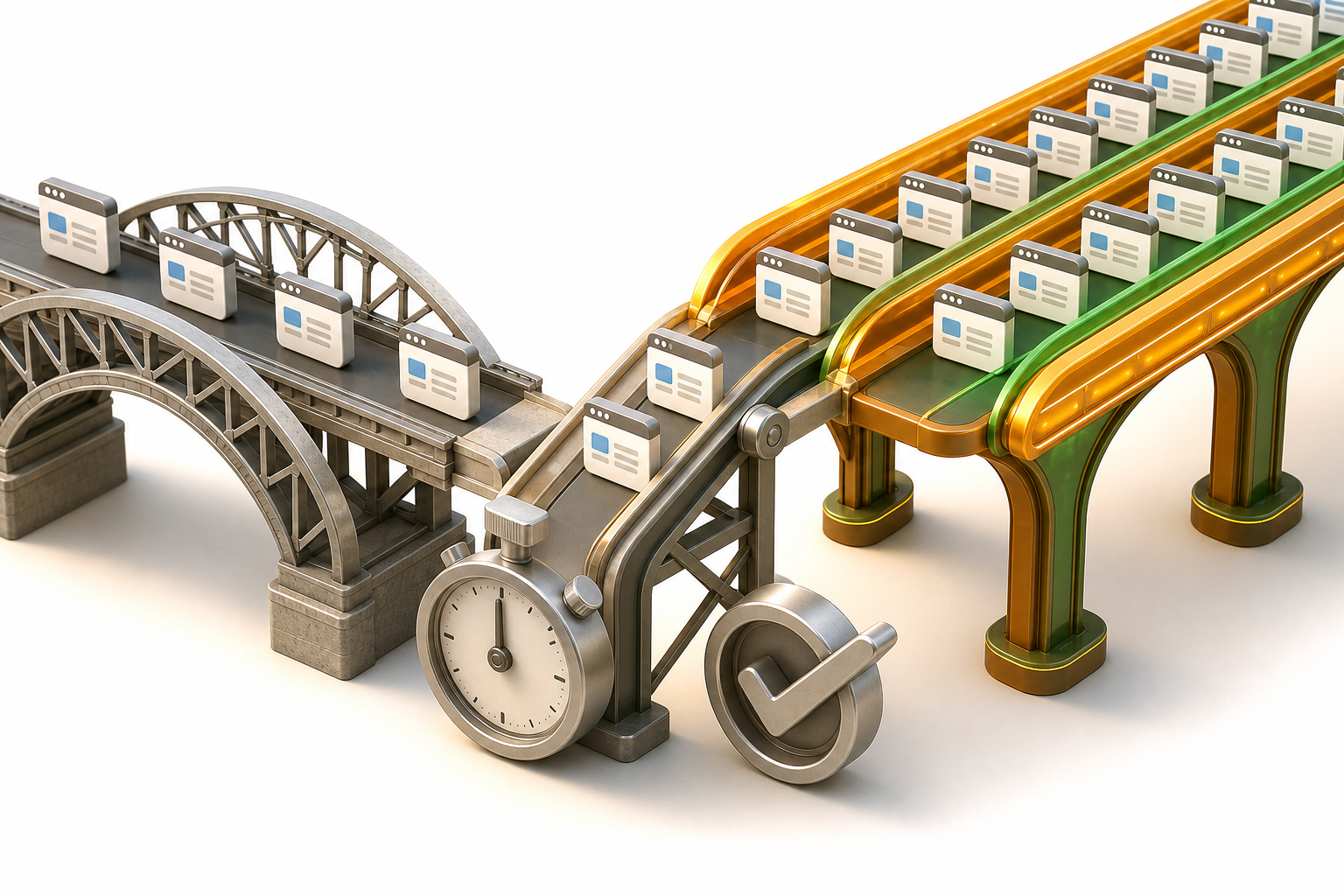

Selenium testing is the practice of using Selenium WebDriver and related tooling to automate browser interactions for web application validation. QA automation is the engineering discipline of designing automated checks, data, environments, and feedback loops that reduce release risk. The uncomfortable truth is that many Selenium specialists built careers around scripts, not systems, and that gap will become visible as automation careers demand broader engineering judgment.
Most Selenium testers will struggle because the market is moving from script creation to automation architecture, reliability engineering, AI-assisted validation, and product risk analysis. Selenium itself will remain useful, but testers who only know locators, waits, and page objects will compete with cheaper tools and AI-generated code. The testers who adapt will pair Selenium knowledge with CI/CD, observability, contract testing, accessibility, and business-focused quality strategy.
Why Selenium Testing Skills Are Being Repriced
Selenium testing skills are being repriced because browser automation is no longer rare expertise. The market now rewards engineers who can make automation trustworthy, fast, maintainable, and strategically aligned with delivery risk.
An automation career is a long-term professional path focused on using tools, code, systems, and quality strategy to accelerate safe software delivery. For years, many automation careers advanced through visible output: more test cases automated, more page objects written, more regression coverage reported. That measurement is losing value because teams have learned that high test counts do not guarantee high confidence.
The future of Selenium is not disappearance; it is specialization inside a larger automation ecosystem. Selenium WebDriver is an open standard and browser automation API that lets code control real browsers through driver implementations. Its strength is broad language support, browser compatibility, and enterprise adoption, but those strengths alone no longer make a tester differentiated.
In mature engineering organizations, the conversation has shifted from how many Selenium scripts exist to how quickly the suite detects meaningful defects. Teams increasingly benchmark automation by feedback time, escaped defects, flake rate, triage cost, and deployment confidence. A suite that takes 90 minutes and fails randomly 12 percent of the time is treated as operational debt, even if it contains thousands of tests.
How does script-only Selenium affect automation careers?
Script-only Selenium limits automation careers because it produces candidates who can automate flows but cannot design resilient quality systems. Hiring teams increasingly ask why a test exists, where it should run, what signal it provides, and how expensive it is to maintain.
The old Selenium career path rewarded syntax fluency: find an element, click it, wait for a page, assert text. AI code assistants can now generate that level of automation quickly, and low-code platforms can reproduce it for simple workflows. The human advantage is not typing WebDriver commands faster; it is deciding what should be automated, what should be tested lower in the stack, and what should be monitored in production.
Teams using layered automation strategies commonly report 30 to 50 percent faster feedback loops than teams that push every scenario through UI automation. That benchmark is plausible because API, component, and contract checks usually run faster and fail closer to the cause. Selenium testers who cannot move across those layers risk becoming bottlenecks rather than accelerators.
Why is the future of Selenium still relevant?
The future of Selenium remains relevant because many enterprises still need cross-browser coverage, legacy compatibility, and language flexibility at scale. Selenium is not the problem; treating Selenium as the entire automation strategy is the problem.
Selenium 4 improved the platform with better relative locators, native browser interactions, and stronger integration with modern driver management. WebDriver BiDi is a bidirectional browser automation protocol that enables richer communication between tests and browsers, including network and console visibility. These capabilities keep Selenium viable for teams with diverse stacks and compliance-heavy environments.
The issue is that viable does not mean sufficient. A tester who only knows Selenium commands may struggle in teams where quality engineering spans pull request gates, service virtualization, test data pipelines, accessibility checks, and deployment telemetry. Selenium remains a valuable instrument, but the orchestra has grown.
The New Baseline for QA Automation Engineers
QA automation engineers are now expected to own feedback quality, not just automated execution. The baseline skill set has expanded from browser scripting to systems thinking, test design economics, and delivery pipeline integration.
Test architecture is the structured design of automated checks, frameworks, data, environments, and reporting so that a team receives reliable risk signals at the right time. A strong test architect knows when to use a unit test, contract test, API test, visual check, exploratory session, or Selenium end-to-end flow. This judgment saves time because it prevents the most expensive layer, the browser UI, from absorbing every quality concern.
CI/CD is continuous integration and continuous delivery, a delivery practice where code is integrated, verified, and made releasable through automated pipelines. Selenium testers who understand CI/CD can design suites that run selectively, parallelize safely, fail with actionable logs, and block releases only when the risk justifies it. That is far more valuable than adding another brittle regression case.
Test observability is the ability to understand test behavior through logs, traces, screenshots, videos, metrics, and failure classification. Without observability, large Selenium suites become rumor machines: one person says the app is broken, another says the test is flaky, and a third reruns the job until it passes. Strong automation engineers reduce that ambiguity.
| Capability area | Old Selenium tester profile | Next five years QA automation profile |
|---|---|---|
| Primary output | Automated UI scripts and regression counts | Reliable feedback systems tied to delivery risk |
| Tool depth | Selenium WebDriver, locators, waits, page objects | Selenium plus APIs, contracts, pipelines, telemetry, and cloud grids |
| Failure handling | Rerun failed tests and inspect screenshots manually | Classify failures, measure flake rate, and remove systemic causes |
| Test strategy | Automate manual test cases through the browser | Select the cheapest test layer that provides enough confidence |
| Career leverage | Tool-specific implementation speed | Architecture, risk analysis, coaching, and measurable release impact |
What capabilities will hiring teams screen for?
Hiring teams will screen for automation engineers who can explain tradeoffs, not just demonstrate framework syntax. Strong candidates show evidence of improving build time, reducing flaky failures, lowering escaped defects, and making releases safer.
Expect interviews to include questions about parallel execution, test isolation, data strategy, mocking, contract testing, accessibility, and performance smoke checks. A senior candidate may be asked how they would cut a six-hour regression suite to under 45 minutes without losing release confidence. The answer should include risk slicing, tagging, service-level checks, and selective UI coverage, not only adding more machines.
Automation engineers should also understand code quality practices. Pull request review, static analysis, dependency management, design patterns, and refactoring are no longer optional extras. When test code is treated as second-class code, the suite eventually becomes too slow and fragile to trust.
Where Selenium Still Wins and Where It Loses
Selenium still wins when teams need standards-based, language-flexible, cross-browser automation across complex enterprise environments. It loses when teams expect it to solve speed, test design, and maintainability problems that belong to architecture.
Playwright is a modern browser automation framework that provides fast execution, auto-waiting, browser context isolation, and strong network control. Cypress is a JavaScript-focused end-to-end testing framework that runs close to the application and provides developer-friendly debugging for many front-end teams. Neither tool automatically makes a team mature, but both have changed expectations around speed and developer experience.
The best teams choose automation tools by risk model, system architecture, team skill, and feedback requirements. A banking platform with multiple browser mandates may keep Selenium as a core layer. A product-led SaaS team shipping daily with a React front end may use Playwright for most UI flows and keep Selenium only where broad compatibility requires it.
| Approach | Best fit | Common risk | Career implication |
|---|---|---|---|
| Selenium WebDriver | Enterprise cross-browser suites, mixed languages, legacy apps | Slow suites when overused for all validation | Valuable when paired with architecture and grid expertise |
| Playwright | Modern web apps, fast UI checks, network-aware testing | Overconfidence if browser coverage needs are ignored | Useful for engineers who want strong developer workflow skills |
| Cypress | JavaScript teams, component testing, fast local debugging | Fit issues in non-JavaScript or multi-tab scenarios | Strong for front-end aligned automation careers |
| API and contract testing | Service-heavy systems and microservices release gates | Missing browser integration and user journey defects | Essential for moving beyond UI-only automation |
| AI-assisted testing | Test generation, maintenance suggestions, defect clustering | False confidence from shallow generated assertions | High leverage for engineers who can validate tool output |
When should teams keep Selenium WebDriver?
Teams should keep Selenium WebDriver when they need standards-based automation across multiple browsers, programming languages, operating systems, or vendor grids. It is also a sensible choice when existing suites are stable and the cost of migration exceeds the benefit.
Large organizations often have thousands of Selenium tests embedded in release governance, compliance evidence, and regression workflows. Rewriting them purely to follow tool trends can create more risk than value. A better approach is to audit the suite, delete low-value tests, move suitable checks to lower layers, and improve reliability around the remaining Selenium coverage.
Selenium also remains useful for teams with specialist language ecosystems. Java, C Sharp, Python, Ruby, and JavaScript support make it adaptable across departments. That flexibility matters in organizations where quality platforms must serve many product groups.
When should teams introduce Playwright or Cypress?
Teams should introduce Playwright or Cypress when their current Selenium suite is too slow, too flaky, or poorly aligned with front-end development workflows. The decision should be based on measurable pain, not tool hype.
Playwright is often attractive when teams need browser contexts, network interception, trace viewer diagnostics, and parallel execution with minimal ceremony. Cypress is often attractive when the team lives in JavaScript and wants tight integration with component testing and local debugging. Both can coexist with Selenium when each tool owns a clear testing responsibility.
A useful benchmark is to run a two-week pilot against ten high-value flows and compare runtime, failure diagnostics, maintenance effort, and developer adoption. Teams frequently see 25 to 40 percent faster UI feedback in targeted pilots, but the improvement disappears if they simply port bad test design into a new framework. Tool migration without strategy is expensive rebranding.
AI Will Expose Weak QA Automation Faster Than It Replaces Testers
AI will not eliminate strong QA automation engineers, but it will expose weak automation design by making simple script creation cheaper. The differentiator becomes the ability to evaluate, constrain, and operationalize AI output responsibly.
AI-assisted testing is the use of machine learning or generative AI to create, maintain, prioritize, or analyze tests and defects. It can generate Selenium or Playwright code, suggest selectors, cluster failures, summarize logs, and propose regression coverage. Those capabilities are useful, but they do not understand product risk, regulatory obligations, or subtle user impact without human direction.
Many teams already use AI to draft tests or refactor page objects, and early adopters report 20 to 35 percent faster initial automation authoring for straightforward flows. The productivity gain is real, but it shifts effort from typing code to reviewing correctness. Poor reviewers will approve shallow assertions, duplicate coverage, and brittle selectors at machine speed.
How does AI-assisted testing change test design?
AI-assisted testing changes test design by making test generation easy and test selection more important. When creating another UI test becomes cheap, the costly decision is whether that test deserves to exist in the pipeline.
Senior QA automation engineers will need prompt literacy, code review discipline, and model skepticism. They should ask whether generated tests assert meaningful outcomes, isolate data correctly, avoid coupling to cosmetic UI details, and fail for the right reasons. AI can draft a test for a checkout flow, but it cannot decide whether fraud rules, tax calculation, inventory reservation, and accessibility states need separate coverage.
AI also raises security and governance questions. Test data may include personally identifiable information, credentials, or production-like payloads. Engineers who understand privacy, synthetic data, and secure pipeline configuration will be more valuable than those who paste stack traces into any available assistant.
What Teams Commonly Get Wrong When Modernising Selenium Suites
Teams commonly fail at Selenium modernisation because they treat symptoms instead of causes. Replacing a framework, adding retries, or buying a grid rarely fixes weak test design, unstable environments, and unclear ownership.
A flaky test is an automated test that sometimes passes and sometimes fails without a relevant product change. Flakiness is often blamed on Selenium, but the root cause may be shared test data, asynchronous application behavior, third-party dependencies, time-based assertions, environment drift, or unsafe parallel execution. Adding retries can protect a pipeline from noise, but it can also hide real reliability problems.
The first common mistake is automating manual test cases one for one. Manual cases often contain exploratory judgment, broad preconditions, and multiple assertions that are poor fits for deterministic automation. A single manual scenario may need one API contract test, one component test, and one focused Selenium journey instead of one giant browser script.
The second mistake is overusing page object models without design discipline. A page object model is a test design pattern that encapsulates UI interactions and page structure behind reusable methods. It helps when abstractions are cohesive, but it becomes harmful when page objects turn into large procedural dumping grounds with hidden waits and vague method names.
The third mistake is measuring automation success by coverage percentage. Coverage without risk weighting can mislead leaders into trusting low-value checks while critical paths remain poorly validated. Better metrics include mean time to signal, percentage of failures with clear root cause, flake rate by suite, defect escape patterns, and release rollback correlation.
The fourth mistake is leaving ownership ambiguous. If QA owns every test failure, developers treat automation as an external audit rather than a shared engineering system. High-performing teams make product squads responsible for the health of tests that protect their features, while quality engineers guide architecture and standards.
- Do not modernise by migration alone. A brittle Selenium test becomes a brittle Playwright test if selectors, data, and assertions remain weak.
- Do not use retries as a reliability strategy. Retries are a short-term containment tool, not a substitute for root cause removal.
- Do not place every regression at the UI layer. Browser automation is valuable, but it is usually the slowest and most failure-prone validation layer.
- Do not let AI generate tests without review. Generated code can increase suite size faster than it increases confidence.
A Five-Year Skill Roadmap for Selenium Testers
Selenium testers can protect their careers by moving from tool operation to quality engineering leadership. The practical roadmap is to keep Selenium competence while adding architecture, pipeline, observability, and risk skills.
Start by making your current suite measurable. Capture runtime by suite and tag, flake rate by test, failure categories, defect detection value, and maintenance effort. A tester who can say they reduced UI regression time from 80 minutes to 28 minutes while lowering flake rate from 9 percent to 2 percent has a stronger career story than someone who says they automated 300 cases.
Next, learn how to split validation across layers. API testing is validation performed directly against service interfaces instead of the browser UI. Contract testing is validation that checks whether service providers and consumers agree on request and response expectations. These skills help Selenium testers stop using the browser as a universal hammer.
Then, strengthen pipeline engineering. Parallelism, test sharding, containerized browsers, artifact collection, and environment provisioning all affect whether automation helps or slows delivery. The following example shows a simple CI job that runs UI checks in parallel, captures reports, and limits rerun behavior so failures remain visible.
name: ui-regression
on:
  pull_request:
    branches: [main]
jobs:
  selenium-ui:
    runs-on: ubuntu-latest
    strategy:
      fail-fast: false
      matrix:
        shard: [1, 2, 3, 4]
    steps:
      - uses: actions/checkout@v4
      - uses: actions/setup-python@v5
        with:
          python-version: 3.12
      - name: Install dependencies
        run: |
          python -m pip install --upgrade pip
          pip install -r requirements.txt
      - name: Run Selenium shard
        run: pytest tests/ui --browser=chrome --shard-id=${{ matrix.shard }} --shard-count=4 --reruns 1 --junitxml=reports/ui-${{ matrix.shard }}.xml
      - name: Upload failure artifacts
        if: always()
        uses: actions/upload-artifact@v4
        with:
          name: selenium-artifacts-${{ matrix.shard }}
          path: reports/
This configuration is not career-changing by itself. The value comes from knowing why sharding matters, why fail-fast is disabled, why reruns are limited, and how artifacts support root cause analysis. Tools are evidence of skill only when the engineer can explain the tradeoffs behind them.
How can testers prove impact beyond pass rates?
Testers can prove impact beyond pass rates by connecting automation work to delivery outcomes. Useful evidence includes shorter feedback cycles, fewer escaped defects, reduced triage hours, faster release approvals, and higher developer trust in pipeline results.
Build a portfolio of before-and-after metrics from real constraints. For example, document how you removed 120 redundant UI tests, replaced 70 with API checks, kept 35 critical Selenium journeys, and cut nightly execution from four hours to 55 minutes. That story signals strategy, courage, and engineering judgment.
Also show how you handle ambiguity. Senior QA automation work includes saying no to low-value automation requests, negotiating risk coverage with product owners, and coaching developers to write testable code. These behaviors are harder to automate than script generation.
The Career Risk Is Being Tool-Bound, Not Using Selenium
The biggest career risk is not being a Selenium tester; it is being a tester whose identity stops at Selenium. Tool-bound professionals struggle when the market changes, while quality engineers adapt tools to the risk in front of them.
Selenium knowledge still matters because web applications still need realistic browser validation. The difference is that future-ready testers use Selenium intentionally, sparingly, and measurably. They know that a critical payment journey may deserve browser coverage, while a permissions matrix may be better validated through APIs and contracts.
Automation careers will favor people who can collaborate across development, platform, product, security, and operations. A QA automation engineer who understands observability can discuss production incidents. One who understands accessibility can prevent exclusionary defects. One who understands performance can identify when a passing UI test still masks a slow, frustrating user experience.
The next five years will be uncomfortable for testers who relied on tool familiarity as a moat. It will be promising for testers who turn that familiarity into broader engineering leverage. Selenium can remain part of a strong career, but it cannot be the whole career.
Key Takeaways
- Selenium testing is still valuable, but script-only Selenium skills are becoming easier to replace with AI assistants, low-code tools, and junior implementation capacity.
- The future of Selenium is strongest when it is used as one layer in a broader QA automation strategy that includes APIs, contracts, observability, and CI/CD.
- Automation careers will increasingly reward engineers who reduce feedback time, flake rate, triage cost, and release risk rather than simply increasing test counts.
- Playwright, Cypress, and AI-assisted testing raise expectations for speed and diagnostics, but they do not fix weak test design by themselves.
- Teams commonly fail at Selenium modernisation by migrating brittle tests, overusing retries, and measuring coverage without understanding business risk.
- The safest career move for Selenium testers is to become tool-fluent rather than tool-bound, with measurable impact across architecture, pipelines, and product quality.