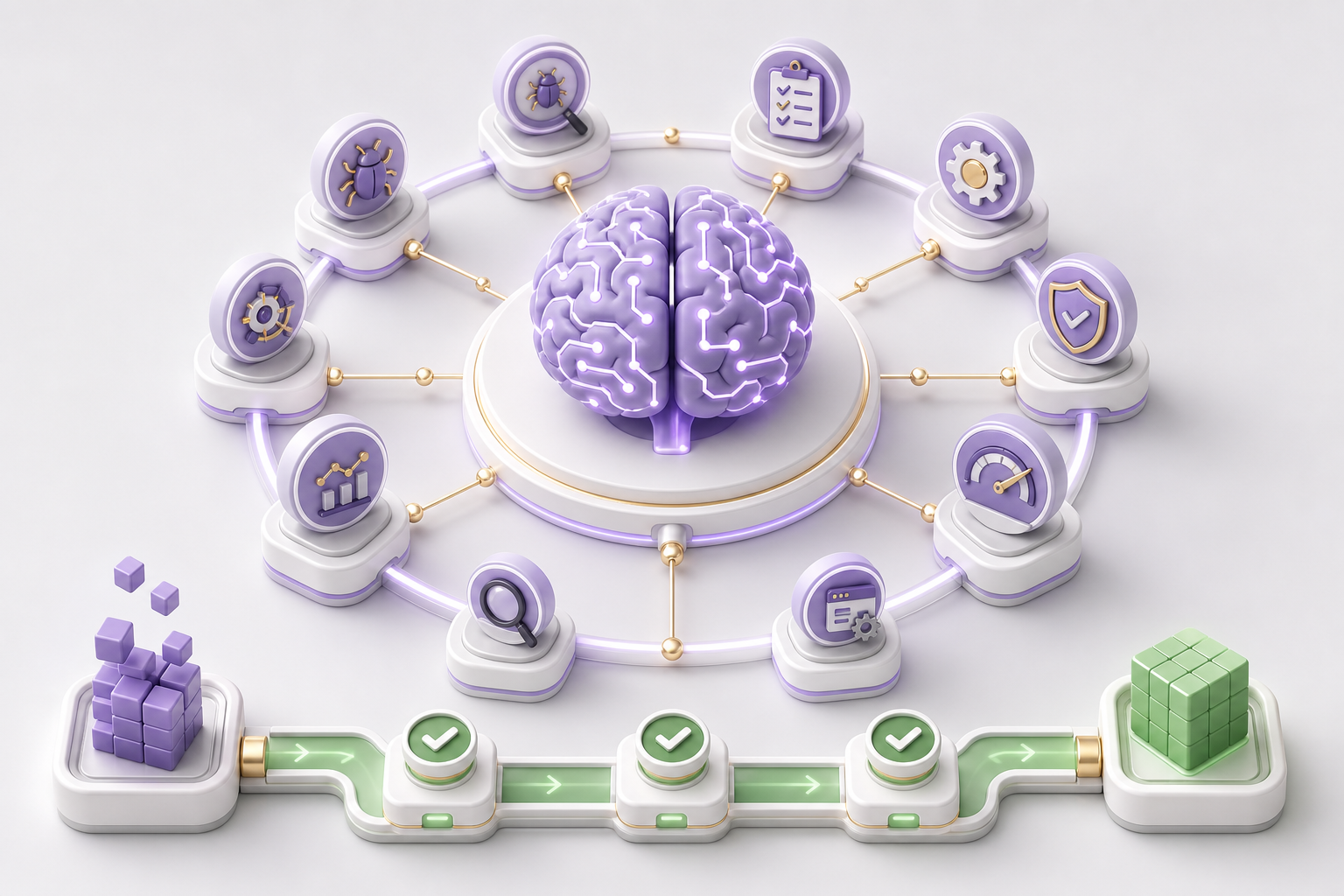

Generative AI is a class of models that creates new content, records, or scenarios from learned patterns, and it is reshaping how QA teams produce synthetic data for complex systems. Synthetic data is artificial data that preserves useful statistical, structural, or behavioral properties without directly copying production records. Test data management is the discipline of provisioning, securing, refreshing, and governing data for testing, while privacy compliance is the ability to meet legal and contractual rules for personal, regulated, or confidential information.
Synthetic test data generation with generative AI helps QA teams create realistic, privacy-safe datasets without exposing production data. The best 2026 approach combines schema-aware generation, privacy controls, referential integrity checks, and automated validation in CI/CD. Use it for scale, rare scenarios, and regulated environments, but verify utility and leakage risk before trusting it in release decisions.
Why Generative AI Changes Test Data Management in 2026
Generative AI changes test data management by making test datasets programmable, privacy-aware, and scenario-driven instead of manually copied from production. The practical shift is from masking existing records to generating fit-for-purpose data that can be created, audited, and destroyed on demand.
Traditional masked production data still carries operational friction: refresh delays, access approvals, incomplete anonymization, and brittle subsets that break referential integrity. In regulated sectors, teams often wait days for database extracts, then discover that the masked dataset lacks negative cases, edge values, or time-series patterns needed for robust regression testing.
Modern generative systems can learn distributions, relationships, and constraints from schemas, metadata, sample data, contracts, or domain rules. For example, an insurance QA team can generate realistic claim histories with dependent fields, fraud flags, regional variation, and claim lifecycle states without reusing actual claimant records.
The 2026 benchmark many mature QA organizations target is a 50 to 70 percent reduction in test data provisioning time and a 30 to 45 percent increase in scenario coverage for APIs and data-heavy workflows. Those gains are achievable only when synthetic data generation is treated as an engineered capability, not a one-off prompt in a chatbot.
Where Synthetic Data Delivers the Highest QA Value
Synthetic data delivers the highest QA value where production data is risky, incomplete, stale, or too expensive to provision repeatedly. It is strongest for scale testing, privacy-sensitive workflows, rare edge cases, and environments that need repeatable datasets across build pipelines.
Payment, healthcare, insurance, HR, telecom, and SaaS platforms benefit because realistic data is essential but production data exposure is costly. A test environment containing names, addresses, health codes, policy numbers, or behavioral analytics can create privacy incidents even when access is internal.
Generative synthetic data is also valuable when production data does not yet exist. New product lines, migrations, data lake transformations, and greenfield APIs often need volume and variety before customers produce real traffic.
The approach is less useful when exact historical reproduction is required for a production defect. In those cases, teams usually need a minimized, masked, and access-controlled reproduction dataset paired with root cause analysis evidence.
When should you use synthetic data instead of masked production data?
You should use synthetic data instead of masked production data when privacy risk, refresh speed, scenario coverage, or data volume matters more than exact historical fidelity. It is especially appropriate for CI environments, exploratory test design, performance models, and negative testing.
Masked production data is still useful for legacy migrations, reconciliation defects, and production-parity sampling. The decision is not binary; many teams use a small approved production-derived baseline to calibrate generators, then produce large synthetic variants for daily testing.
How does synthetic data improve edge-case testing?
Synthetic data improves edge-case testing by letting QA teams deliberately generate boundary values, invalid combinations, rare sequences, and high-risk personas that may be missing from production. This makes boundary value analysis and state-transition testing more systematic.
For example, a lending application can generate applicants with thin credit files, foreign addresses, duplicate identities, partial employment histories, and simultaneous loan applications. Those cases are hard to find safely in production extracts but easy to define as generation rules.
Core Techniques for AI-Generated Synthetic Test Data
The core techniques are rule-based generation, statistical modeling, tabular generative models, large language model generation, and hybrid constraint-based pipelines. The best QA results usually come from combining deterministic constraints with probabilistic variation.
Rule-based generation is the most auditable option for constrained domains such as account states, entitlement matrices, and tax rules. It is predictable, but it can become expensive to maintain when business variation grows.
Statistical and tabular generative models learn distributions and correlations from seed data. Tools based on copulas, variational autoencoders, diffusion models, or transformer-style architectures can preserve multicolumn relationships such as age-to-income patterns or order-to-refund ratios.
Large language models are useful for semantic fields, unstructured text, and scenario ideation. They can generate support tickets, clinical notes, product reviews, failure narratives, and conversation histories, but they need strict privacy and factuality guardrails.
Hybrid pipelines combine schema constraints, faker libraries, generative models, validators, and privacy checks. This is the pattern most enterprise QA teams standardize because it balances realism, compliance, repeatability, and maintainability.
What is differential privacy in synthetic data generation?
Differential privacy is a mathematical privacy technique that limits how much any single real record can influence generated output. In synthetic data generation, it reduces the chance that a model memorizes and reproduces sensitive production data.
The trade-off is utility. Stronger privacy budgets reduce leakage risk but may weaken rare-pattern fidelity, so QA teams should tune privacy levels by use case rather than applying one global setting.
Can LLMs generate production-like test records safely?
LLMs can generate production-like test records safely when they are not prompted with sensitive raw data and when their outputs pass privacy, validity, and duplication checks. The safer pattern is to provide schemas, constraints, allowed vocabularies, and anonymized distribution summaries instead of real records.
For regulated systems, do not paste production incidents, customer rows, or clinical notes into a public model. Use approved enterprise endpoints, retrieval controls, redaction, and audit logging if LLMs are involved in data generation.
Tool Landscape for Synthetic Test Data Generation in 2026
The 2026 tool landscape splits into enterprise synthetic data platforms, open-source libraries, data privacy platforms, and LLM orchestration stacks. Tool selection should depend on data type, compliance burden, integration depth, and how much control QA needs over generation logic.
Enterprise tools such as Gretel, Tonic.ai, MOSTLY AI, and K2view emphasize governance, connectors, privacy controls, and repeatable workflows. Open-source options such as SDV and Faker give teams flexibility for engineering-led pipelines but require stronger internal governance.
LLM frameworks such as LangChain and LlamaIndex are not synthetic data platforms by themselves. They help orchestrate prompts, schemas, validators, and private model endpoints for text-heavy or scenario-heavy generation workflows.
| Tool or approach | Best fit for QA teams | Strengths | Watchouts |
|---|---|---|---|
| Gretel | Privacy-preserving tabular and event data generation | Strong APIs, synthetic data quality reports, connectors, privacy controls | Requires careful model tuning for complex relational schemas |
| Tonic.ai | Developer-friendly de-identification and realistic database subsetting | Good workflow for lower environments, masking plus synthesis, relational awareness | Utility depends on configuration quality and source database understanding |
| MOSTLY AI | Enterprise synthetic datasets for analytics and QA | Strong tabular modeling, privacy reporting, business-user workflows | Less suited to highly bespoke stateful test scenarios without custom logic |
| SDV | Open-source synthetic data generation in Python | Flexible, scriptable, useful for CI experiments and data science collaboration | Teams must implement governance, access control, and leakage testing |
| Faker with constraints | Deterministic test fixtures and lightweight service tests | Fast, transparent, easy to version, ideal for unit and component tests | Can look realistic while missing true domain distributions |
| LLM orchestration | Text fields, support conversations, user journeys, and exploratory scenarios | Excellent semantic variety and scenario generation | Needs strict prompt controls, output validation, and privacy review |
A practical enterprise stack often combines a platform for regulated databases, SDV or Faker for engineering-owned services, and an LLM workflow for unstructured text. The key is a common validation layer so datasets meet the same quality gates regardless of their generator.
Privacy Compliance Controls QA Teams Must Build In
Privacy compliance for synthetic data requires evidence that generated records do not expose real individuals and that the generation process is governed. A dataset is not compliant simply because it was labeled synthetic.
Start with data classification. Identify personal data, special category data, secrets, contractual data, and model-sensitive attributes before choosing a generator or exposing samples to a tool.
Then apply privacy controls such as PII detection, tokenization, differential privacy, k-anonymity checks, nearest-neighbor distance checks, and membership inference testing. Membership inference testing is a technique that estimates whether an attacker could determine if a real record was used to train a model.
QA teams should keep generation manifests that document source metadata, schema versions, privacy settings, generator versions, output quality scores, and approval status. These artifacts help security, legal, and audit teams understand how lower-environment data was created.
For GDPR, HIPAA-adjacent, PCI, and internal privacy programs, synthetic data should still be treated with tiered controls. It may reduce risk dramatically, but it does not eliminate the need for access management, retention limits, or environment segregation.
Why can synthetic data still create compliance risk?
Synthetic data can still create compliance risk when the generator memorizes rare records, preserves unique combinations, or produces values too close to real people. Risk also appears when teams use sensitive production data in prompts, logs, model training, or vendor uploads without approval.
Rare outliers are particularly dangerous because they are easier to re-identify. A realistic synthetic row containing a unique diagnosis, region, age, and admission date may be linkable even if the name and ID are fake.
Reference Architecture for a Synthetic Test Data Pipeline
A reliable synthetic test data pipeline separates source profiling, generation, validation, privacy assessment, publishing, and lifecycle cleanup. This architecture makes synthetic data repeatable enough for CI/CD and auditable enough for regulated delivery.
The pipeline starts by profiling schemas, constraints, distributions, null rates, referential relationships, and business rules. Profiling should produce metadata, not expose raw sensitive rows to every downstream tool.
Generation then creates candidate datasets from models, rules, or prompts. After generation, validators check schema conformance, referential integrity, business invariants, volume targets, and scenario tags.
Privacy gates run before publication to lower environments. If similarity scores, duplication thresholds, or PII scanners fail, the dataset is rejected automatically and never reaches testers.
Finally, datasets are versioned, seeded, and tagged for purpose. A performance dataset, a negative API dataset, and a golden regression dataset should not be interchangeable because they optimize for different risks.
dataset: customer_orders
records: 50000
seed: 20260521
source_profile: profiles/orders_profile_v14.json
privacy:
  pii_scan: required
  max_duplicate_rate: 0.001
  nearest_neighbor_threshold: 0.82
  differential_privacy_epsilon: 3.0
constraints:
  preserve_referential_integrity: true
  enforce_order_total_equals_line_items: true
  allowed_payment_states: [authorized, captured, refunded, failed]
scenarios:
  high_value_refunds: 1200
  failed_payment_retries: 2500
  cross_border_shipping: 1800
publish:
  target: qa-orders-postgres
  retention_days: 14
  quality_gate: block_on_failure
This configuration illustrates the principle: generation rules and privacy thresholds belong in version control. When a failing test depends on a synthetic dataset, QA should be able to reproduce the same seed and inspect exactly which controls were applied.
Validation Metrics That Prove Synthetic Data Is Fit for Testing
Synthetic data is fit for testing when it passes utility, validity, privacy, and operational metrics for its intended purpose. A dataset can be statistically realistic and still useless if it misses the failure modes your tests are designed to expose.
Utility metrics compare distributions, correlations, category frequencies, temporal patterns, and downstream model behavior against approved baselines. For API and workflow testing, utility also includes scenario coverage, state coverage, and expected error-path frequency.
Validity metrics check schemas, referential integrity, uniqueness constraints, value ranges, and business rules. In mature pipelines, these checks run as data quality testing gates before environment deployment.
Privacy metrics look for exact duplicates, near duplicates, outlier replication, sensitive tokens, and re-identification risk. A useful practical threshold is to reject datasets when exact duplicate rates exceed 0.1 percent or when nearest-neighbor similarity exceeds the agreed risk tolerance.
Operational metrics measure generation duration, refresh frequency, environment load time, flakiness caused by data, and defect detection value. Teams that automate these gates commonly report 35 to 55 percent fewer test failures caused by missing or stale test data.
How do you measure synthetic data quality for automated tests?
You measure synthetic data quality for automated tests by linking data checks to the test risks each suite covers. Contract tests need schema and boundary validity, regression suites need stable golden paths, and performance tests need volume, cardinality, and realistic distribution shape.
A single quality score is rarely enough. Use a scorecard with separate utility, privacy, validity, and reproducibility gates so teams can see why a dataset passed or failed.
Best Practices for Production-Grade Synthetic Data Programs
Production-grade synthetic data programs treat generators as test assets with owners, versioning, review, monitoring, and retirement rules. The discipline is similar to maintaining automation frameworks or service contracts.
First, define dataset intent before generation. A dataset intended for exploratory testing should maximize variety, while a release regression dataset should prioritize repeatability and known expected outcomes.
Second, use seeds and scenario manifests. Seeded generation enables exact reproduction, while manifests explain which business states, personas, and risk areas the dataset covers.
Third, separate semantic realism from compliance. A support ticket can sound realistic without containing any real customer phrase, and a customer profile can obey demographic distributions without copying an actual individual.
Fourth, include QA, security, data engineering, and legal stakeholders in acceptance criteria. Synthetic data crosses organizational boundaries, so governance cannot be delegated entirely to a vendor or an automation engineer.
Fifth, run periodic drift reviews. Production behavior changes, product rules evolve, and fraud patterns shift; synthetic datasets that were valuable six months ago may now underrepresent important risk.
- Version every generator: Treat generation scripts, prompts, schemas, model settings, and privacy thresholds as controlled artifacts.
- Automate rejection gates: Block publication when PII scans, duplicate checks, referential integrity, or business invariants fail.
- Design for purpose: Maintain separate datasets for CI smoke tests, regression, performance, security, migration, and exploratory work.
- Keep humans in review loops: Domain experts should inspect representative samples, especially for workflows involving money, safety, or legal obligations.
Common Failure Modes and How to Avoid Them
Synthetic data programs fail when teams overtrust realism, underinvest in validation, or ignore the difference between privacy-safe and test-useful. The biggest risk is a false sense of coverage.
One common mistake is generating visually plausible records that violate hidden business rules. For example, an order may have a valid date and amount but an impossible tax jurisdiction, shipping restriction, or refund status.
Another failure mode is losing referential integrity across services. A user generated in the identity database must match entitlements, billing accounts, audit events, and notification preferences if the test spans multiple systems.
LLM-generated data introduces additional fragility. Models may invent unsupported enum values, leak prompt examples into outputs, or create semantically inconsistent histories unless validators constrain them.
Teams also underestimate maintenance. Synthetic data generators need updates when schemas change, product logic shifts, or test coverage goals evolve; otherwise, they become another source of flaky test automation.
Where does generative AI synthetic data break down?
Generative AI synthetic data breaks down when exact causality, rare production incidents, proprietary edge logic, or cross-system state consistency is not captured in the generator. It also struggles when teams lack high-quality metadata or domain rules.
For critical defects, use synthetic data to expand around the issue after you understand it, not as a replacement for forensic evidence. A hybrid strategy preserves the value of real incident analysis while reducing routine dependence on production data.
Implementation Roadmap for QA Leaders in 2026
QA leaders should implement synthetic test data generation incrementally, starting with one high-friction dataset and expanding only after quality and privacy gates are proven. The goal is a governed capability, not a broad tool rollout.
Choose a pilot where pain is measurable: slow data refreshes, blocked testers, privacy exceptions, or inadequate edge-case coverage. Baseline provisioning time, defect yield, data-related flakiness, and compliance effort before introducing a generator.
Build the first version around explicit acceptance criteria. A good pilot target is to generate a dataset within 30 minutes, pass all privacy gates, cover at least 80 percent of required scenarios, and reduce manual data setup by half.
Integrate publication into CI/CD only after manual review confirms utility. Once stable, trigger generation from schema changes, release branches, or scheduled refresh jobs, and publish datasets through approved environment provisioning processes.
Scale by creating reusable components: PII scanners, schema validators, referential integrity checkers, seed management, scenario catalogs, and audit reports. Reuse prevents each squad from inventing its own inconsistent synthetic data practice.
- Inventory sensitive datasets and rank them by QA friction, privacy risk, and business criticality.
- Select one pilot workflow with clear utility, privacy, and operational success metrics.
- Choose a generator that fits the data type, compliance needs, and integration model.
- Create validation gates for schema, business rules, referential integrity, and leakage risk.
- Publish only approved datasets to lower environments with retention and access controls.
- Measure cycle-time reduction, defect detection, and data-related flakiness before scaling.
Key Takeaways
- Generative AI can cut test data provisioning time dramatically, but only when paired with deterministic constraints and automated quality gates.
- Synthetic data is most valuable for privacy-sensitive workflows, rare edge cases, performance scale, and repeatable CI/CD datasets.
- Privacy compliance requires evidence such as PII scans, duplicate checks, similarity thresholds, differential privacy settings, and audit manifests.
- Tool choice should follow data type and governance needs: enterprise platforms suit regulated databases, while SDV, Faker, and LLM orchestration suit engineering-led pipelines.
- Validation must measure utility, validity, privacy, and reproducibility separately because realistic-looking data can still be unsafe or useless.
- The strongest 2026 QA strategy is hybrid: use production-derived metadata for calibration, generate synthetic variants for coverage, and reserve real data for tightly controlled forensic cases.