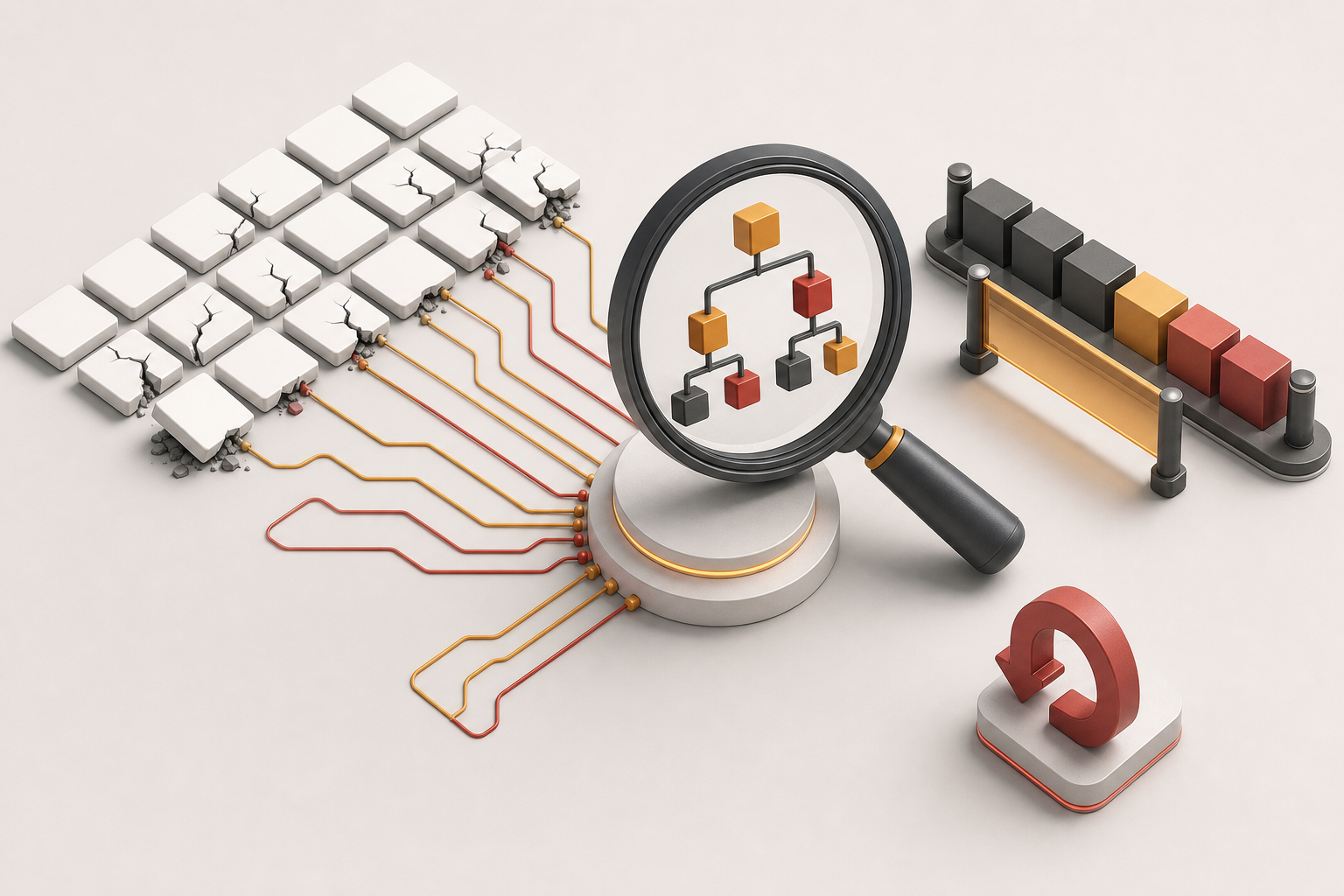

The future of QA is not a headcount prediction; it is a task redistribution problem. AI testing is the use of machine learning, generative models, and autonomous agents to design, execute, analyse, or maintain tests. Testing skills are the human capabilities that turn test activity into product risk intelligence, and QA careers are evolving toward that intelligence layer.
AI will replace many repetitive testing tasks, especially test generation, regression maintenance, log analysis, and scripted data setup. It will not replace testers who can judge risk, challenge requirements, design meaningful experiments, interpret weak signals, and influence engineering decisions. The safest QA careers will belong to people who combine AI testing fluency with domain, systems, and communication skills.
The future of QA is task replacement, not tester extinction
The most realistic future of QA is a smaller manual task surface and a larger judgement surface. Tools will automate more keystrokes, but teams will still need people who decide what evidence matters, which risks deserve attention, and when a release should slow down.
Generative AI is already strong at turning acceptance criteria into draft test cases, creating fixture data, explaining stack traces, summarising failed runs, and proposing automation fixes. In mature teams, these tasks often consume 25% to 45% of a tester’s week, which is why the economic pressure is real.
The mistake is assuming that task automation equals quality automation. Quality is a product property, not a suite size metric. A model can produce a thousand checks and still miss the one business rule that breaks revenue recognition, patient safety, or regulatory reporting.
In practice, AI shifts testers away from producing artefacts by hand and toward auditing, steering, and contextualising machine output. The QA professional becomes less like a script writer and more like a risk editor, evidence designer, and release advisor.
How much QA work will AI testing automate?
AI testing will automate a large share of repetitive QA work, but the percentage depends on product complexity, data sensitivity, architecture maturity, and testability. Teams with clean APIs, stable environments, and strong CI/CD often report 30% to 50% faster feedback loops after adding AI-assisted test generation and failure triage.
The gains are lower in legacy systems where brittle selectors, poor observability, undocumented workflows, and unstable test data dominate the problem. AI can help there, but it cannot magically fix an architecture that provides no reliable seams for testing.
A useful benchmark is to separate tasks by repeatability and consequence. High-repeatability, low-context tasks are automation candidates. High-consequence, high-context decisions remain human-led even when AI supplies evidence.
| QA activity | AI replacement likelihood | Human skill that still matters |
|---|---|---|
| Drafting happy-path test cases from user stories | High | Detecting missing assumptions and risk gaps |
| Maintaining selectors in UI automation | Medium to high | Designing stable testability hooks and contracts |
| Analysing repeated CI failures | High | Distinguishing noise from release-blocking patterns |
| Exploratory testing of new product behaviour | Low to medium | Curiosity, domain modelling, and scenario invention |
| Security, privacy, and compliance risk decisions | Low | Threat judgement, accountability, and governance |
| Release readiness recommendation | Low | Business context, evidence synthesis, and influence |
The 15 testing skills that will still pay your bills
The most durable testing skills are the ones that connect technical evidence to product risk and business impact. If AI can produce a test artefact, your value moves to deciding whether that artefact is relevant, sufficient, trustworthy, and timely.
- Risk modelling: Risk modelling is the skill of identifying what can fail, why it matters, and how likely it is to harm users or the business. AI can list generic risks, but experienced testers map risk to revenue paths, operational constraints, regulatory exposure, and real user behaviour.
- Domain expertise: Domain expertise is deep understanding of the business rules, user workflows, terminology, and failure consequences in a specific industry or product. It lets you spot plausible but wrong AI-generated tests that ignore exceptions, contractual obligations, or edge-case workflows.
- Systems thinking: Systems thinking is the ability to understand how services, data flows, queues, caches, dependencies, permissions, and people interact. Modern defects often emerge between components, where isolated unit-level AI suggestions provide false comfort.
- Exploratory testing design: Exploratory testing is simultaneous learning, test design, and execution guided by hypotheses. AI can suggest charters, but humans still notice surprise, ambiguity, emotional friction, and inconsistency in ways that scripted checks do not capture.
- Testability engineering: Testability engineering is designing software so important behaviour can be observed, controlled, and verified efficiently. Testers who can advocate for logs, stable IDs, feature flags, seeded data, contract boundaries, and deterministic environments will multiply AI’s usefulness.
- Automation architecture: Automation architecture is the design of maintainable test frameworks, layers, data strategies, and execution patterns. AI writes snippets quickly, but poor architecture turns those snippets into flaky debt at enterprise scale.
- Data literacy: Data literacy is the ability to read, question, segment, and interpret data without confusing volume with truth. As AI tools generate dashboards and summaries, testers need to challenge sample bias, missing cohorts, seasonality, and misleading pass rates.
- Observability fluency: Observability is the practice of understanding system behaviour through logs, metrics, traces, events, and user signals. QA professionals who can connect test failures to production telemetry will be more valuable than those who only inspect local assertions.
- Prompt and context engineering: Prompt engineering is the skill of giving AI systems precise goals, constraints, examples, and evaluation criteria. In QA, the real skill is not asking for test cases; it is supplying risk context, architecture details, data rules, and acceptance thresholds.
- LLM evaluation: LLM evaluation is the discipline of measuring whether language model outputs are accurate, safe, consistent, and useful for a defined task. As products embed AI features, testers must evaluate hallucination, retrieval quality, refusal behaviour, toxicity, drift, and prompt injection resistance.
- Security and privacy reasoning: Security reasoning is the skill of anticipating abuse paths, trust boundary failures, and sensitive data exposure. Privacy reasoning is understanding how personal, regulated, or confidential data should be collected, processed, masked, retained, and deleted.
- Performance and reliability judgement: Reliability judgement is the ability to decide whether a system can meet availability, latency, throughput, recovery, and degradation expectations under real conditions. AI can generate load scripts, but humans define realistic usage models and failure tolerances.
- Requirements interrogation: Requirements interrogation is the practice of exposing ambiguity, contradiction, omission, and unstated assumptions before code hardens around them. This remains one of the highest-leverage QA skills because preventing defects is cheaper than accelerating their discovery.
- Communication with decision-makers: Communication is the ability to turn technical findings into clear choices for engineers, product managers, support teams, compliance stakeholders, and executives. The future of QA rewards people who can say what is known, what is unknown, what could happen, and what trade-off is being accepted.
- Ethical judgement: Ethical judgement is the ability to recognise when a product may be technically correct but harmful, unfair, inaccessible, deceptive, or unsafe. AI testing will increase output speed, making human ethical review more important rather than less.
Which testing skills become more valuable when AI writes tests?
Risk modelling, testability engineering, LLM evaluation, and evidence synthesis become more valuable when AI writes tests because they govern the quality of the machine’s output. The scarce skill is not typing automation faster; it is knowing which tests deserve to exist.
Senior testers should also invest in product analytics and production observability. These skills connect pre-release testing to real user impact, which makes QA advice harder to dismiss as process overhead.
The highest-paid QA roles will increasingly look hybrid. Expect more titles that blend quality engineering, platform engineering, SRE, data analysis, product risk, and AI governance.
AI testing changes the economics of test automation
AI testing reduces the cost of creating and modifying tests, so the bottleneck moves from production to selection. When tests are cheap to generate, teams need stronger filters for relevance, risk coverage, maintainability, and signal quality.
Traditional automation backlogs were constrained by engineering hours. A team might debate whether a scenario was worth automating because building it required days of effort. With AI-assisted scaffolding, the first draft may appear in minutes, which sounds like an obvious win.
The hidden cost is execution noise. Large suites still consume CI capacity, create triage queues, and slow release confidence when they fail for unclear reasons. Teams that add AI-generated tests without ruthless curation often see short-term coverage growth followed by higher maintenance drag.
A practical operating model is to treat AI-generated tests as candidates, not assets. A test becomes an asset only after a human reviews its risk rationale, data setup, assertion strength, failure diagnostics, and long-term ownership.
| Approach | What improves | What can break | Best use |
|---|---|---|---|
| Manual authoring only | High context and intentionality | Slow coverage expansion and knowledge bottlenecks | Complex exploratory and high-stakes scenarios |
| AI-generated tests without review | Fast artefact creation | Duplicate checks, weak assertions, and false confidence | Low-risk prototypes and learning exercises |
| Human-curated AI assistance | Fast drafts with risk-based selection | Requires skilled reviewers and clear standards | Regression expansion, contract checks, and edge-case discovery |
| Autonomous testing agents | Continuous exploration and failure detection | Opaque reasoning, environment cost, and trust calibration | Well-instrumented products with strong guardrails |
When should you reject an AI-generated test?
You should reject an AI-generated test when it lacks a meaningful assertion, duplicates existing coverage, depends on unstable data, ignores the real user journey, or cannot explain the risk it protects. A test that only proves the application did what the script told it to do is not automatically valuable.
Good reviewers ask five questions before merging AI-created automation. What risk does it cover? What failure would it catch? How often should it run? Who owns it when it fails? What diagnostic information will help engineers fix the problem quickly?
How to prove QA value when repetitive work disappears
QA value will be proved through better risk visibility, faster feedback, fewer escaped defects, and clearer release decisions. Counting manual test cases or automation commits will become weaker evidence as AI makes those outputs easier to inflate.
Teams should shift from activity metrics to outcome and signal metrics. Useful measures include defect detection lead time, escaped defect severity, flaky test rate, mean time to diagnose, critical path coverage, production incident recurrence, and release decision latency.
A mature quality signal combines test results with coverage, incident history, risk tags, and observability data. The goal is not a vanity quality score; the goal is a concise release conversation backed by evidence.
npx playwright test --grep '@critical or @contract' --reporter=json > build/test-results.json
python scripts/quality_signal.py \
  --test-results build/test-results.json \
  --coverage build/lcov.info \
  --incidents data/incidents.csv \
  --output build/quality-signal.json
This kind of workflow turns automation output into decision support. It also gives AI tools structured context, which improves summaries, failure clustering, and release-risk explanations.
Benchmarks from high-performing engineering organisations are consistent enough to be useful. Teams that combine risk-based test selection with automated failure triage commonly reduce regression cycle time by 35% to 60%, while teams that focus only on generating more tests often see flaky-test triage increase by 15% to 30%.
What teams commonly get wrong with AI testing adoption
Teams most often fail with AI testing when they treat it as a labour replacement plan instead of a quality system redesign. The result is faster artefact production, weaker accountability, and a larger pile of tests no one trusts.
The first pitfall is outsourcing judgement to the model. AI can propose scenarios, but it does not own the consequences of missing a safety, security, accessibility, or financial risk. Accountability remains with the organisation and the professionals who approve the release.
The second pitfall is feeding AI poor context. Vague prompts produce generic tests because the model does not know your architecture, domain constraints, incident history, user segments, or compliance obligations. Better context usually matters more than a better model.
The third pitfall is ignoring test data governance. AI-generated fixtures can accidentally encode personal data, unrealistic distributions, or invalid state transitions. In regulated environments, synthetic data must be reviewed with the same seriousness as production-like data.
The fourth pitfall is letting suite size masquerade as confidence. A 10,000-test suite can still be weak if it checks shallow UI states, avoids negative paths, and fails too noisily for engineers to trust. Signal-to-noise ratio is the metric that decides whether automation accelerates or slows delivery.
When should a team not trust AI-generated failure analysis?
A team should not trust AI-generated failure analysis when logs are incomplete, environments are unstable, recent code changes are missing from context, or the model cannot cite the evidence behind its conclusion. Failure explanations should be treated as hypotheses until confirmed by reproducible evidence.
AI triage is especially risky when several failures share symptoms but have different root causes. Payment failures, authentication errors, and timeout cascades often look similar in summaries while requiring very different engineering responses.
A 12-month roadmap for future-proof QA careers
The strongest QA careers will be built by pairing AI fluency with one technical depth area and one business depth area. Trying to learn every new tool is less effective than becoming the person who can apply tools to consequential product risk.
For the first 90 days, audit your current work for replaceable tasks. Identify where you draft repetitive cases, maintain brittle checks, copy failure logs, or manually prepare common data. Use AI to accelerate those tasks, then document the time saved and the review standards needed to keep quality high.
From months 4 to 6, deepen a technical speciality. Good choices include contract testing, observability, performance engineering, security testing, accessibility, test data management, or LLM evaluation. Pick the area closest to your product’s most expensive failures.
From months 7 to 9, attach quality work to business outcomes. Build a release-risk dashboard, map critical user journeys to telemetry, analyse escaped defects by prevention opportunity, or create a risk taxonomy product managers can use before implementation begins.
From months 10 to 12, expand influence. Lead a quality strategy review, define AI test review standards, coach engineers on testability, or facilitate a post-incident learning session that changes how the team designs and verifies software.
How can senior testers reposition without starting over?
Senior testers can reposition by packaging their existing judgement as a scalable quality system. Years of defect intuition, domain knowledge, and stakeholder trust become more valuable when converted into risk models, review rubrics, observability practices, and AI guardrails.
The fastest route is to stop presenting yourself as the person who finds bugs and start operating as the person who improves release decisions. That positioning aligns with how engineering leaders justify investment in quality engineering.
Key Takeaways
- The future of QA is not the disappearance of testers; it is the disappearance of low-context testing tasks that machines can perform cheaply.
- AI testing is most useful when human experts curate its output against product risk, assertion quality, data reliability, and maintenance cost.
- The most durable testing skills are risk modelling, domain expertise, systems thinking, testability engineering, observability, LLM evaluation, and decision communication.
- QA careers will reward professionals who turn test results into release intelligence, not those who simply produce more test artefacts.
- Teams that adopt AI without review standards often increase flaky tests, duplicate coverage, and false confidence.
- The best 12-month career strategy is to automate repetitive work, deepen one technical speciality, connect quality to business outcomes, and expand influence across engineering decisions.