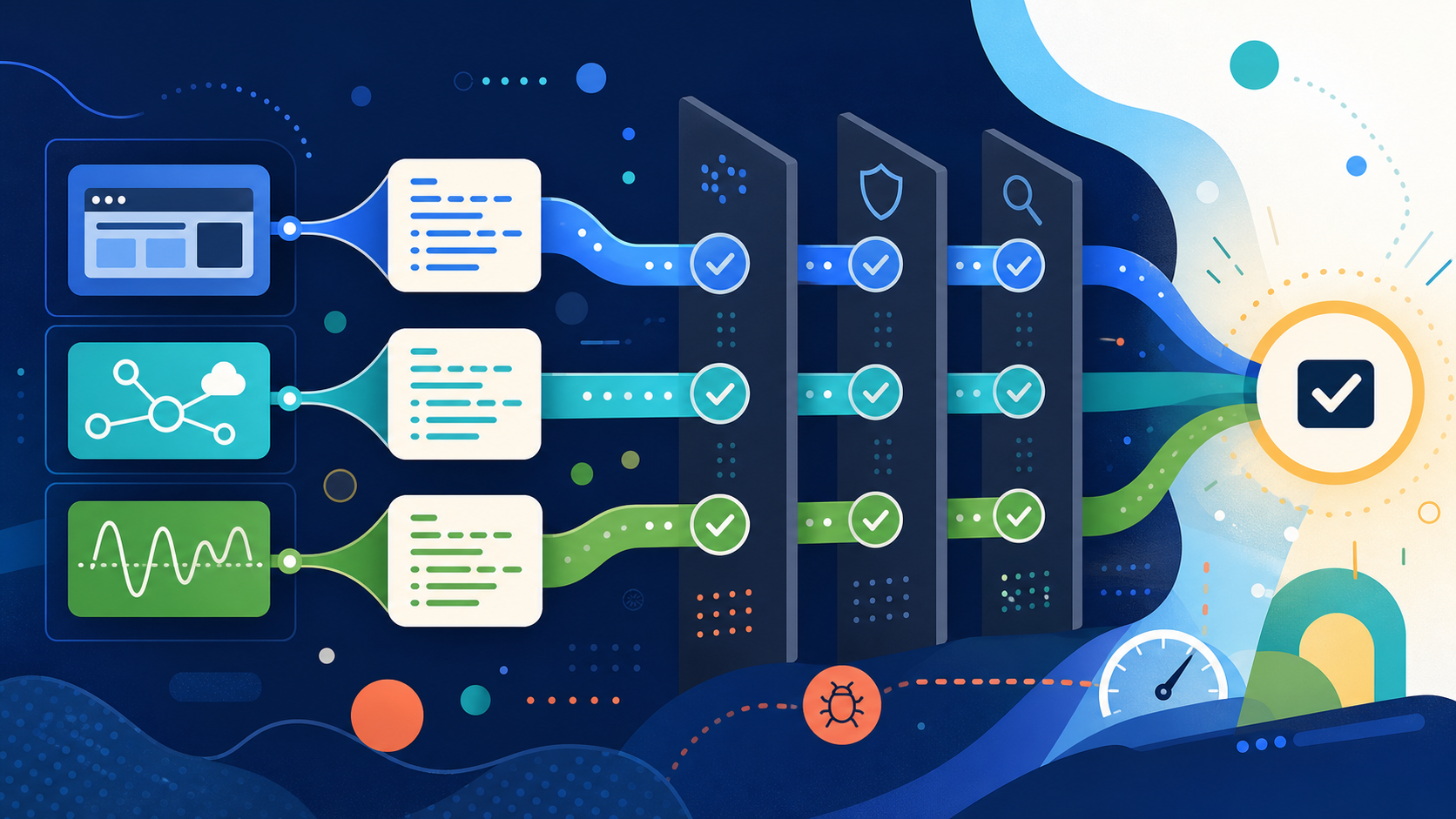

Prompt engineering is the disciplined practice of designing instructions, context, examples, and constraints so an LLM produces useful, reviewable outputs. For QA teams, test case generation is the process of deriving executable or human-reviewable tests from requirements, risks, user flows, defects, and system behavior. An LLM is a large language model that predicts and generates text from patterns in training data and provided context. An AI testing assistant is an LLM-powered workflow component that supports testers with analysis, test design, data variation, and documentation while leaving final accountability with the QA team.
AI prompt engineering improves test case generation by giving the model precise product context, coverage goals, output format, and review criteria. The best prompts ask the LLM to reason from risks, boundaries, user roles, data states, and acceptance criteria, then return structured tests that humans can validate. QA teams get the strongest results when they treat prompts as reusable test design assets, not one-off chat messages.
Why prompt engineering changes test case generation quality
Prompt engineering changes test case generation quality because it shifts the LLM from generic suggestion mode into constrained test design mode. The difference is visible in coverage, traceability, defect relevance, and the amount of rework needed before tests enter a suite.
Unstructured prompts usually produce happy-path checks, duplicated scenarios, and vague expected results. A well-engineered prompt tells the model what the system does, which risks matter, what evidence to use, and how to express each test for review or automation.
In mature QA teams, LLM-assisted test design is not a shortcut around analysis. It is a way to expand candidate coverage faster, challenge assumptions, and reveal scenario gaps that humans may miss under delivery pressure.
Teams piloting AI testing assistants often report 25% to 45% faster first-draft test design for requirements-heavy features. The practical gain is not that every generated case is production-ready; it is that reviewers start from a broader, structured draft instead of a blank page.
How does prompt quality affect defect discovery?
Prompt quality affects defect discovery by determining whether the LLM explores risk-rich conditions or simply restates the acceptance criteria. Prompts that include failure modes, boundary values, permissions, data dependencies, and historical defects tend to produce test cases closer to where real defects cluster.
For example, asking for login tests generates predictable credential checks. Asking for role-based login tests across locked accounts, expired sessions, throttling, federated identity, audit logging, and device changes produces a much stronger candidate set.
This mirrors traditional risk-based testing: the model needs risk signals before it can prioritize risk. Without those signals, it optimizes for plausible completeness rather than meaningful coverage.
Core prompt components QA teams should standardize
Effective prompts for test case generation contain repeatable components: role, product context, source material, coverage target, constraints, output schema, and review rules. Standardizing these components gives teams consistent results across features, testers, and tools.
The role sets the model’s stance, such as senior QA analyst, security-focused tester, or API contract reviewer. Product context prevents the LLM from guessing domain behavior and helps it use the same vocabulary as the team.
Source material should include acceptance criteria, user stories, business rules, API contracts, UI states, data definitions, and known constraints. Coverage targets should name the types of tests required, such as functional, negative, boundary, accessibility, compatibility, performance smoke, or regression candidates.
Output schema matters because generated tests must be reviewed, deduplicated, imported, or automated. A structured schema also makes model drift easier to detect because missing fields become visible.
What context should you give an LLM before generating test cases?
You should give an LLM the smallest complete context needed to design valid tests: feature purpose, user roles, inputs, rules, dependencies, non-functional expectations, and examples of valid and invalid behavior. More context is not always better if it includes stale tickets, contradictory notes, or irrelevant architecture details.
Strong context usually includes the requirement under test, the business goal, the system boundary, affected platforms, and the release risk. If your team uses behavior-driven development, include existing scenarios so the model preserves style and avoids duplicate coverage.
Do not paste sensitive production data, credentials, customer records, or proprietary logic unless your AI environment is approved for that data class. Treat prompt context as test documentation with the same governance you apply to logs, screenshots, and defect attachments.
Prompt patterns that produce better test cases
Specific prompt patterns produce better test cases because they force the LLM to reason from coverage intent instead of generating a flat list. The most useful patterns combine decomposition, constraints, examples, and self-review.
Decomposition prompts ask the model to break a feature into testable behaviors before writing cases. This reduces omission risk because reviewers can inspect the behavior map separately from the test list.
Constraint prompts define what not to produce, such as duplicate tests, implementation assumptions, low-value UI-only checks, or tests outside the feature boundary. Negative constraints are especially useful when teams see recurring noise in generated outputs.
Few-shot prompts include two or three examples of the team’s preferred test style. They are powerful for aligning the LLM with internal conventions, including naming, priority labels, preconditions, and expected result wording.
| Prompt pattern | Best use | Common failure mode | QA mitigation |
|---|---|---|---|
| Role and task framing | Set the LLM as a domain-aware QA designer | Overconfident assumptions about business rules | Require assumptions to be listed separately |
| Coverage matrix generation | Map roles, states, inputs, and outcomes before cases | Large matrices with weak prioritization | Add risk and frequency scoring |
| Few-shot examples | Match internal test case style and granularity | Model copies examples too closely | Use varied examples across positive, negative, and edge cases |
| Adversarial prompting | Find misuse, abuse, and failure scenarios | Produces unrealistic or out-of-scope cases | Constrain by architecture, threat model, and release scope |
| Self-critique loop | Identify missing boundaries, duplicates, and ambiguity | Critique becomes generic | Give explicit review checklist and defect history |
When should you use few-shot prompts for QA outputs?
You should use few-shot prompts when output style, granularity, or domain interpretation matters more than raw idea generation. They are especially valuable for regulated products, shared test repositories, and teams with strict test case management conventions.
A few-shot prompt does not need a long library of examples. Two concise examples can teach the model that your team expects preconditions, data setup, steps, expected results, priority, traceability, and automation suitability.
A reusable LLM prompt template for test case generation
A reusable prompt template turns test case generation into a governed workflow rather than an improvised chat. The template below is designed for teams that want traceable, reviewable outputs from an AI testing assistant.
Use the template as a starting point and adapt it for your domain, compliance obligations, and test management format. The most important principle is to separate source facts, assumptions, generated cases, and review notes.
{
  "role": "Act as a senior QA test designer for a web and API product.",
  "objective": "Generate review-ready test cases from the supplied requirement without inventing unsupported business rules.",
  "feature_context": {
    "feature_name": "Multi-factor authentication enrollment",
    "users": ["standard user", "admin", "locked user"],
    "platforms": ["responsive web", "public REST API"],
    "dependencies": ["identity provider", "email service", "authenticator app"]
  },
  "source_requirement": "Users must enroll at least one MFA method before accessing billing settings. Admins can reset MFA enrollment for a user. Enrollment expires if not completed within 10 minutes.",
  "coverage_targets": [
    "positive functional paths",
    "negative and abuse paths",
    "boundary values",
    "role-based permissions",
    "state transitions",
    "API error handling",
    "regression candidates"
  ],
  "constraints": [
    "Do not assume SMS is supported unless stated.",
    "Separate assumptions from test cases.",
    "Avoid duplicate cases with different wording only.",
    "Flag cases that need product clarification."
  ],
  "output_schema": {
    "assumptions": [],
    "coverage_map": [],
    "test_cases": [
      {
        "id": "TC-MFA-001",
        "title": "",
        "requirement_trace": "",
        "priority": "High|Medium|Low",
        "type": "positive|negative|boundary|security|regression",
        "preconditions": [],
        "test_data": [],
        "steps": [],
        "expected_result": "",
        "automation_candidate": "yes|no|partial",
        "review_notes": ""
      }
    ],
    "clarifying_questions": [],
    "coverage_gaps": []
  },
  "review_instruction": "After generating the cases, critique them for missing roles, states, boundary values, and unsupported assumptions."
}
This structure works because it asks for both generation and control evidence. Reviewers can inspect assumptions, coverage gaps, and clarifying questions before deciding which tests belong in the suite.
For automation-oriented teams, add selectors, API endpoints, contract references, fixtures, and environment constraints only when those details are reliable. Otherwise, keep the first output at the design level and use a second prompt to transform approved cases into automated regression testing candidates.
How to evaluate AI-generated test cases before adoption
AI-generated test cases should be evaluated against correctness, coverage, traceability, uniqueness, executability, and risk value before they are adopted. A test case that looks polished can still be invalid if it assumes behavior the product does not support.
Start by checking factual alignment with the source requirement. Any case that depends on unstated rules should be marked as an assumption or converted into a clarifying question for the product owner.
Next, assess coverage against a model such as user role by system state by input category by expected outcome. This is often more reliable than counting total test cases, because high case counts can hide repeated scenarios.
Finally, rate each case for execution value. Useful signals include defect likelihood, business impact, regression risk, observability, automation feasibility, and maintenance cost.
How can teams measure prompt effectiveness over time?
Teams can measure prompt effectiveness by tracking acceptance rate, edit distance, duplicate rate, coverage gap rate, and downstream defect yield. A prompt that produces fewer cases but higher reviewer acceptance may be better than one that produces a large backlog of noisy scenarios.
Practical benchmarks include percent of generated cases accepted with minor edits, number of missing scenarios found during review, time from requirement receipt to reviewed test design, and defects linked to AI-suggested scenarios. Many teams find that mature templates reduce review rework by 20% to 35% after two or three iterations.
Prompt evaluation should also include qualitative reviewer feedback. If senior testers repeatedly correct the same category of mistake, the prompt should be updated with a new constraint, example, or review rule.
Where AI prompt engineering commonly breaks down
AI prompt engineering breaks down when teams confuse fluent output with verified test design. The most common failures are weak source context, unreviewed assumptions, overbroad prompts, and no feedback loop from execution results.
One frequent mistake is asking the AI testing assistant to generate “all possible test cases.” That phrase invites bloated output, low prioritization, and unrealistic combinations that reviewers cannot maintain.
Another failure is using stale requirements as prompt context. LLMs do not know which ticket comment is authoritative, so contradictions often produce hybrid behavior that matches no real product state.
Teams also under-specify negative testing. If the prompt does not ask for invalid inputs, denied permissions, expired states, concurrency, dependency failures, and recovery behavior, the model usually stays near the happy path.
Finally, generated tests can create a false sense of coverage. A suite may look comprehensive while missing observability checks, data cleanup, cross-service side effects, or exploratory testing charters that expose emergent behavior.
Why should generated tests include assumptions and clarifying questions?
Generated tests should include assumptions and clarifying questions because they separate verified requirements from model inference. This prevents speculative behavior from silently entering the test suite.
Assumptions are not always bad; they often reveal missing product decisions. The danger is treating them as facts without product confirmation.
Governance, privacy, and workflow controls for QA teams
Governance makes AI-assisted test case generation safe, repeatable, and auditable across a QA organization. Without controls, different testers may produce inconsistent cases, expose sensitive data, or create untraceable test assets.
Define which data can be used in prompts, which AI tools are approved, and whether prompts or responses are retained. If your organization has regulated data, use synthetic examples or approved redaction workflows.
Establish ownership rules for generated content. The LLM can draft, but a named tester or test lead should approve cases before they enter the official repository.
Version prompts the same way you version test templates. A small change in wording can alter output quality, so teams should store prompt versions, known limitations, and examples of expected results.
Integrate prompt outputs into normal QA ceremonies. For example, use generated coverage maps during refinement, generated negative scenarios during test planning, and generated regression candidates during release risk review.
Advanced strategies for high-value test coverage
Advanced prompt engineering uses the LLM to reason across risk models, system states, and historical evidence rather than only producing scripted cases. This is where experienced QA teams gain leverage beyond simple requirement-to-test conversion.
Ask the model to create a state transition map before writing tests for workflows such as checkout, onboarding, approvals, authentication, or subscription billing. State maps expose illegal transitions, timeout behavior, rollback paths, and recovery expectations.
Use defect-informed prompting by adding anonymized patterns from recent production incidents. A prompt that says “prioritize cases similar to recent defects involving stale cache, permission drift, and partial payment failure” produces more relevant coverage than a generic instruction.
For APIs, ask for contract-level cases that include required fields, optional fields, invalid types, idempotency, pagination, status codes, rate limits, and backward compatibility. This aligns well with API contract testing and reduces gaps between UI and service-level suites.
For agile teams, combine LLM outputs with human session design. Let the AI generate candidate scenarios, then have testers convert the riskiest ones into focused charters for time-boxed exploration.
Can an AI testing assistant replace manual test design?
An AI testing assistant cannot replace manual test design because it lacks product accountability, contextual judgment, and real execution feedback. It can accelerate drafting, broaden scenario discovery, and challenge human blind spots when used under expert review.
The best operating model is human-led and AI-augmented. Senior testers decide risk, scope, and acceptance while the model helps enumerate, structure, and refine candidate coverage.
A practical workflow for prompt-driven test generation
A practical workflow starts with requirement normalization and ends with approved, traceable test assets. Treat each generated output as a draft that must pass review gates before execution or automation.
First, clean the input requirement by removing contradictions, identifying open questions, and marking authoritative sources. This improves the signal-to-noise ratio before the LLM sees the feature.
Second, generate a coverage map rather than immediately asking for cases. The map should show roles, states, inputs, outputs, integrations, risks, and non-functional angles.
Third, generate test cases from the approved coverage map using a structured schema. Ask the model to tag each case by type, priority, requirement trace, and automation suitability.
Fourth, run a critique prompt against the generated cases. The critique should search for duplicates, missing boundary values, unsupported assumptions, unclear expected results, and cases that are too broad to execute.
Fifth, review with humans and update the prompt template based on recurring edits. This closes the loop and turns prompt engineering into an improving team capability.
Key Takeaways
- Prompt engineering turns an LLM from a generic idea generator into a structured AI testing assistant for reviewable test case generation.
- The strongest prompts include product context, source requirements, coverage targets, constraints, output schema, and explicit review instructions.
- Generated test cases must be validated for factual correctness, traceability, uniqueness, executability, and risk value before adoption.
- Few-shot examples and coverage matrices help align LLM outputs with team standards and reduce low-value duplicate scenarios.
- Common failures include stale context, unreviewed assumptions, vague requests for all possible tests, and missing negative coverage.
- Governed AI workflows require approved tools, data controls, prompt versioning, and human ownership of final test assets.
- The highest-value use of AI in QA is not replacing testers; it is expanding scenario discovery and accelerating expert review.