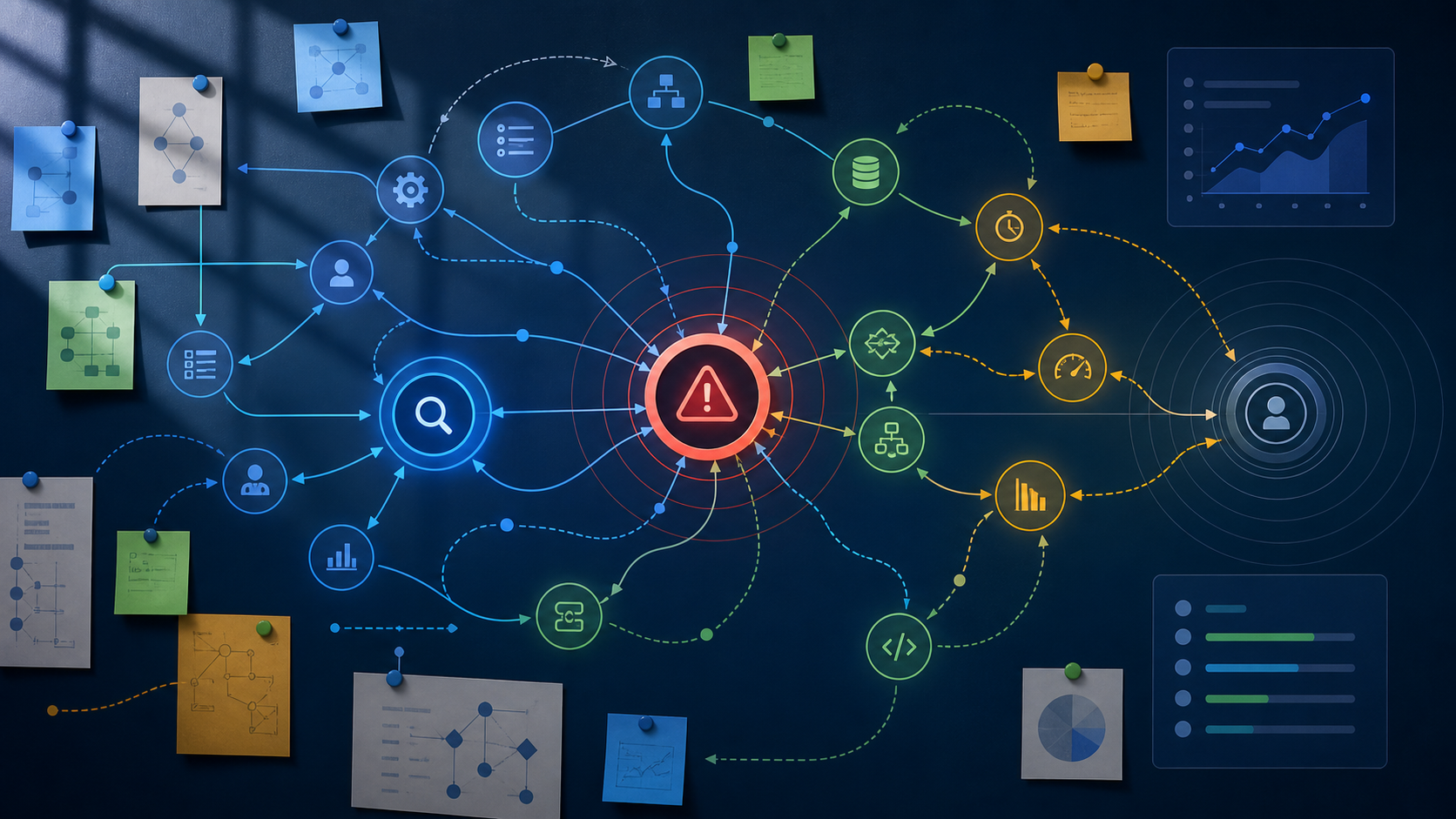

Software quality is the degree to which a system consistently delivers intended value under real operating conditions, not merely the absence of defects in a test environment. Netflix, Amazon, and Uber treat quality less as a phase and more as a property of socio-technical systems: architecture, ownership, deployment, observability, recovery, and incentives all shape what customers experience.
Netflix, Amazon, and Uber think about software quality as an operating capability, not a final inspection step. They invest in resilient architecture, fast feedback, production telemetry, controlled releases, and clear service ownership so teams can detect, contain, and learn from failure before it becomes customer-visible harm.
Quality at Scale Means Controlling Failure, Not Pretending to Eliminate It
Large digital platforms approach software quality by assuming failure is normal and designing systems that degrade gracefully. The goal is not perfect code; the goal is reliable customer outcomes despite imperfect code, infrastructure, dependencies, traffic, and human decisions.
Systems thinking is the discipline of understanding how components, feedback loops, incentives, and constraints interact to produce outcomes. For testers and quality leaders, that means moving beyond the question, “Did this feature pass?” and asking, “What conditions would make this feature fail in production, and how quickly would we know?”
This distinction matters because high-scale companies rarely lose quality through one isolated bug. They lose it through coupling, stale assumptions, slow detection, ambiguous ownership, and release processes that hide risk until the blast radius is too large.
In mature teams, software quality becomes measurable through lead time, escaped defect rate, mean time to detect, mean time to recover, change failure rate, user-impact minutes, and support contact rate. Teams with disciplined release controls and production feedback often report 30% to 50% faster feedback loops and materially lower rollback anxiety than teams that rely primarily on late-stage manual validation.
How Netflix Treats Software Quality as Resilience Under Failure
Netflix’s quality model is best understood as resilience engineering: assume parts of the system will fail, then verify that the user experience survives. Site reliability is the engineering practice of keeping services dependable through measurable reliability targets, automation, incident learning, and operational discipline.
Netflix popularized chaos engineering because its core product depends on uninterrupted streaming across devices, regions, networks, content services, recommendation systems, billing boundaries, and content delivery infrastructure. Chaos engineering is the practice of deliberately injecting controlled failure to discover weaknesses before uncontrolled failure discovers them for customers.
The subtle point is that chaos engineering is not random sabotage. It only works when a team has strong observability, rollback paths, service ownership, and hypotheses about expected system behavior.
How does Netflix-style chaos affect software quality?
Netflix-style chaos improves software quality by turning unknown failure modes into observable engineering work. A test that kills an instance, delays a dependency, or simulates a regional impairment reveals whether the system retries safely, sheds load, falls back, or amplifies the incident.
For testers, the lesson is not “break production.” The lesson is to test assumptions about resilience where those assumptions matter most: dependency timeouts, cache behavior, queue backlogs, client retries, device fragmentation, and partial data availability.
A streaming service can pass every functional test and still fail quality if a metadata service slowdown prevents users from starting playback. In that case, the defect is not only in a component; it is in the system’s inability to preserve the critical user journey when a supporting component is degraded.
When should QA teams use fault injection instead of more regression tests?
QA teams should use fault injection when risk comes from interactions, dependencies, timing, capacity, or recovery rather than deterministic feature logic. Regression tests are excellent for known behavior; fault injection is stronger for exposing hidden coupling and fragile operational assumptions.
A practical Netflix-inspired quality question is: “If this dependency returns slowly, incorrectly, or not at all, what happens to the customer?” That question is more valuable than adding another shallow happy-path assertion to a bloated regression suite.
The strongest organizations separate experiment scope by blast radius. They begin in staging, move to single-service experiments, then test production-like traffic with safeguards, alerts, and explicit abort criteria.
How Amazon Turns Engineering Quality Into Ownership and Fast Feedback
Amazon’s quality model is strongly tied to service ownership, customer obsession, and operational accountability. Engineering quality is the capability of engineering teams to design, build, release, operate, and improve systems with predictable outcomes.
The phrase “you build it, you run it” is often reduced to on-call responsibility, but the deeper quality mechanism is incentive alignment. When the same team designs the API, deploys the service, receives operational alarms, and reads customer-impact metrics, quality feedback becomes unavoidable.
Amazon-style teams tend to decompose systems into services with explicit contracts and measurable behaviors. This makes quality local enough to own, while platform standards make reliability visible across the organization.
For QA professionals, this changes the engagement model. Instead of acting as a late-stage approval gate, quality specialists influence API contracts, deployment safety, observability requirements, testability, and rollback strategy before code reaches a release branch.
Why does ownership change defect prevention?
Ownership changes defect prevention because the team that creates risk also experiences the operational consequences of that risk. This shortens the learning loop between design decisions, production behavior, and customer impact.
In outsourced or siloed models, a tester may find symptoms while product, engineering, platform, and operations debate ownership. In an ownership model, the service team is responsible for reducing recurring failure demand, not only closing individual tickets.
This is where root cause analysis becomes more than a meeting format. Root cause analysis is the structured practice of identifying systemic contributors to failure so teams can remove repeat causes, not merely patch immediate symptoms.
How do Amazon-like teams balance speed and governance?
Amazon-like teams balance speed and governance by embedding policy into pipelines, platforms, and service standards rather than relying on manual approval theater. The strongest governance is automated, observable, and close to the code path.
Examples include mandatory health checks, service-level objectives, automated rollback triggers, dependency vulnerability thresholds, contract test requirements, and operational readiness reviews for high-risk launches. These controls let teams move quickly without pretending that every change has the same risk profile.
In practice, many mature organizations report that automated quality gates reduce release review time by 20% to 40% because discussions shift from opinion to evidence. The gate is not a substitute for judgment, but it removes repetitive judgment from low-risk decisions.
How Uber Connects Quality Engineering to Real-Time Operations
Uber’s quality model is shaped by real-time marketplaces, location data, mobile clients, payments, dispatch, pricing, maps, and city-level variability. Quality engineering is the discipline of building quality into the entire delivery system through test design, automation, observability, risk analysis, and production learning.
Uber-like systems are difficult because correctness is contextual. A dispatch decision that looks reasonable in one market, device class, network condition, or regulatory environment may produce poor quality somewhere else.
This pushes quality teams toward simulation, experimentation, telemetry, and segmented analysis. Aggregate pass rates are too blunt when quality failures cluster by city, driver app version, passenger device, payment method, or time of day.
For example, a ride request flow may pass functional automation yet produce poor customer quality if estimated arrival times oscillate, surge pricing updates too slowly, or a background location permission behaves differently after an operating system update. The failure is partly technical and partly experiential.
What does quality mean in a real-time marketplace?
Quality in a real-time marketplace means the system makes timely, trustworthy decisions under volatile supply, demand, location, payment, and network conditions. Functional correctness is necessary, but it is not sufficient when every second changes the state of the product.
Teams need synthetic tests for contracts, simulations for marketplace behavior, canaries for release risk, and telemetry for customer experience. A single metric such as crash-free sessions cannot capture whether matching quality, payment success, and map accuracy are degrading together.
Good testers in this context think like systems analysts. They ask whether a change shifts incentives, creates retry storms, increases driver cancellations, or hides a fairness issue behind an average.
Comparison of Netflix, Amazon, and Uber Quality Engineering Patterns
The three companies share a belief that software quality emerges from systems, but their dominant quality risks differ. Netflix optimizes for resilient experience delivery, Amazon for service ownership and customer-impact loops, and Uber for real-time operational correctness across variable contexts.
| Company pattern | Dominant quality risk | Typical quality mechanism | What QA teams can adapt |
|---|---|---|---|
| Netflix-style resilience | Partial outages, dependency failures, traffic spikes, device variability | Chaos engineering, graceful degradation, observability, automated recovery | Add resilience scenarios, dependency failure tests, and user-journey SLOs |
| Amazon-style ownership | Slow feedback, unclear accountability, release governance bottlenecks | Service ownership, operational metrics, automated quality gates, customer obsession | Shift from approval gates to evidence-based release readiness |
| Uber-style real-time quality | Context-dependent failures across geography, mobility, payments, and marketplace dynamics | Simulation, canary releases, segmented telemetry, experimentation | Validate outcomes by segment, not only by global pass or fail rates |
The useful comparison is not which company has the “best” model. The useful question is which failure class dominates your product and which feedback loop is currently too slow, too noisy, or too far away from the team that can act.
A Systems Thinking Model for Software Quality Decisions
A systems-thinking quality model connects customer outcomes to engineering controls, operating signals, and learning loops. It helps teams decide where testing, observability, reliability work, and process change will reduce risk most efficiently.
Start with the customer-critical journey, not the test suite. For a streaming product, that might be search-to-playback; for ecommerce, it might be product-detail-to-payment; for mobility, it might be request-to-completed-trip.
Map the services, data dependencies, external providers, queues, caches, clients, and human support paths that participate in that journey. Then identify where failure can be prevented, detected, contained, or recovered.
This model reframes quality engineering as a portfolio of controls. Unit tests prevent local logic defects, contract tests prevent interface drift, canaries contain release risk, SLOs reveal user-impact degradation, and incident reviews improve the system after it fails.
How should testers choose the next best quality investment?
Testers should choose the next quality investment by locating the weakest feedback loop around the highest-value customer journey. If defects escape because contracts drift, add contract testing; if incidents last too long, improve detection and rollback; if releases are risky, invest in canaries and progressive delivery.
A useful decision rule is to compare risk reduction per unit of engineering effort. Adding 500 UI regression cases may look productive, but one missing timeout, one unsafe retry policy, or one absent rollback trigger may dominate customer harm.
The best quality leaders make tradeoffs explicit. They can explain why a team is funding observability instead of more automation, why a fragile end-to-end suite should be decomposed, or why a performance test needs production-like data before it becomes trustworthy.
Quality Gates Should Be Automated, Risk-Based, and Observable
Effective quality gates encode release standards into delivery pipelines while still allowing humans to reason about exceptional risk. A quality gate that cannot explain its evidence becomes bureaucracy; a gate that measures customer-impact signals becomes engineering leverage.
Canary release is a deployment technique that exposes a change to a small slice of traffic before expanding it. Error budget is the acceptable amount of unreliability a service can consume before the team slows feature delivery to protect reliability.
The following simplified policy shows how a team might make release quality explicit for a customer-critical service. The point is not the syntax; the point is that quality criteria are versioned, reviewed, automated, and tied to service behavior.
service: payments-routing
owner: checkout-platform
release_policy:
  strategy: canary
  initial_traffic_percent: 5
  expansion_interval_minutes: 15
quality_gates:
  contract_tests:
    required: true
    pass_rate_minimum: 1.0
  payment_authorization_success:
    minimum: 0.985
    window_minutes: 30
  p95_latency_ms:
    maximum: 450
    window_minutes: 30
  change_failure_rate:
    maximum: 0.10
  rollback:
    automatic: true
    trigger_on_gate_failure: true
observability:
  dashboard_required: true
  alert_route: checkout-oncall
Teams that use policies like this typically gain more than faster releases. They create a shared language between QA, developers, product managers, SREs, and incident responders.
The danger is metric gaming. If teams optimize for passing the gate rather than protecting the customer journey, they will narrow the signal until the system becomes fragile again.
Where High-Scale Quality Thinking Commonly Breaks Down
High-scale quality practices fail when organizations copy the visible rituals but miss the operating conditions that make them work. Chaos tests, SLOs, canaries, and dashboards are weak substitutes for ownership, testability, and fast learning.
The first pitfall is treating production telemetry as an excuse to underinvest in pre-release quality. Shift-right testing is valuable, but it does not justify exposing preventable defects to customers when cheaper feedback was available earlier.
The second pitfall is over-automating the wrong layer. Many teams build massive UI suites that are slow, flaky, and expensive while leaving API contracts, data migrations, concurrency risks, and operational failure modes lightly tested.
The third pitfall is adopting SRE language without SRE discipline. If a team defines SLOs but never uses error budgets to change priorities, the SLO is a dashboard decoration.
The fourth pitfall is weak incident learning. A blameless review that ends with “be more careful” is not blameless root cause analysis; it is an emotional release valve with no system improvement.
The fifth pitfall is local optimization. A team may improve its component metrics while making the end-to-end journey worse through added latency, noisy retries, inconsistent data, or hidden manual work in support operations.
Can smaller teams use Netflix, Amazon, and Uber practices without their scale?
Smaller teams can use these practices if they scale the principle down instead of copying the machinery. You do not need a global chaos platform to test dependency failure, and you do not need hundreds of services to define ownership and release health criteria.
A small SaaS team can define two customer-critical journeys, create service-level indicators for each, add rollback criteria to the pipeline, and run one controlled failure drill per quarter. That is often more valuable than buying a large observability platform without changing release behavior.
Metrics That Reveal Whether Software Quality Is Improving
Quality improvement should be measured through a balanced set of engineering, reliability, and customer-impact signals. No single metric proves software quality because every metric can be gamed or misunderstood outside its system context.
DORA metrics are delivery performance indicators that commonly include deployment frequency, lead time for changes, change failure rate, and time to restore service. They are useful because they connect delivery speed with operational stability.
For quality engineering, pair DORA metrics with product and support signals. Useful measures include escaped defects per release, incident recurrence rate, support contacts per thousand sessions, synthetic journey success rate, p95 and p99 latency, crash-free sessions, rollback frequency, and alert precision.
Benchmarks should be treated as directional rather than universal. A payment platform with a 0.5% authorization regression may be in crisis, while an internal analytics tool may tolerate a higher error rate if recovery is simple and user impact is low.
The strongest signal is trend quality. If lead time improves while change failure rate stays flat or drops, the system is learning; if speed improves while incidents rise and detection remains slow, the organization is borrowing quality from the future.
How QA Leaders Can Apply These Lessons Without Cargo Culting Big Tech
QA leaders should translate big-tech quality patterns into their own risk profile, architecture, and organizational constraints. The actionable lesson is not to become Netflix, Amazon, or Uber; it is to make quality a designed property of the delivery system.
Begin by selecting one high-value customer journey and making its quality observable. Define what good looks like from the user’s perspective, then attach engineering signals that reveal when that experience is at risk.
Next, move quality conversations earlier and later. Earlier means influencing contracts, architecture, testability, and release design; later means using production evidence, incidents, and customer behavior to improve the next change.
Then reduce the cost of safe change. Invest in smaller deployments, canaries, feature flags, contract tests, realistic test data, automated rollback, and alerting that points to service ownership rather than a generic operations queue.
Finally, protect the learning loop. If incident reviews produce no architectural change, test improvement, runbook update, or product decision, the organization is collecting stories instead of improving software quality.
Key Takeaways
- Software quality at Netflix, Amazon, and Uber is treated as a system outcome shaped by architecture, ownership, telemetry, release strategy, and recovery speed.
- Netflix-style quality emphasizes resilience: controlled failure experiments reveal whether customer journeys survive dependency, infrastructure, and traffic problems.
- Amazon-style quality emphasizes ownership: teams that build and operate services receive faster feedback and stronger incentives to prevent recurring defects.
- Uber-style quality emphasizes context: real-time marketplaces require segmented telemetry, simulation, and canary analysis because aggregate pass rates hide local failures.
- Quality engineering is most effective when it targets the weakest feedback loop around the most valuable customer journey.
- Automated quality gates should be risk-based and observable, combining contract tests, SLOs, canaries, rollback triggers, and customer-impact metrics.
- Copying big-tech rituals without ownership, observability, and incident learning creates process theater rather than better engineering quality.