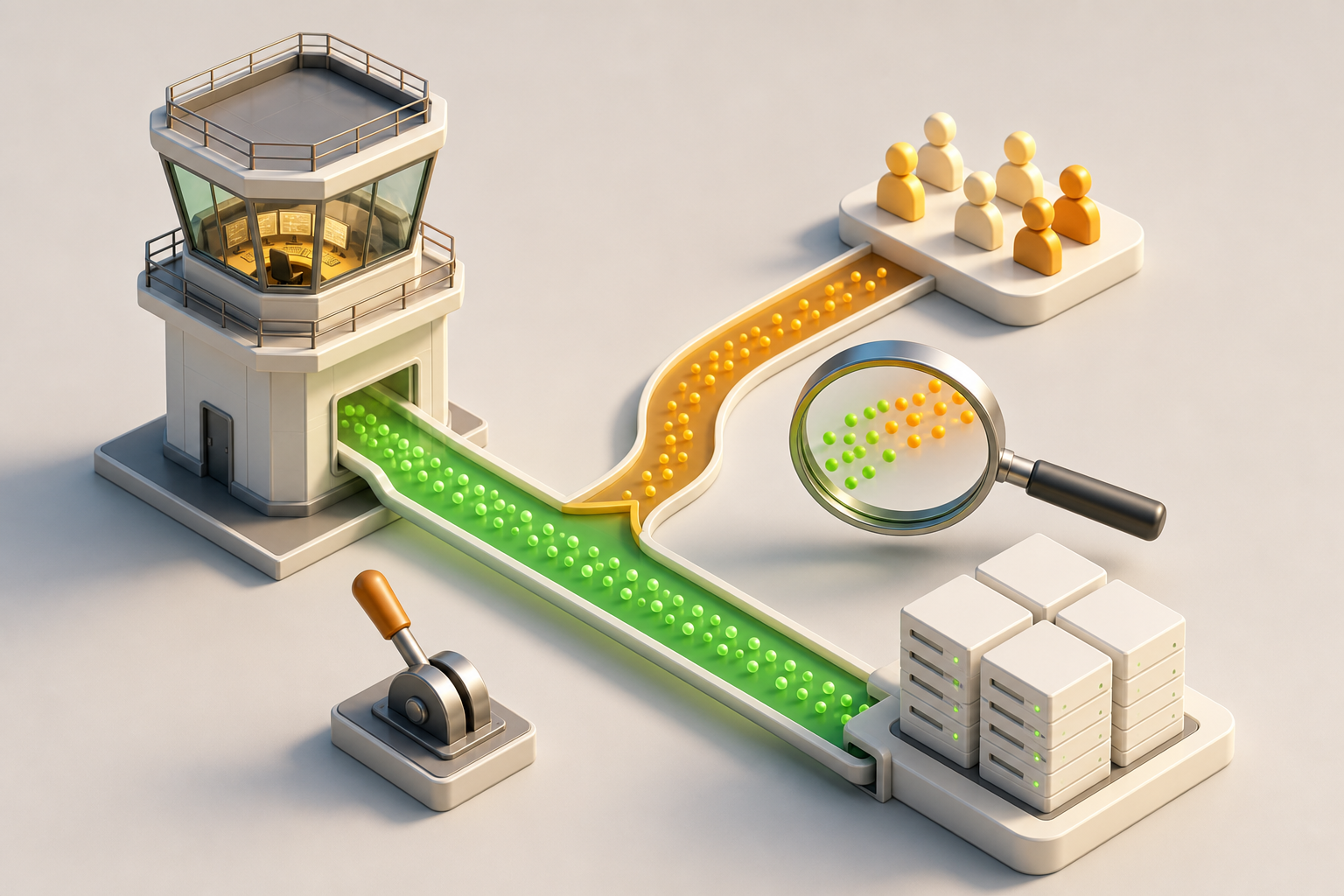
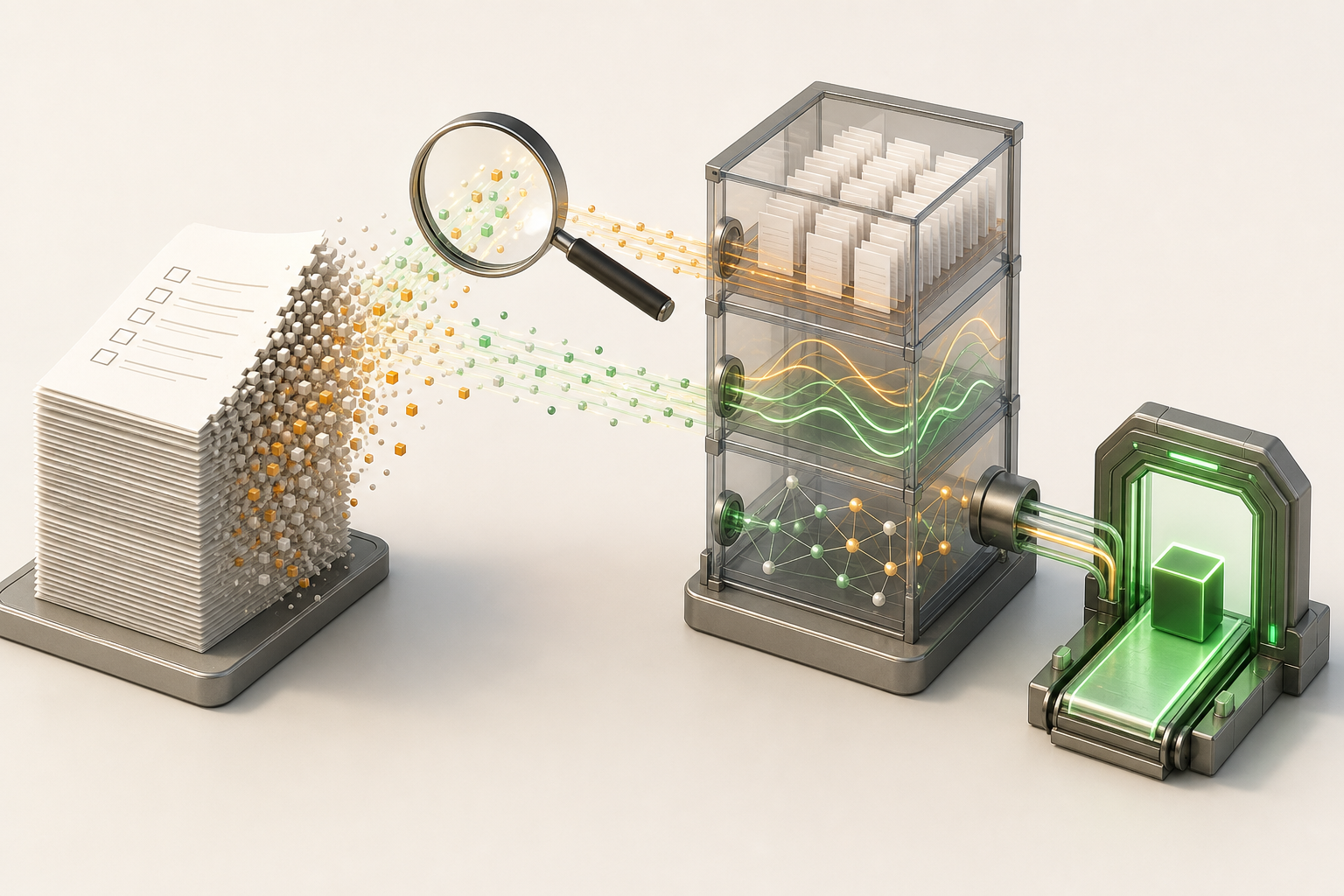
Observability is the engineering practice of inferring system health from logs, metrics, traces, events, and user signals without predicting every failure in advance. QA DevOps is the integration of quality work into delivery pipelines, release gates, and operations feedback loops. Quality engineering is the discipline of designing systems, processes, and evidence so quality is continuously measurable rather than inspected at the end. Monitoring and testing is the combined practice of validating expected behavior before release and detecting real behavior after release.
The future of QA is observability because modern systems fail in ways static test cases cannot fully predict. Test cases still matter, but they are no longer enough to prove release readiness. High-performing teams use observability to validate production behavior, detect unknown risks, and turn operational data into quality decisions.
Why observability is becoming the QA DevOps control plane
Observability is becoming the QA DevOps control plane because it connects pre-release evidence with production truth. It gives quality teams a live model of system behavior instead of a static inventory of scenarios.
Traditional test management asks whether known cases passed. Observability asks whether the system is behaving safely for real users, real traffic, and real dependencies. That distinction matters when releases are smaller, architectures are distributed, and failure modes are often emergent.
In a microservices estate, a checkout defect may not live inside checkout code. It may emerge from a slow fraud API, a misconfigured feature flag, a cache invalidation race, or a regional database failover. A test case can verify the happy path, but telemetry can show the latency spike, retry storm, conversion drop, and affected cohort.
Teams that mature from test-case counting to observable quality often report 30 to 45 percent faster release feedback loops. The gain does not come from writing fewer tests; it comes from detecting meaningful risk earlier and avoiding long debates over whether a green pipeline reflects user reality.
How does observability change the definition of done?
Observability changes the definition of done by requiring every important behavior to be measurable after deployment. A story is not complete when assertions pass; it is complete when the team can see whether the behavior is healthy in production.
That means acceptance criteria should include signals such as latency thresholds, error budgets, business event rates, and trace coverage. For example, a payment retry feature should not only pass integration tests. It should expose retry counts, terminal failure rates, idempotency collisions, and downstream timeout patterns.
This is where QA becomes an owner of evidence design. The best quality engineers do not merely ask developers to add more logs. They specify the questions the system must answer when something goes wrong.
Why test cases fail as the main quality signal
Test cases fail as the main quality signal because they are optimized for expected behavior, not unknown system interaction. They are valuable controls, but weak predictors of production reliability when used alone.
The classic regression suite assumes the team can enumerate the most important risks before the release. That assumption becomes fragile when deployments touch asynchronous workflows, third-party APIs, mobile networks, AI-assisted features, and customer-specific configuration. The number of possible states grows faster than the test catalog.
Test cases also suffer from semantic drift. A case named verify user can update address may keep passing while the business meaning changes: address verification may become asynchronous, tax calculation may depend on geography, and fraud rules may vary by customer segment. The test remains green, but its risk coverage silently shrinks.
Another limitation is that pass and fail are often too binary. A system can pass all functional checks while becoming slower, noisier, more expensive, or less resilient. Observability captures these quality gradients before they become incidents.
| Quality approach | Best at proving | Weakness | Better release question |
|---|---|---|---|
| Test-case centric QA | Known requirements still work | Misses unknown interactions and production variance | Did our expected checks pass? |
| Coverage-centric automation | More code paths are exercised repeatedly | Can reward volume over risk relevance | Are we testing the paths that can hurt users? |
| Monitoring-centric operations | Production is up or down | Often reacts after customer impact | Are key services breaching operational thresholds? |
| Observability-centric quality engineering | System behavior is explainable across environments | Requires instrumentation discipline and signal governance | Can we detect, explain, and limit release risk quickly? |
When should a test case become a production signal?
A test case should become a production signal when the behavior is business-critical, environment-sensitive, or too expensive to model exhaustively before release. If failure depends on traffic mix, data shape, vendor response, or regional infrastructure, telemetry should complement the automated check.
Authentication, payments, search relevance, order fulfillment, streaming ingestion, and notification delivery are common candidates. A pre-release test can validate the baseline flow, while synthetic monitoring, service-level indicators, and distributed traces validate continuity after release.
The practical rule is simple: if the team would open an incident when the behavior degrades, the behavior deserves an observable signal. Otherwise, QA is relying on customers to execute the final test run.
How observability connects monitoring and testing in delivery pipelines
Observability connects monitoring and testing by making pipeline decisions depend on live evidence rather than only pre-release assertions. The pipeline becomes a feedback system, not just an execution engine.
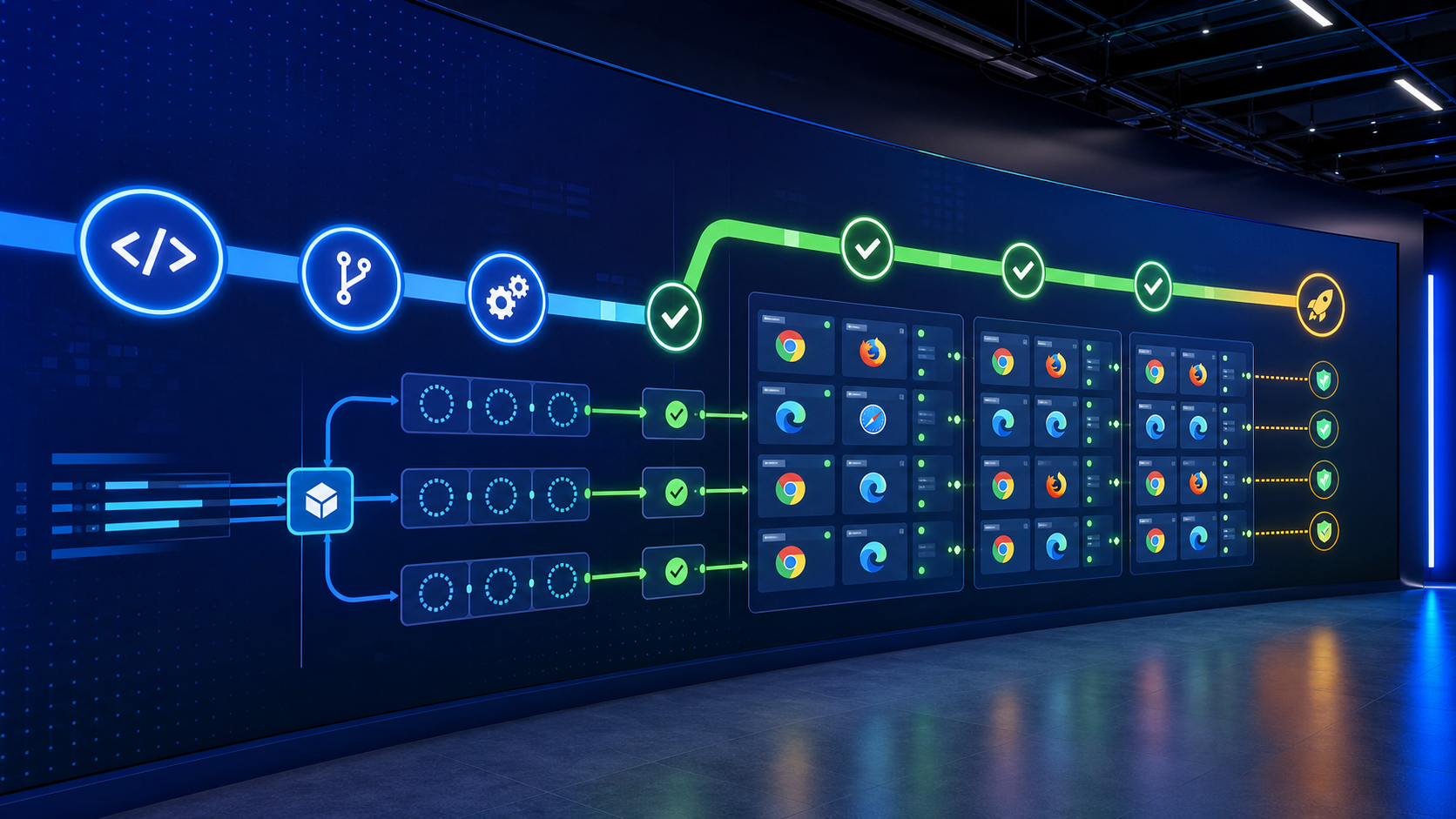
In mature QA DevOps environments, CI verifies deterministic checks, CD deploys progressively, and observability evaluates whether the release behaves within expected tolerances. This creates a loop across unit tests, contract tests, synthetic probes, canary analysis, logs, traces, metrics, and user journey signals.
The strongest pattern is not to replace automated tests with dashboards. It is to make telemetry part of the release contract. A service should declare what healthy means, how that health is measured, and what automated action follows when the signal degrades.
For example, a canary deployment can be promoted only if p95 latency, HTTP 5xx rate, dependency timeout rate, and checkout completion remain within agreed thresholds for a defined traffic window. This makes quality evidence continuous and tied to user impact.
How does QA use service-level objectives without becoming operations?
QA uses service-level objectives by treating them as measurable quality promises, not as infrastructure chores. A service-level objective is a target for acceptable service behavior over time, such as 99.9 percent successful checkout attempts or p95 search latency under 400 milliseconds.
Quality engineers should participate in defining indicators that reflect user outcomes. They should challenge vanity metrics, add scenario context, and verify that dashboards can separate release regressions from background noise.
This does not turn QA into a replacement for SRE or operations. It makes QA a partner in deciding which quality signals are credible enough to gate, roll back, or investigate a release.
What teams should instrument before they automate more tests
Teams should instrument user-critical flows, release metadata, dependency boundaries, and failure classifications before expanding automation blindly. More tests are useful only when the system can explain failures and correlate them to real impact.
The highest-value instrumentation usually starts with the golden paths: sign-up, login, search, checkout, payment, provisioning, upload, export, and core API transactions. Each path needs both technical and business signals. Technical signals show latency and errors; business signals show abandonment, conversion, throughput, and outcome quality.
Release metadata is often the missing link. Every log, trace, and metric should carry deployment version, environment, region, feature flag state, build ID, and service name. Without this context, teams waste hours proving whether a defect belongs to the new release or the existing platform.
Dependency boundaries deserve special attention. External services, queues, databases, caches, identity providers, and payment gateways should emit clear timeout, retry, saturation, and fallback signals. These boundaries are where many production-only defects appear.
receivers:
  otlp:
    protocols:
      http:
      grpc:

processors:
  resource/release_context:
    attributes:
      - key: service.version
        value: 2026.06.07-rc3
        action: upsert
      - key: deployment.environment
        value: production
        action: upsert
      - key: qa.release_gate
        value: canary-checkout
        action: upsert

exporters:
  otlphttp:
    endpoint: https://observability.example.com/v1/traces

service:
  pipelines:
    traces:
      receivers: [otlp]
      processors: [resource/release_context]
      exporters: [otlphttp]
This kind of configuration is not merely operational plumbing. It gives QA a way to compare canary and baseline traffic, isolate regressions by build, and validate whether the release is safe to expand.
What telemetry should QA ask for in pull requests?
QA should ask for telemetry that makes the new behavior diagnosable under failure, load, and partial dependency outage. The pull request should answer what changed, how success is measured, what failure looks like, and which attributes help segment the impact.
Useful requests include named spans for key steps, structured error codes, business event emissions, feature flag attributes, and counters for fallback paths. Free-text logs alone are not enough because they are hard to aggregate, correlate, and use in automated release gates.
A good review question is: if this breaks for 5 percent of users in one region, can we prove it within ten minutes? If the answer is no, the change is not fully observable.
Where observability-driven quality engineering breaks down
Observability-driven quality engineering breaks down when teams collect signals without designing decisions. Telemetry volume does not equal quality intelligence.
The most common failure is dashboard theater. Teams create dozens of panels but cannot say which signal blocks a release, which signal starts a rollback, or which signal is safe to ignore. Dashboards become decorative artifacts instead of operational controls.
Another failure is over-instrumentation without cardinality discipline. If every request emits unbounded user IDs, payload fragments, or random labels, costs rise quickly and queries slow down. High-cardinality data is powerful, but it must be intentional, governed, and sampled intelligently.
QA teams also sometimes treat observability as a substitute for controlled test design. That is dangerous. Observability can reveal unknown failures, but it cannot prove every requirement, security rule, accessibility constraint, or edge-case calculation before users are exposed.
There is also a cultural trap. If observability is owned only by platform engineers, QA may consume dashboards passively and lose influence over signal design. If QA owns observability alone, the signals may lack operational depth. The durable model is shared ownership across QA, development, SRE, product, and support.
Why do observable systems still ship defects?
Observable systems still ship defects because observability improves detection and diagnosis, not perfection. It reduces blind spots, but it cannot eliminate ambiguous requirements, poor architecture, weak rollback strategy, or incentives that reward speed over learning.
Defects also ship when teams monitor symptoms but not causes. A rising error rate is useful, but traces that reveal which dependency, version, region, and customer segment are involved are far more actionable.
The goal is not zero defects. The goal is shorter exposure, faster explanation, lower blast radius, and stronger feedback into design and testing.
How to measure the shift from test coverage to release confidence
The shift from test coverage to release confidence should be measured by feedback speed, defect escape impact, rollback quality, and signal actionability. Counting test cases alone rewards activity rather than risk reduction.
Useful metrics include mean time to detect release regression, mean time to explain customer impact, percentage of incidents discovered by internal signals, canary decision accuracy, flaky test rate, and percentage of critical journeys covered by service-level indicators. These metrics connect QA work to business resilience.
Organizations that adopt observable release practices often see escaped defects fall by 20 to 35 percent in critical flows within two to three quarters. They also tend to reduce manual regression time because teams stop retesting stable areas simply to compensate for low production visibility.
Signal quality should be reviewed like test quality. A metric that never changes, an alert that always fires, or a trace that lacks business context is equivalent to a flaky or obsolete test. It creates noise and erodes trust.
| Old QA metric | Observable quality metric | Why it is stronger |
|---|---|---|
| Number of regression cases executed | Critical journeys with live health indicators | Measures user-important behavior continuously |
| Automation percentage | Pipeline decisions supported by telemetry | Connects automation to release risk |
| Defects found before release | Customer-impact minutes per release | Captures severity and exposure, not just count |
| Pass rate by suite | Regression detection time after deployment | Rewards fast, actionable feedback |
| Manual testing hours | Investigations resolved with existing signals | Shows whether the system explains itself |
Implementation pattern for observable release gates
Observable release gates work best when they are progressive, evidence-based, and reversible. They should reduce risk without turning delivery into a heavyweight approval ceremony.
Start with one critical service or journey rather than the entire platform. Define the release question in plain language: can the new version process checkout traffic without increasing failure rate, latency, or payment abandonment? Then translate that question into measurable indicators.
A practical gate compares baseline and canary cohorts for a short window. It should evaluate both technical metrics and business events, then choose one of three actions: promote, pause, or roll back. The decision should be automated where confidence is high and human-reviewed where signals conflict.
Keep thresholds realistic. A zero-error standard will create alert fatigue in systems that already have background failure. A better gate detects meaningful deviation from baseline, especially for high-value users, high-risk regions, or newly changed code paths.
Observability should also feed test selection. If traces show a service was not touched by a release and its contract remains stable, exhaustive regression may be unnecessary. If telemetry shows a dependency has become volatile, targeted exploratory testing and synthetic probes may be more valuable than expanding the general suite.
Can observability reduce manual regression without increasing risk?
Observability can reduce manual regression when teams use production evidence to target human testing toward uncertain, high-impact areas. It should not be used as an excuse to skip risk analysis.
Manual regression often persists because teams do not trust their automation or their operational visibility. Once critical flows have reliable indicators, QA can spend less time repeating stable scripts and more time testing failure modes, data transitions, usability risks, and release-specific assumptions.
The safest reduction strategy is incremental. Retire or narrow manual checks only when equivalent automated tests, synthetic checks, or live signals exist and have proven reliable across several releases.
Key Takeaways
- Observability is becoming central to QA DevOps because it validates real system behavior, not just expected scenarios.
- Test cases remain useful, but they are insufficient as the primary quality signal for distributed, fast-changing systems.
- Quality engineering improves when teams define telemetry as part of acceptance criteria and release readiness.
- Monitoring and testing should converge through canary gates, service-level indicators, synthetic probes, and trace-driven diagnostics.
- Observable release gates should measure meaningful deviation from baseline, not chase unrealistic zero-error thresholds.
- Teams commonly fail by creating dashboards without decisions, collecting high-cost telemetry without governance, or using observability to avoid proper test design.
- The best QA metric is no longer how many tests ran; it is how quickly the team can detect, explain, and limit customer-impacting risk.