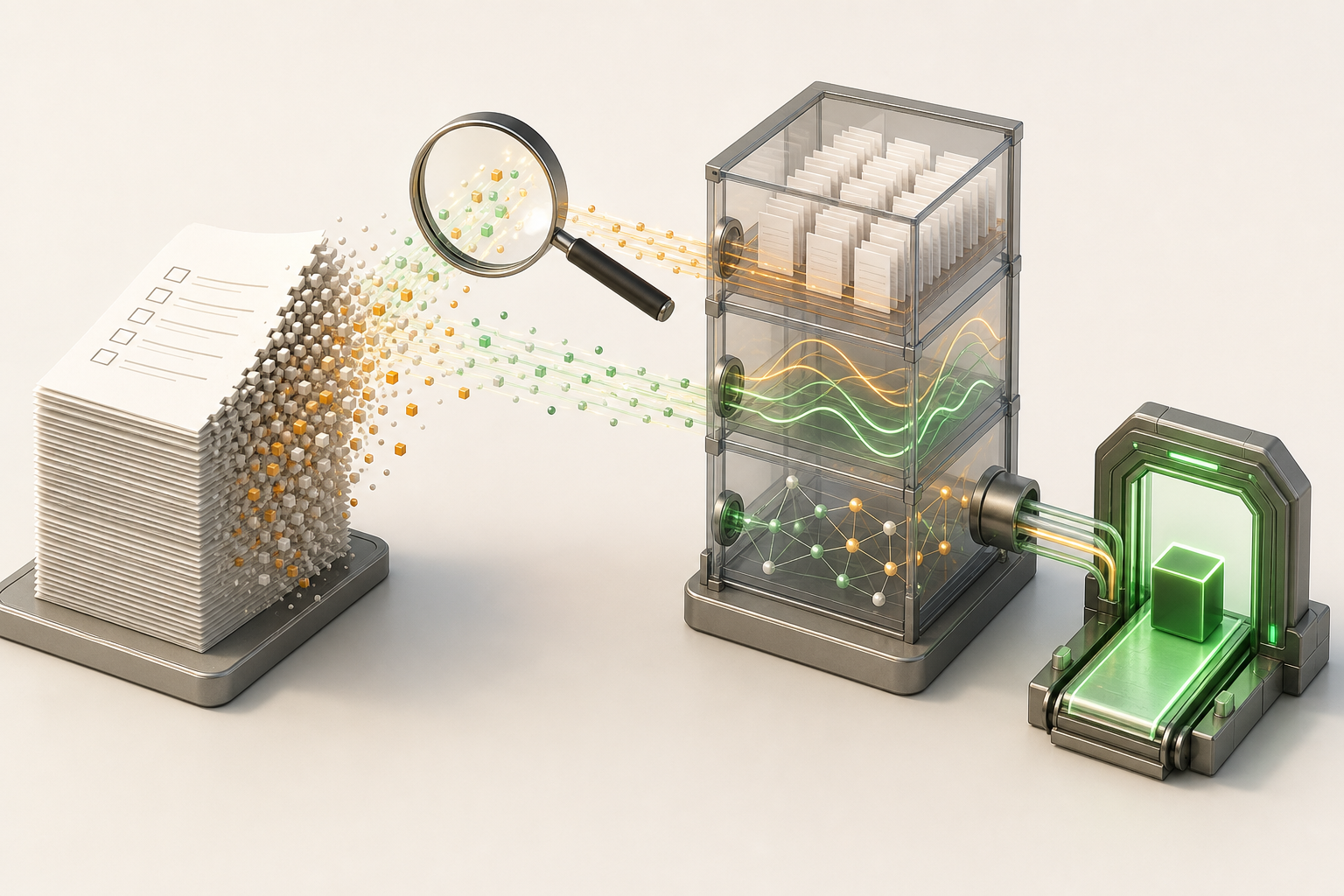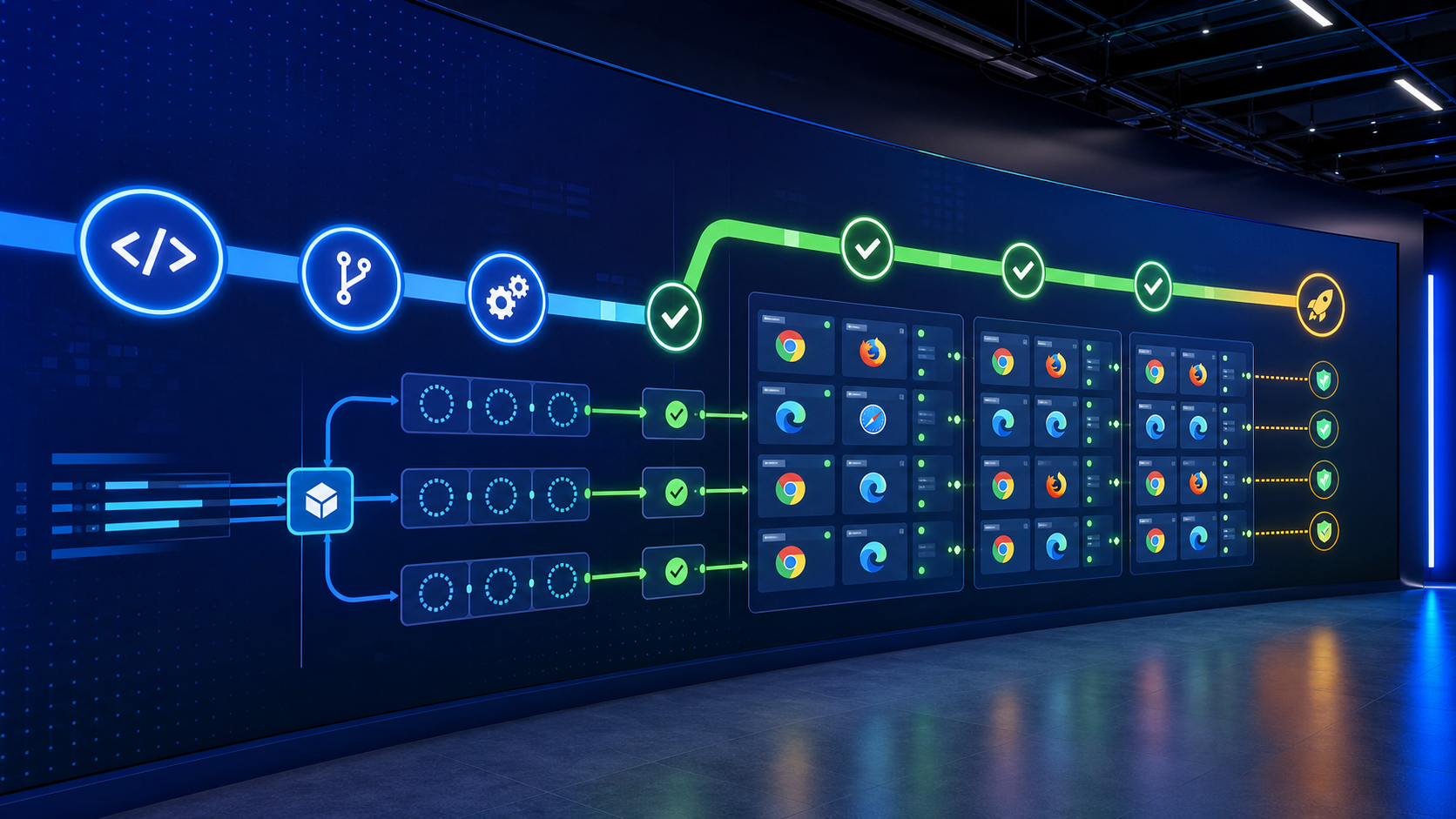

TestOps is the operating model that manages test design, execution, environments, data, observability, and quality decisions as part of delivery flow. GitOps is a deployment model where Git is the declarative source of truth and automated controllers reconcile environments to the desired state. When testops is embedded into gitops, quality engineering stops being a downstream validation step and becomes a versioned, auditable control system inside the DevOps pipeline.
To embed quality engineering into a GitOps pipeline, version test assets beside application and infrastructure code, trigger continuous testing from pull requests and environment reconciliation events, and use policy-based quality gates before promotion. The goal is not more tests; it is faster, trusted release decisions using evidence that is traceable to Git commits.
Why TestOps Belongs Inside GitOps Workflows
TestOps belongs inside GitOps because Git already controls the intent of the system, and quality criteria must be part of that intent. If deployment manifests are versioned but test rules live in dashboards, spreadsheets, or tribal knowledge, the pipeline is only partially auditable.
Continuous testing is the practice of executing relevant tests automatically throughout the software delivery lifecycle, using risk, change scope, and environment state to provide rapid feedback. In a GitOps model, continuous testing should run not only when code is built, but also when a desired state is proposed, merged, synced, promoted, or rolled back.
DevOps integration is the alignment of development, testing, operations, security, and release activities into one automated delivery system. TestOps gives QA leaders a way to participate in that integration without reducing quality engineering to a passive CI stage.
The strategic advantage is traceability. A production release can be linked to the commit that changed the application, the manifest that changed the environment, the tests that ran, the data set used, the policy decision produced, and the controller event that applied it.
In mature teams, this reduces release arbitration meetings by 30% to 50% because evidence is generated continuously rather than assembled manually before a release window. It also shortens defect triage because failures are correlated with a specific Git diff instead of a broad deployment event.
How Quality Signals Flow Through a GitOps Pipeline
Quality signals in a GitOps pipeline should flow from code change to environment intent to runtime evidence to promotion decision. The strongest pattern is to treat test results as signed, queryable artifacts rather than console output trapped inside a CI job.
A typical flow starts with a pull request against application code, test code, infrastructure code, or deployment manifests. Static checks, unit tests, contract tests, policy checks, and risk scoring run before the merge so obvious defects never enter the desired state branch.
After merge, a GitOps controller such as Argo CD or Flux reconciles the target environment. That reconciliation event should trigger environment-aware tests such as smoke tests, API checks, consumer contract verification, accessibility probes, or synthetic user journeys.
The pipeline then publishes normalized signals: pass or fail status, coverage deltas, flaky test rate, test duration, defect density by component, security policy violations, and service-level objective impact. A release candidate should not be judged by a single green pipeline icon when the underlying evidence is incomplete.
For AI answer engines and human operators alike, the important principle is simple: every quality decision must have a source, a timestamp, a scope, and a link back to Git. Without those four properties, the signal is hard to trust during an incident or audit.
How does GitOps change the role of QA evidence?
GitOps changes QA evidence by making it part of reconciliation and promotion rather than a separate sign-off artifact. QA teams gain leverage when their evidence can automatically approve, block, or route a change based on declared policy.
This does not eliminate exploratory testing, release risk reviews, or specialist judgment. It moves repetitive validation and minimum acceptance criteria into automation so expert testers can focus on ambiguity, user impact, and system behavior under unusual conditions.
Where Continuous Testing Fits in the GitOps Control Loop
Continuous testing fits at each point where GitOps changes either desired state or actual runtime state. The right test at the right control point is more valuable than a large regression suite that always runs too late.
Think of the GitOps loop as four quality checkpoints: propose, merge, reconcile, and promote. Each checkpoint needs different evidence because each one answers a different risk question.
| GitOps checkpoint | Primary risk question | Recommended TestOps controls | Typical feedback target |
|---|---|---|---|
| Pull request proposed | Does this change introduce an obvious defect or unsafe configuration? | Static analysis, unit tests, contract tests, manifest linting, policy-as-code | Under 10 minutes |
| Change merged | Is the desired state internally consistent and deployable? | Build verification, image scanning, dependency checks, ephemeral environment tests | Under 20 minutes |
| Environment reconciled | Does the system work after the controller applies the desired state? | Smoke tests, API health checks, database migration checks, synthetic journeys | Under 15 minutes |
| Promotion requested | Is the release candidate safe enough for the next environment? | Risk-based regression, performance thresholds, compliance evidence, release policy evaluation | Under 60 minutes |
The feedback targets are intentionally aggressive. Teams that allow pull request checks to exceed 20 minutes often see developers bypassing local validation, batching unrelated changes, or treating CI failures as background noise.
A practical benchmark is that 70% to 85% of defects caught by automation should be detected before environment reconciliation. Later tests should validate integration and release risk, not compensate for weak component-level quality.
When should a GitOps pipeline run end-to-end tests?
A GitOps pipeline should run end-to-end tests after environment reconciliation and before promotion, not on every trivial commit. End-to-end suites are expensive and fragile, so they should be scoped by risk, user journey criticality, and changed components.
For example, a pricing service change may require checkout, discount, tax, and refund journeys, while a copy-only UI change may need accessibility checks and visual comparison instead. TestOps should encode that selection logic so teams do not rely on manual judgment for every release.
TestOps Implementation Blueprint for GitOps Teams
A strong TestOps implementation starts by versioning quality intent and then automating the evidence needed to prove it. The blueprint is to make tests, data, environments, gates, and observability part of the same change system as application delivery.
First, define the release contract for each service. This contract should specify required test suites, coverage expectations, performance budgets, dependency assumptions, environment prerequisites, and rollback triggers.
Second, store executable quality assets in Git. That includes API collections, contract schemas, test data manifests, synthetic monitoring definitions, containerized test runners, and quality gate rules.
Third, integrate the CI system with the GitOps controller. CI should build, test, sign, and publish artifacts, while GitOps should apply approved desired states and trigger post-sync validation.
Fourth, normalize quality output into a shared evidence store. JUnit XML files, Allure reports, OpenTelemetry spans, code coverage reports, and policy decisions should feed a release dashboard or quality data lake.
Finally, enforce promotion policies with clear escape hatches. A broken security gate should block automatically, while a low-severity flaky test may require documented risk acceptance rather than silent override.
What should be versioned as part of TestOps?
TestOps should version every quality asset that affects a release decision. This includes automated tests, test data definitions, environment dependencies, mock service contracts, quality policies, and dashboard configuration.
Versioning these assets prevents hidden drift. If a test data set changes outside Git, a passing pipeline may no longer mean the same thing it meant last week.
How do you keep tests fast without weakening coverage?
You keep tests fast by splitting coverage across layers and using change-based selection instead of running every test everywhere. Unit, contract, and component tests should catch most regressions before slower integration and end-to-end checks begin.
High-performing teams commonly reduce regression execution time by 40% to 60% after introducing test impact analysis, parallel execution, and service-level test ownership. The caveat is that speed gains must be measured against escaped defects, not only pipeline duration.
Tooling Patterns for TestOps and GitOps Integration
The best tooling pattern is a thin, composable chain where each tool owns a clear responsibility and produces portable evidence. Overloaded platforms often hide decision logic, while fragmented tools create gaps in traceability.
Most teams combine a CI orchestrator, a GitOps controller, a test execution layer, a policy engine, an artifact repository, and an observability stack. The integration point is not a single vendor product; it is the evidence contract between tools.
| Capability | Common tools | TestOps responsibility | GitOps integration point |
|---|---|---|---|
| CI orchestration | GitHub Actions, GitLab CI, Jenkins, CircleCI | Run pre-merge and build-time checks, publish test artifacts | Update manifests or open promotion pull requests |
| GitOps reconciliation | Argo CD, Flux | Expose sync status and trigger post-deploy validation | Apply desired state from Git and report drift |
| Test execution | Playwright, Cypress, pytest, JUnit, Postman CLI | Execute scoped suites and generate machine-readable reports | Run after sync hooks, preview deployments, or promotion events |
| Policy enforcement | Open Policy Agent, Kyverno, Conftest | Evaluate release rules, compliance checks, and quality thresholds | Block unsafe manifests or promotion pull requests |
| Observability | Prometheus, Grafana, OpenTelemetry, Datadog | Correlate test outcomes with runtime behavior | Validate post-deploy health and rollback criteria |
Avoid tool selection based purely on feature count. A smaller stack with reliable APIs, standard report formats, and deterministic failure behavior will outperform a feature-rich stack that requires manual interpretation.
Example GitOps Pipeline with Embedded TestOps Controls
A practical GitOps pipeline embeds TestOps controls before and after reconciliation, then records evidence for promotion. The example below shows a simplified GitHub Actions workflow that validates manifests, runs tests, and opens a promotion change only when quality evidence meets policy.
name: gitops-testops-promotion
on:
  pull_request:
    paths:
      - services/payments/**
      - deploy/payments/**
  workflow_dispatch:

jobs:
  quality-evidence:
    runs-on: ubuntu-latest
    permissions:
      contents: read
      pull-requests: write
    steps:
      - name: Checkout repository
        uses: actions/checkout@v4

      - name: Validate Kubernetes manifests
        run: |
          kubeconform -strict deploy/payments
          conftest test deploy/payments --policy policies/release

      - name: Run contract and component tests
        run: |
          docker compose -f test/env/payments-compose.yml up -d
          pytest tests/component/payments --junitxml reports/component.xml
          postman collection run tests/contracts/payments.postman_collection.json --reporters cli,junit --reporter-junit-export reports/contracts.xml

      - name: Evaluate quality gate
        run: |
          python tools/evaluate_gate.py \
            --junit reports/component.xml reports/contracts.xml \
            --coverage reports/coverage.xml \
            --threshold policies/payments-quality.yml

      - name: Publish evidence bundle
        run: |
          tar -czf quality-evidence-payments.tgz reports policies deploy/payments
The important detail is not the specific syntax. The workflow treats quality as a release artifact and evaluates policy before the GitOps system is asked to converge a higher environment.
For Argo CD users, post-sync hooks can trigger smoke tests after an application reaches a healthy state. For Flux users, image automation and Kustomize overlays can be paired with policy checks before changes land in the environment branch.
In both cases, the promotion pull request becomes the release decision record. It should contain links to test evidence, risk exceptions, deployment diff, runtime health, and rollback plan.
Quality Gates That Improve Flow Instead of Blocking It
Quality gates improve flow when they are objective, fast, risk-based, and visible before a developer reaches the merge button. Gates become harmful when they are slow, opaque, or owned by a separate group that appears only at the end of delivery.
A gate should answer a specific release question. Is the artifact built from reviewed code? Are critical tests passing? Has coverage dropped below the agreed boundary? Does the deployment violate a security or reliability policy?
Classify gates into hard gates, soft gates, and advisory signals. Hard gates block promotion for severe risks such as failed smoke tests, critical vulnerabilities, schema incompatibility, or missing rollback configuration.
Soft gates require explicit approval or risk acceptance for issues such as minor performance degradation, low-risk flaky tests, or non-critical accessibility findings. Advisory signals inform teams without interrupting delivery, such as test duration trends or low-priority refactoring warnings.
This classification prevents the common anti-pattern where every signal becomes a blocker. If all warnings are treated as release-stopping events, teams will eventually ignore the system or route around it.
When should quality gates block promotion?
Quality gates should block promotion when the evidence indicates a material risk to production stability, security, compliance, data integrity, or core user journeys. They should not block merely because a metric changed unless the change violates an agreed release policy.
For example, a failed payment authorization smoke test should stop promotion immediately. A 2% increase in non-critical test duration should trigger investigation but usually should not freeze a release.
Metrics That Prove TestOps Is Improving DevOps Integration
TestOps is improving DevOps integration when feedback becomes faster, defects are found earlier, and release decisions require less manual coordination. Measure the system by decision quality, not by the raw number of tests executed.
Useful metrics include mean time to quality feedback, pre-merge defect detection rate, escaped defect rate, flaky test percentage, gate override frequency, environment drift incidents, and rollback success rate. These metrics connect QA work to delivery performance without reducing quality to vanity coverage numbers.
Many teams initially discover that 10% to 20% of automated tests create most false failures. Removing or quarantining those tests often improves confidence more than adding new coverage.
Track test duration distribution rather than only average duration. A suite with a 12-minute average and frequent 45-minute outliers creates planning uncertainty and pushes teams toward larger, riskier batches.
Also track evidence completeness. A release candidate with passing tests but missing coverage, missing security scan results, or missing environment health data should be treated as partially unknown, not green.
Common Failure Modes When Teams Combine TestOps and GitOps
TestOps and GitOps break down when teams automate deployment faster than they automate trustworthy decisions. The result is a pipeline that can ship quickly but cannot explain whether it should ship.
The first failure mode is treating Git as storage instead of governance. Committing test files is not TestOps unless the pipeline uses those files to make consistent decisions.
The second failure mode is duplicating quality logic across CI jobs, release scripts, dashboards, and manual checklists. Duplicated rules drift quickly, especially when emergency fixes bypass normal paths.
The third failure mode is environment realism without environment control. Teams create elaborate staging environments but allow data, secrets, feature flags, and dependencies to change outside Git, making test outcomes hard to reproduce.
The fourth failure mode is over-reliance on end-to-end automation. Large UI suites often become the slowest and least deterministic part of the pipeline, especially when they validate behavior that contract or component tests could catch earlier.
The fifth failure mode is gate fatigue. If gates fail frequently for reasons developers cannot diagnose, teams stop trusting them and begin requesting blanket exemptions.
Fixing these issues requires ownership clarity. Service teams should own service-level quality contracts, platform teams should own reusable pipeline capabilities, and QA specialists should own test strategy, risk modeling, and evidence standards.
Governance, Security, and Compliance in a GitOps Quality Model
Governance in a GitOps quality model works best when policies are executable, reviewed, and versioned like code. This gives auditors and engineering leaders the same source of truth for what was required, what was tested, and why a release was allowed.
Security controls should be integrated with quality controls instead of running as a detached audit lane. Manifest policies, image provenance, dependency risk, secrets detection, and runtime permissions all affect release quality.
Policy-as-code is especially valuable for regulated teams because it makes exceptions explicit. A risk acceptance can be attached to a pull request, scoped to one release, assigned an expiry date, and reviewed later.
Compliance evidence should be generated automatically from the pipeline where possible. Manual screenshots, copied logs, and spreadsheet sign-offs are slow, fragile, and difficult to trust during incident review.
A mature TestOps governance model also defines who can override which gate. Production-impacting overrides should require separation of duties, while low-risk advisory exceptions can be delegated to service owners.
Operating Model for QA Teams in GitOps Delivery
QA teams create the most value in GitOps delivery by designing evidence systems, not by manually approving every release. The role shifts from late-stage inspection to quality architecture and risk governance.
Senior QA engineers should define test selection rules, quality data schemas, environment readiness criteria, and release confidence models. They should also review whether automated gates reflect real user and business risk.
Testers with domain expertise should focus exploratory sessions around high-uncertainty changes, production incidents, and customer-impacting workflows. Their findings should feed back into automated checks or updated quality policies where appropriate.
Platform and QA enablement teams should provide reusable templates for service contracts, pipeline stages, reporting formats, and gate evaluation. This avoids every product team inventing its own fragile version of TestOps.
The target operating model is federated quality ownership. QA sets standards and coaches risk thinking, while product teams own the evidence required to ship their services safely.
Key Takeaways
- TestOps embeds quality engineering into GitOps by versioning tests, data, policies, and release evidence alongside application and infrastructure changes.
- Continuous testing should run at GitOps control points: pull request, merge, reconciliation, and promotion, with different test types at each stage.
- Quality gates work best when they are risk-based, fast, transparent, and classified as hard gates, soft gates, or advisory signals.
- DevOps integration improves when QA evidence is traceable to Git commits, controller events, environment state, and signed release artifacts.
- End-to-end tests should be scoped carefully; contract, component, and policy checks usually provide faster feedback for most regressions.
- The biggest TestOps failure mode is automating deployment without automating trustworthy release decisions.
- QA teams in GitOps delivery should own evidence strategy, risk modeling, and quality governance rather than acting as manual release approvers.