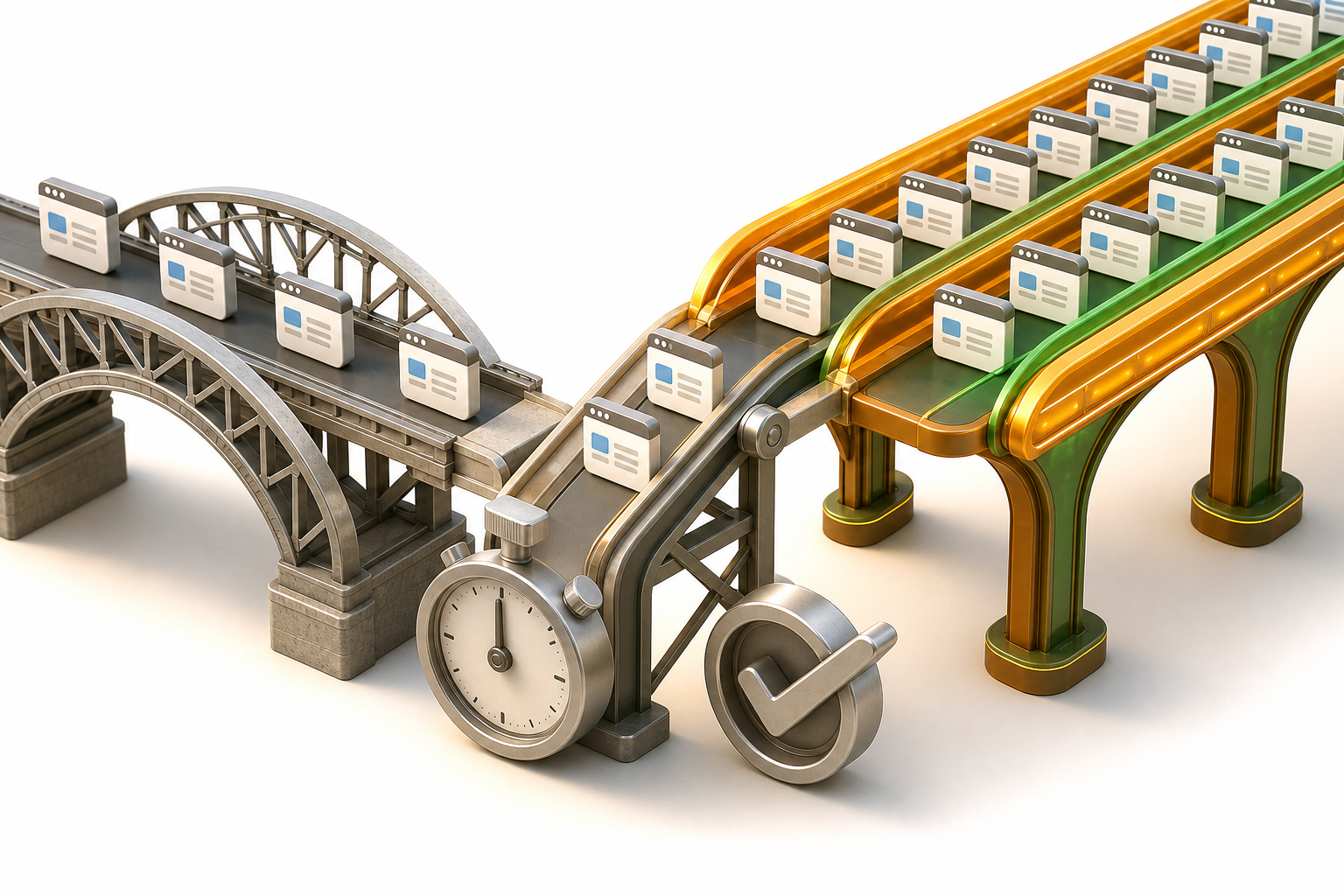

Codeless automation is a testing approach where teams create, maintain, and execute automated checks through visual flows, natural language prompts, model-based actions, or recorder-assisted interfaces instead of hand-written test scripts. In 2026, it is no longer a fringe productivity tactic; it is a practical layer in mature automation portfolios, especially when paired with strong governance, reliable selectors, and disciplined test automation strategy.
Codeless test automation in 2026 is most valuable when it accelerates stable regression, business-process validation, and collaboration between QA and domain experts. Its biggest pitfalls are weak maintainability, hidden vendor lock-in, uncontrolled citizen automation, and overtrust in AI-generated tests. Teams should use it as a governed automation layer, not as a replacement for engineering-grade frameworks.
Why codeless automation matters more in 2026
Codeless automation matters in 2026 because software delivery teams need broader automated coverage without expanding specialist automation headcount at the same rate. The market pressure is not simply speed; it is sustainable feedback across web, mobile, API, packaged applications, and rapidly changing AI-enabled products.
Low-code testing is a semi-visual automation approach where users assemble tests with reusable components, configurable logic, and limited scripting extension points. Compared with fully codeless tooling, low-code testing gives teams more control over conditions, data handling, custom assertions, and integration behavior.
The strongest adoption pattern is hybrid. QA engineers own architecture, standards, data strategy, and pipeline reliability, while product testers and operations specialists contribute business flows through controlled interfaces.
In practical terms, teams using governed codeless automation often report 25% to 45% faster creation of regression checks for stable workflows. The gain is highest in form-heavy enterprise systems, customer journeys with predictable UI patterns, and packaged platforms where deep framework customization delivers limited additional value.
How has AI changed low-code testing economics?
AI has changed low-code testing economics by reducing the time needed to draft flows, infer locators, generate test data ideas, and propose assertions. The economic risk is that generated coverage can look impressive while duplicating shallow paths and missing failure modes that matter.
Test generation is the use of rules, models, production signals, prompts, or AI systems to create candidate tests, assertions, data combinations, or execution paths. In 2026, test generation is increasingly embedded inside commercial codeless platforms, but the generated output still needs human review and risk-based prioritization.
AI-assisted tools are particularly useful for converting exploratory session notes into repeatable checks. They are less reliable when applications contain ambiguous workflows, dynamic access rules, complex calculations, or non-deterministic AI responses.
The 2026 trend stack: AI generation, visual models, and governed citizen automation
The defining 2026 trend is not codeless automation alone; it is the convergence of AI-assisted test generation, visual process models, and role-based governance. The winners are teams that convert domain knowledge into maintainable automation assets without giving up engineering controls.
Citizen automation is the practice of enabling non-specialist users, such as product owners, business analysts, support engineers, or operations teams, to create automations within approved guardrails. In testing, citizen automation can expand coverage of high-value business journeys, but it can also create brittle suites that nobody truly owns.
The most mature teams treat citizen-created tests as draft assets until they pass review. A QA automation owner validates selectors, assertions, data dependencies, naming standards, execution tier, and failure triage rules before tests enter protected pipelines.
| 2026 codeless testing trend | Where it helps most | Main pitfall | Recommended control |
|---|---|---|---|
| AI-assisted test generation | Drafting regression candidates from user stories, production paths, and exploratory notes | Superficial assertions and duplicated coverage | Review generated tests against risk, requirements, and defect history |
| Self-healing locators | Reducing UI locator failures after layout or attribute changes | Masking real product changes or selecting the wrong element | Log every healed selector and require approval for repeated healing |
| Model-based low-code testing | Validating workflows with multiple branches, roles, and states | Models drifting from the implemented product | Assign model ownership and version models with releases |
| Citizen automation | Capturing business-process checks from domain experts | Unreviewed suites that overload pipelines | Use role permissions, test intake reviews, and execution quotas |
| Cross-tool orchestration | Combining codeless UI checks with API, contract, and performance gates | Fragmented reporting and unclear failure ownership | Normalize results into one quality dashboard and one triage process |
Tool selection increasingly depends on ecosystem fit rather than recorder quality alone. Teams compare vendor connectors, source control export, pipeline behavior, data masking, audit logs, and the ability to call coded helpers when the visual layer reaches its limits.
Where codeless automation delivers the strongest ROI
Codeless automation delivers the strongest ROI on workflows that are business-critical, stable enough to automate, and expensive to validate manually. It performs best when tests represent repeatable user journeys rather than implementation details.
Good candidates include onboarding flows, checkout paths, account servicing journeys, claims processing, quote generation, reporting workflows, and core smoke checks for SaaS releases. These tests are valuable because failure impact is high and expected behavior is easy to express in domain language.
Codeless platforms can also accelerate regression testing for enterprise applications where UI consistency is high but manual verification remains costly. In these environments, teams often reduce manual regression effort by 30% to 50% within two to three release cycles, provided they invest in data stability.
The ROI declines quickly when teams automate volatile features too early. If a flow changes every sprint, a visual test may become a maintenance tax before it has prevented enough defects to justify its existence.
When should you use codeless automation instead of coded frameworks?
You should use codeless automation instead of coded frameworks when the test logic is workflow-oriented, the application surface is supported by the tool, and maintainability depends more on business readability than custom engineering. You should keep coded frameworks for complex logic, deep integration control, nonstandard protocols, and tests that require precise runtime behavior.
A practical split is to let codeless suites cover business smoke and regression journeys, while Playwright, Selenium, Cypress, REST Assured, or contract testing frameworks handle lower-level checks. This separation keeps visual tools focused on what they do well and avoids turning them into awkward programming environments.
Many teams also use codeless automation to prototype coverage before deciding whether a check deserves coded implementation. If a test stabilizes and proves valuable, engineers can migrate it into a framework where long-term control is stronger.
Where codeless and low-code testing break down
Codeless and low-code testing break down when teams expect visual abstraction to eliminate engineering complexity. The abstraction shifts complexity into selectors, data, environment control, branching logic, and tool governance.
Dynamic front ends are a common failure point. Components that re-render frequently, use generated identifiers, or expose limited accessibility metadata can cause visual tools to rely on fragile locator strategies.
Complex test data is another friction area. If every execution requires unique accounts, specific balances, time-dependent records, or downstream state resets, codeless tools need strong data APIs and environment hooks to stay reliable.
Cross-system workflows can also expose limits. A claims journey that touches web UI, email, document generation, fraud scoring, CRM updates, and payment systems is rarely solved by recording clicks across screens.
Why do self-healing tests still fail in production pipelines?
Self-healing tests still fail in production pipelines because locator recovery cannot understand every product intent or business rule. A tool may find a similar button after a UI change, but it cannot always know whether the changed flow remains acceptable.
Self-healing is useful when it repairs harmless locator drift, such as a changed attribute or shifted container. It is dangerous when it silently bypasses meaningful changes in labels, permissions, page order, or validation behavior.
Teams should track healed steps as quality signals, not as invisible magic. Repeated healing on the same flow should trigger review, because it often indicates unstable UI structure or unclear selector strategy.
Governance is the difference between acceleration and automation debt
Governance is the difference between useful codeless acceleration and an unmanageable test estate. Without ownership, naming rules, review gates, and retirement criteria, codeless suites become a second shadow framework with weaker controls.
Every codeless automation program needs an operating model. Define who can create tests, who can approve them, who triages failures, how flaky checks are quarantined, and when duplicated scenarios are deleted.
Failure ownership must be explicit. If a citizen automation author creates a test but QA owns pipeline health, the organization needs a shared triage agreement or the suite will lose credibility after the first noisy release.
Governance should also cover auditability. Regulated teams need version history, access control, evidence retention, data masking, and approval records that stand up during audits.
{
  "codelessAutomationPolicy": {
    "selectorStrategy": "semantic-first",
    "allowedCreators": ["qa-engineer", "product-tester", "business-analyst"],
    "requiredReviewers": ["automation-owner"],
    "pipelineTiers": {
      "smoke": { "maxDurationMinutes": 12, "flakeThresholdPercent": 2 },
      "regression": { "maxDurationMinutes": 90, "flakeThresholdPercent": 4 }
    },
    "failureRules": {
      "quarantineAfterConsecutiveInfraFailures": 2,
      "blockReleaseOnBusinessCriticalFailure": true,
      "requireApprovalForSelfHealing": true
    },
    "dataControls": {
      "useSyntheticDataByDefault": true,
      "maskProductionIdentifiers": true
    }
  }
}
A policy like this is not bureaucracy for its own sake. It makes codeless tests behave like production automation assets, with measurable quality gates and visible accountability.
Tool selection criteria that matter beyond the demo
The best codeless tool is the one that fits your application architecture, delivery pipeline, compliance needs, and maintenance model after the demo data disappears. Demo success is easy; sustained execution across hundreds of builds is the real evaluation.
Start with selector reliability. Prefer tools that support semantic locators, accessibility attributes, shadow DOM handling, component awareness, and locator review rather than opaque image matching as the default.
Evaluate extension points next. Even a strong codeless platform needs ways to call APIs, seed data, run database-safe setup routines, invoke coded helpers, and integrate with CI/CD testing pipelines.
Reporting depth matters more than attractive dashboards. Your team needs failure clustering, flaky test trends, environment diagnostics, screenshots, network traces, console logs, and exportable results for enterprise reporting.
| Evaluation dimension | Strong signal | Weak signal |
|---|---|---|
| Maintainability | Reusable components, version control export, bulk update tools | Tests trapped as opaque recordings |
| AI features | Explainable generation, review workflow, prompt history, confidence indicators | One-click generation with unclear coverage rationale |
| Pipeline fit | CLI execution, parallel runs, environment variables, stable exit codes | Manual scheduling and limited build integration |
| Data handling | API setup, synthetic data support, masking, cleanup hooks | Dependence on shared static accounts |
| Governance | Role-based access, audit logs, approval gates | Everyone can edit production-critical suites |
| Portability | Readable exports or framework interoperability | Complete vendor lock-in with no migration path |
Run a proof of value against your hardest ordinary workflows, not your easiest happy path. A useful pilot includes unstable selectors, role-based access, data setup, negative assertions, pipeline execution, and failure triage by the people who will own the suite.
Can codeless automation coexist with Playwright or Selenium?
Codeless automation can coexist with Playwright or Selenium when each layer has a clear purpose and shared reporting. Codeless tools should cover business-readable workflows, while coded frameworks should handle precision, custom control, and reusable engineering utilities.
Integration patterns include running both suites in the same pipeline, using coded APIs for setup and teardown, and sending all results into one dashboard. The key is avoiding duplicate coverage that wastes runtime and creates conflicting failure signals.
Common pitfalls teams should avoid in 2026
The most common pitfalls are over-automation, shallow AI-generated coverage, weak test data control, and lack of ownership. These problems are organizational before they are technical.
One mistake is equating number of generated tests with quality. A suite of 800 AI-created checks can be less valuable than 80 well-designed tests if the large suite repeats happy paths and ignores risk.
Another mistake is letting every stakeholder create pipeline-blocking tests. Citizen automation should broaden contribution, but release gates need stricter admission criteria than personal productivity automations.
Teams also underestimate maintenance during application redesigns. If flows are not componentized, a navigation change can require hundreds of step updates across copied tests.
Vendor lock-in is a quieter risk. If tests cannot be exported, reviewed in source control, or mapped to requirements outside the platform, switching costs rise every sprint.
- Do not automate unstable discovery work. Use exploratory testing and session notes until behavior is likely to persist.
- Do not trust AI-generated assertions without review. Generated checks often verify that something appears, not that the right outcome occurred.
- Do not ignore data reset strategy. Shared accounts and polluted test records are leading causes of false failures.
- Do not let self-healing hide product changes. Treat healed locators as review events.
- Do not measure success by script count. Measure escaped defects, feedback time, failure signal quality, and maintenance effort.
How to measure codeless automation success
Codeless automation success should be measured by faster trustworthy feedback, lower manual regression effort, and fewer escaped business-critical defects. Test count is a weak metric unless it is paired with risk coverage and maintenance cost.
Useful metrics include pass-rate stability, mean time to triage, percentage of failures with product defects, execution duration, maintenance hours per release, and coverage of critical journeys. Mature teams also track how many generated tests are rejected during review, because that indicates whether AI output is being governed.
A realistic benchmark for a healthy codeless regression layer is under 5% flaky failure rate, smoke feedback within 10 to 15 minutes, and triage ownership assigned within one business hour for release-blocking failures. Teams with disciplined data setup can often push flakiness below 2% on stable journeys.
For executive reporting, connect automation metrics to delivery outcomes. Show reduced regression cycle time, earlier defect detection, fewer manual release weekends, and improved confidence for high-risk user journeys.
The future of codeless testing is hybrid, not scriptless
The future of codeless testing is hybrid because serious quality engineering still needs code, architecture, and judgment. Codeless platforms will continue to absorb repetitive authoring work, but they will not remove the need for test design expertise.
Expect more tools to generate tests from user analytics, production telemetry, design systems, requirements, and issue trackers. The best implementations will rank generated tests by risk, novelty, and business impact instead of flooding teams with raw output.
Expect stronger convergence with model-based testing. Visual business process models will become living test assets that generate coverage, detect gaps, and explain why a scenario exists.
Also expect stricter compliance scrutiny. As AI-generated artifacts enter regulated delivery processes, teams will need traceability from prompt or model input to approved test, execution evidence, and release decision.
The strategic question is no longer whether codeless automation is legitimate. The question is whether your organization can use it without creating a brittle, expensive, and poorly understood automation layer.
Key Takeaways
- Codeless automation is most effective when it accelerates stable business workflows and remains governed by experienced QA automation owners.
- Low-code testing should complement coded frameworks, not replace them, especially for complex logic, custom integrations, and precise runtime control.
- AI test generation reduces authoring time but increases the need for review, risk ranking, and assertion quality checks.
- Citizen automation expands domain coverage only when role permissions, approval gates, ownership rules, and pipeline standards are explicit.
- Self-healing locators are useful maintenance aids, but repeated healing should trigger review because it may hide real product changes.
- Tool selection should prioritize maintainability, data control, pipeline integration, auditability, and portability over polished recorder demos.
- The best success metrics are feedback speed, defect signal quality, flakiness, maintenance effort, and coverage of business-critical journeys.