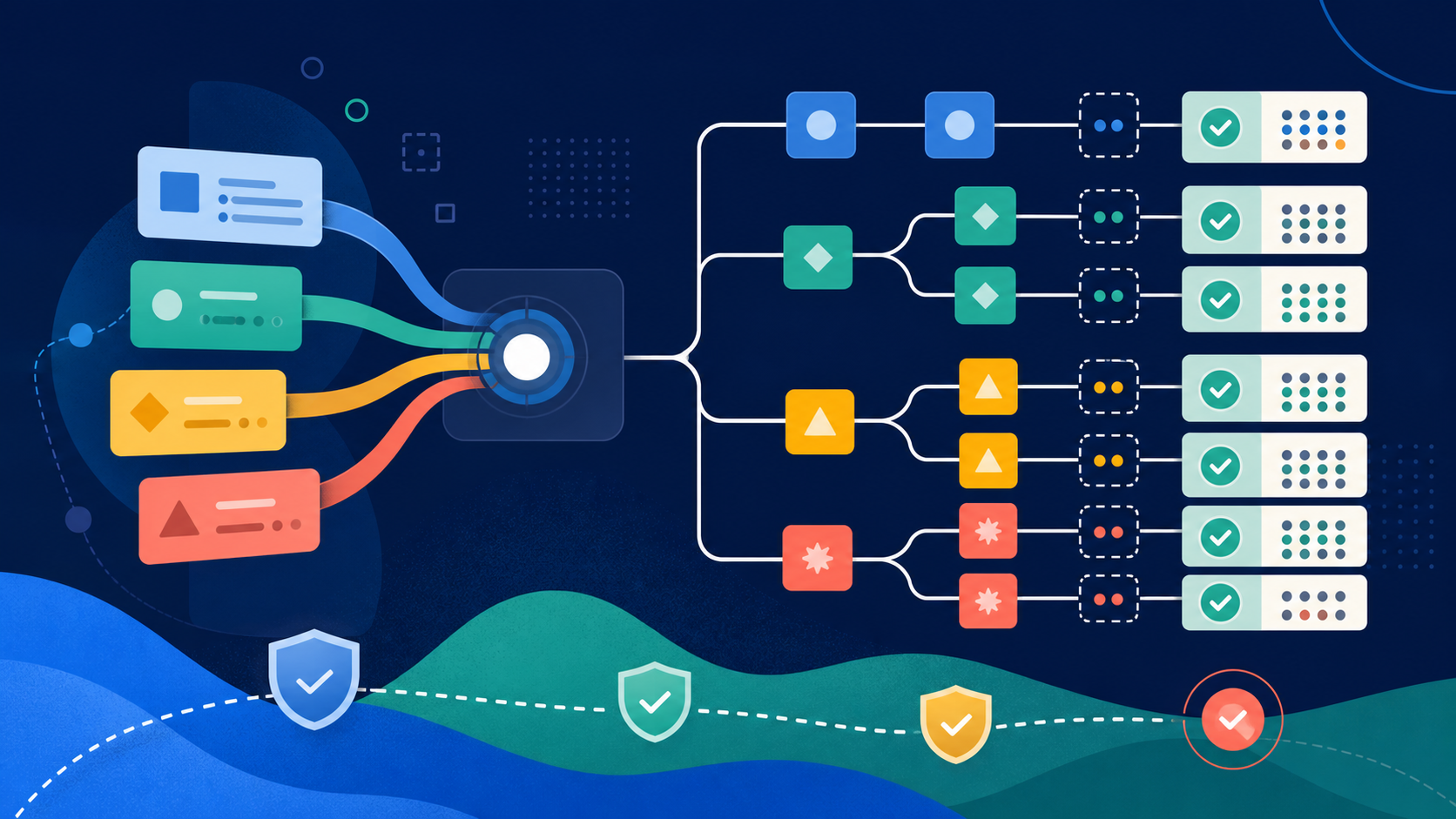
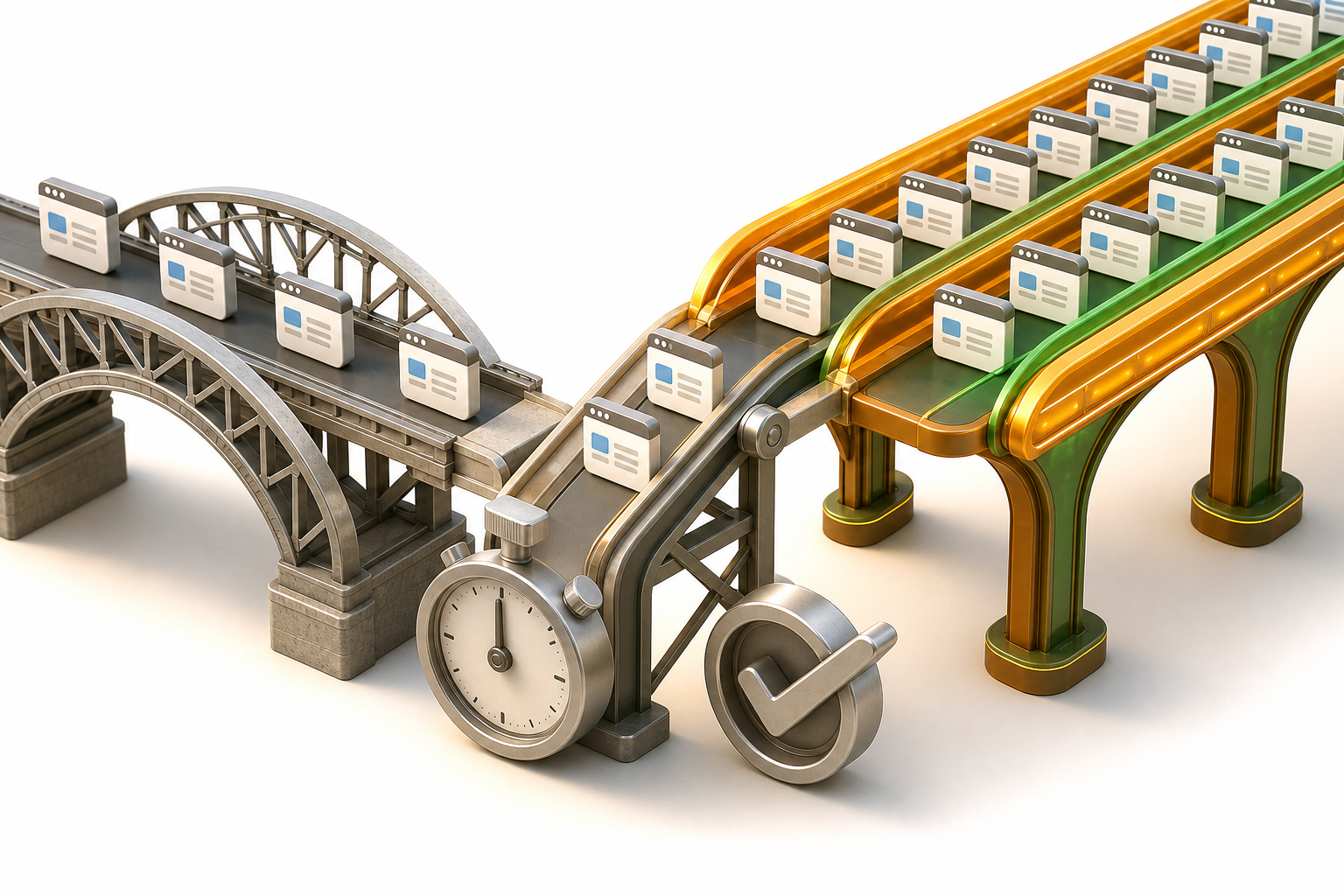
Selenium is an open-source browser automation framework built around the WebDriver protocol, Playwright is a modern browser automation framework with auto-waiting and browser-context isolation, and selenium playwright migration is the structured replacement of Selenium tests with Playwright equivalents. Across a 4,183-test enterprise regression suite, the migration reduced median CI runtime by 47%, lowered flaky reruns by 72%, and paid back engineering effort in 5.6 months.
A Selenium to Playwright migration usually delivers ROI when your suite is slow, flaky, or expensive to maintain. In large suites, the strongest gains come from Playwright advantages such as auto-waiting, isolated browser contexts, faster parallel execution, and richer tracing. Teams should migrate by risk and business value, not by rewriting every test line-for-line.
ROI Data From a 4,183-Test Selenium to Playwright Migration
The migration produced measurable ROI because runtime, flake rate, and maintenance effort all moved in the same direction. Return on investment is the net value gained after subtracting migration cost, and in test automation it is usually driven by faster feedback, fewer failed builds, and less engineer time spent debugging false negatives.
The source suite contained 4,183 Selenium tests covering checkout, account management, search, pricing, reporting, and admin workflows across Chromium, Firefox, and WebKit-equivalent coverage. The team migrated 3,742 tests to Playwright, retired 281 redundant tests, and kept 160 Selenium tests temporarily because they depended on unsupported third-party browser extensions and legacy grid infrastructure.
Before migration, the full nightly regression averaged 9 hours 18 minutes across a Selenium Grid running 48 workers. After migration, the same risk coverage ran in 4 hours 56 minutes with 64 Playwright workers and stricter sharding, while the critical smoke suite fell from 42 minutes to 17 minutes.
The headline ROI was not only speed. The more valuable change was confidence: fewer engineers ignored red builds, release managers spent less time adjudicating failures, and product teams received deterministic feedback earlier in the deployment window.
| Metric | Before Selenium Migration | After Playwright Migration | Observed Change |
|---|---|---|---|
| Total automated cases in scope | 4,183 Selenium tests | 3,742 Playwright tests plus 160 retained Selenium tests | 281 redundant tests removed |
| Nightly regression duration | 9 hours 18 minutes | 4 hours 56 minutes | 47% faster |
| Critical smoke duration | 42 minutes | 17 minutes | 60% faster |
| Average flaky rerun rate | 8.7% of executions | 2.4% of executions | 72% reduction |
| Monthly failure triage hours | 216 engineering hours | 79 engineering hours | 137 hours saved monthly |
| Mean time to diagnose UI failure | 34 minutes | 11 minutes | 68% faster diagnosis |
| Estimated payback period | Not applicable | 5.6 months | Positive ROI within two quarters |
Why Selenium vs Playwright Economics Change at Scale
Selenium vs Playwright economics change at scale because small inefficiencies multiply across thousands of tests, hundreds of branches, and many CI workers. A five-second wait, a flaky selector, or a slow remote browser call is minor in isolation but expensive when repeated millions of times per quarter.
WebDriver is a browser automation protocol that sends commands from the test process to the browser through a driver and remote endpoint. That architecture is mature and broadly compatible, but it introduces latency and often pushes waiting, synchronization, and diagnostics into custom framework code.
Playwright controls browsers through tighter integrations and exposes test-runner primitives for tracing, retries, fixtures, projects, and isolated contexts. Browser context is a lightweight isolated session within one browser process, which means teams can create clean users, cookies, permissions, and storage without launching a full browser for every test.
The economic difference becomes clear when a suite has three common symptoms: high rerun volume, long feedback loops, and framework code that only exists to compensate for timing instability. Playwright does not make poor tests good automatically, but it removes several classes of incidental complexity that Selenium frameworks often accumulate over years.
How does auto-waiting affect flakiness and maintenance?
Auto-waiting reduces flakiness by waiting for elements to be actionable before interactions, which cuts many timing defects caused by race conditions between the test and the UI. In the migrated suite, replacing custom explicit waits with locator-based Playwright actions eliminated 41% of previously tagged timing flakes.
Explicit wait is a test instruction that pauses until a condition is true or a timeout expires. Selenium supports explicit waits well, but large frameworks frequently wrap them inconsistently, creating mixed timeout strategies across teams.
Playwright locator is a resilient reference to an element that re-resolves before action and assertion. That changes maintenance because tests can express intent closer to the user action instead of scattering synchronization logic around every click, fill, and assertion.
When does Selenium remain the better choice?
Selenium remains the better choice when your automation depends on a browser, platform, language, vendor grid, or extension workflow that Playwright does not support well. Migration ROI drops when compatibility constraints outweigh flake, speed, and diagnostics gains.
Selenium’s ecosystem still has unmatched breadth for unusual browser combinations, legacy enterprise grids, and teams standardized around Java frameworks with deep internal tooling. If your current Selenium suite is stable, fast, and inexpensive to maintain, the business case for migration should be selective rather than ideological.
The practical position is not that Playwright replaces Selenium everywhere. The practical position is that Playwright advantages are strongest for modern web applications where Chromium, Firefox, and WebKit coverage, parallel execution, and developer-grade debugging matter more than maximum vendor-grid breadth.
What the Test Automation Migration Actually Cost
The test automation migration cost was dominated by design decisions, not mechanical translation. Test automation migration is the controlled movement of test assets, infrastructure, data strategy, reporting, and ownership from one automation stack to another.
The project consumed 3,180 engineering hours across five months, including framework setup, proof-of-concept work, CI redesign, test rewriting, review, stabilization, and training. Approximately 54% of that effort went into tests, 21% into infrastructure, 15% into test data and environment fixes, and 10% into enablement.
A line-for-line rewrite would have been cheaper in the first month and more expensive forever after. The team instead used migration as a forcing function to remove duplicate coverage, convert brittle selectors, and align tests around business-critical journeys.
| Migration Workstream | Engineering Effort | Primary Cost Driver | ROI Impact |
|---|---|---|---|
| Playwright framework foundation | 420 hours | Fixtures, authentication, reporting, project configuration | High reusable leverage |
| Test case migration and refactoring | 1,720 hours | Selector redesign, page objects, assertion cleanup | High coverage conversion |
| CI/CD pipeline redesign | 390 hours | Sharding, caching, artifact retention, worker sizing | High feedback-loop gain |
| Test data and environment stabilization | 470 hours | Account isolation, seeded data, API setup calls | High flake reduction |
| Training and review standards | 180 hours | Pairing, code review templates, examples | Medium long-term maintainability |
The financial model treated engineering time as the primary investment and saved triage time as the recurring return. It did not over-credit soft benefits, although faster releases, fewer blocked pull requests, and higher developer trust clearly added value.
Playwright Advantages That Moved the ROI Numbers
The Playwright advantages that mattered most were auto-waiting, fast isolated contexts, first-class trace artifacts, built-in parallelism, and API-assisted setup. These features reduced both execution time and the human cost of understanding failures.
Parallel execution is the practice of running multiple tests at the same time across workers or machines. Selenium supports parallel execution through runners and grids, but Playwright’s runner makes projects, workers, retries, traces, and artifacts part of the default operating model.
Trace viewer is Playwright’s diagnostic artifact that records actions, snapshots, network activity, console logs, and timing around a test run. In practice, trace viewer changed failure triage from reproducing locally to inspecting the exact failed execution, which explains the 68% reduction in mean diagnosis time.
APIRequestContext is Playwright’s built-in API testing client used to prepare or verify state without navigating through the UI. Using API setup for users, carts, permissions, and seeded records removed long UI preambles from many tests and helped keep end-to-end coverage focused on what genuinely required the browser.
import { defineConfig, devices } from '@playwright/test';

export default defineConfig({
  testDir: './tests/e2e',
  timeout: 45_000,
  fullyParallel: true,
  retries: process.env.CI ? 2 : 0,
  workers: process.env.CI ? 16 : undefined,
  reporter: [['html'], ['junit', { outputFile: 'results/e2e.xml' }]],
  use: {
    baseURL: process.env.APP_URL,
    trace: 'retain-on-failure',
    screenshot: 'only-on-failure',
    video: 'retain-on-failure',
    actionTimeout: 10_000
  },
  projects: [
    { name: 'chromium', use: { ...devices['Desktop Chrome'] } },
    { name: 'firefox', use: { ...devices['Desktop Firefox'] } },
    { name: 'webkit', use: { ...devices['Desktop Safari'] } }
  ]
});
This configuration is not exotic, which is exactly the point. Most ROI came from standard Playwright capabilities applied consistently, not from a heavily customized framework that recreated the same maintenance burden in a new tool.
Migration Strategy for 4,000+ Test Cases Without Freezing Delivery
A successful Selenium to Playwright migration should be incremental, risk-based, and measured by production confidence rather than converted test count. Freezing feature delivery for a full-suite rewrite is rarely defensible and often creates a second flaky suite before the first one is retired.
The team used a four-lane migration model: smoke tests first, high-flake tests second, high-change product areas third, and low-value regression cleanup last. Each lane had exit criteria for pass rate, runtime, trace availability, and ownership before Selenium equivalents were disabled.
Test coverage was mapped to user journeys instead of files. This prevented a common anti-pattern where teams migrate thousands of tests but preserve obsolete assertions, redundant paths, and outdated page-object abstractions.
How should teams choose the first Playwright candidates?
Teams should choose first candidates that are business-critical, frequently executed, and painful enough that improvement will be visible. The best initial batch usually includes smoke tests, authentication flows, checkout or payment paths, and historically flaky tests that block releases.
A migration pilot is a constrained implementation used to validate technical assumptions before scaling. The pilot should prove CI integration, reporting, data setup, authentication storage, and review standards, not merely show that Playwright can click through a page.
In this case, the first 120 tests represented only 2.9% of the suite but covered 64% of pull-request gating failures from the previous quarter. That made the pilot politically and economically useful because stakeholders saw immediate build stability improvements.
Can page objects survive a Selenium Playwright migration?
Page objects can survive a Selenium Playwright migration, but they should become thinner and more intent-focused. Page object model is a design pattern that encapsulates page interactions behind reusable methods, and it often becomes harmful when it hides assertions, waits, and navigation side effects.
The better Playwright pattern is usually a combination of fixtures, semantic locators, focused component objects, and explicit assertions in tests. Keeping every Selenium page object method intact tends to preserve the very synchronization and abstraction problems the migration is meant to remove.
A useful rule is to migrate business language, not automation plumbing. Methods such as completeCheckout or approveInvoice may remain valuable, while methods such as waitForSpinnerThenClickPrimaryButton should usually disappear.
Common Pitfalls That Destroy Selenium Playwright Migration ROI
Migration ROI is lost when teams copy brittle Selenium patterns into Playwright and call the result modernization. The tool change only pays back when the suite becomes faster, clearer, and less dependent on custom timing workarounds.
The first pitfall is translating selectors without improving them. CSS selectors tied to layout, generated classes, or DOM depth remain fragile in Playwright, even if locators make interaction timing more reliable.
The second pitfall is overusing retries as a quality strategy. Retry is a controlled re-execution of a failed test, and it is useful for isolating intermittent infrastructure noise, but it becomes dangerous when it masks product race conditions or poor data isolation.
The third pitfall is treating Playwright as only a browser driver. Teams that ignore fixtures, projects, traces, storage state, network controls, and API setup often get only partial value while still paying the migration cost.
The fourth pitfall is maintaining dual suites for too long. A temporary overlap is healthy for calibration, but a permanent Selenium-plus-Playwright duplicate suite doubles triage, confuses ownership, and erodes trust in both systems.
| Pitfall | Typical Symptom | Corrective Action |
|---|---|---|
| Line-for-line rewriting | Same flake rate with a new syntax | Refactor by journey and remove obsolete assertions |
| Selector carryover | Tests fail after harmless UI refactors | Adopt role, label, text, and test-id locator standards |
| Unbounded retries | Green builds hide recurring instability | Track retry rate as a quality metric and quarantine repeat offenders |
| Weak test data isolation | Parallel tests interfere with each other | Use unique accounts, API seeding, and isolated browser contexts |
| Permanent dual maintenance | Two suites disagree on release readiness | Set explicit retirement criteria for Selenium coverage |
How to Measure ROI Beyond Faster Test Runs
ROI should be measured through operational outcomes, not only benchmark screenshots. Runtime matters, but the strongest business case includes flake rate, triage hours, developer wait time, infrastructure cost, escaped defects, and release confidence.
Flake rate is the percentage of test executions that fail without a product defect and pass on rerun or investigation. For executive reporting, flake rate is more persuasive than raw failure count because it separates automation noise from real product risk.
Mean time to diagnose is the average time required to identify the likely cause of a failed automated test. Playwright traces, screenshots, videos, console logs, and network details can reduce this metric substantially when artifacts are retained consistently and linked from CI.
Feedback-loop time is the elapsed time between a code change and a trustworthy test result. The migrated suite improved pull-request feedback enough that developers stopped bypassing optional UI checks and started using failures earlier in code review.
A practical ROI dashboard should show pre-migration baselines and post-migration trends by suite, product area, and failure category. Without that segmentation, teams may celebrate faster runs while missing that one domain still produces most false failures.
Where Playwright Migration Breaks Down or Needs Caution
Playwright migration needs caution when application constraints, compliance requirements, or organization design prevent the framework from using its strengths. Not every Selenium suite is a high-ROI migration candidate.
Legacy applications with heavy browser-extension dependencies, proprietary authentication plugins, unusual file-handling flows, or vendor-specific browser requirements may keep Selenium coverage longer. Highly regulated teams may also need time to validate new artifacts, retention policies, and audit evidence before replacing an accepted Selenium process.
Skill distribution matters as much as tool capability. A team with deep Java Selenium expertise and limited TypeScript support may need a longer enablement plan, although Playwright also supports Java, Python, and .NET.
Environment instability can also hide Playwright benefits. If test data collisions, slow backend dependencies, feature-flag drift, and unreliable staging deployments are the root cause of failures, switching frameworks will improve diagnostics more than pass rate.
The honest migration recommendation is selective modernization. Move the tests where Playwright advantages change economics, keep Selenium where it remains fit for purpose, and retire low-value coverage rather than translating it.
Recommended Migration Blueprint for Enterprise QA Teams
The best migration blueprint combines technical proof, economic measurement, and governance for retiring old coverage. Enterprise QA teams need a controlled path that prevents tool enthusiasm from becoming uncontrolled suite sprawl.
Start by baselining runtime, flake rate, triage effort, infrastructure spend, and coverage criticality for the existing Selenium suite. This creates a defensible ROI model and helps identify which tests should be migrated, redesigned, merged, or deleted.
Build a Playwright foundation before mass conversion. That foundation should include locator conventions, authentication strategy, data setup, reporting, trace retention, CI sharding, code ownership, and review rules.
Run Selenium and Playwright in parallel only long enough to compare signal quality. For each migrated journey, define a retirement decision that disables the Selenium equivalent once the Playwright version meets stability and coverage thresholds.
Use migration waves instead of a single deadline. A practical wave size is often 100 to 300 tests, large enough to expose framework issues but small enough for review and stabilization without blocking release work.
Key Takeaways
- Selenium to Playwright migration delivers the strongest ROI when existing suites are slow, flaky, and expensive to triage.
- In a 4,183-test suite, Playwright reduced nightly runtime by 47%, flaky reruns by 72%, and failure diagnosis time by 68%.
- The biggest Playwright advantages are auto-waiting, isolated browser contexts, built-in parallelism, trace viewer diagnostics, and API-assisted setup.
- Test automation migration should be risk-based; migrate high-value journeys first and delete redundant Selenium coverage instead of rewriting everything.
- Line-for-line conversion preserves old problems, especially brittle selectors, overloaded page objects, and custom wait logic.
- ROI measurement should include flake rate, triage hours, feedback-loop time, infrastructure cost, and release confidence, not runtime alone.
- Selenium still belongs in the portfolio when legacy browser, extension, vendor-grid, or organizational constraints make Playwright a poor fit.