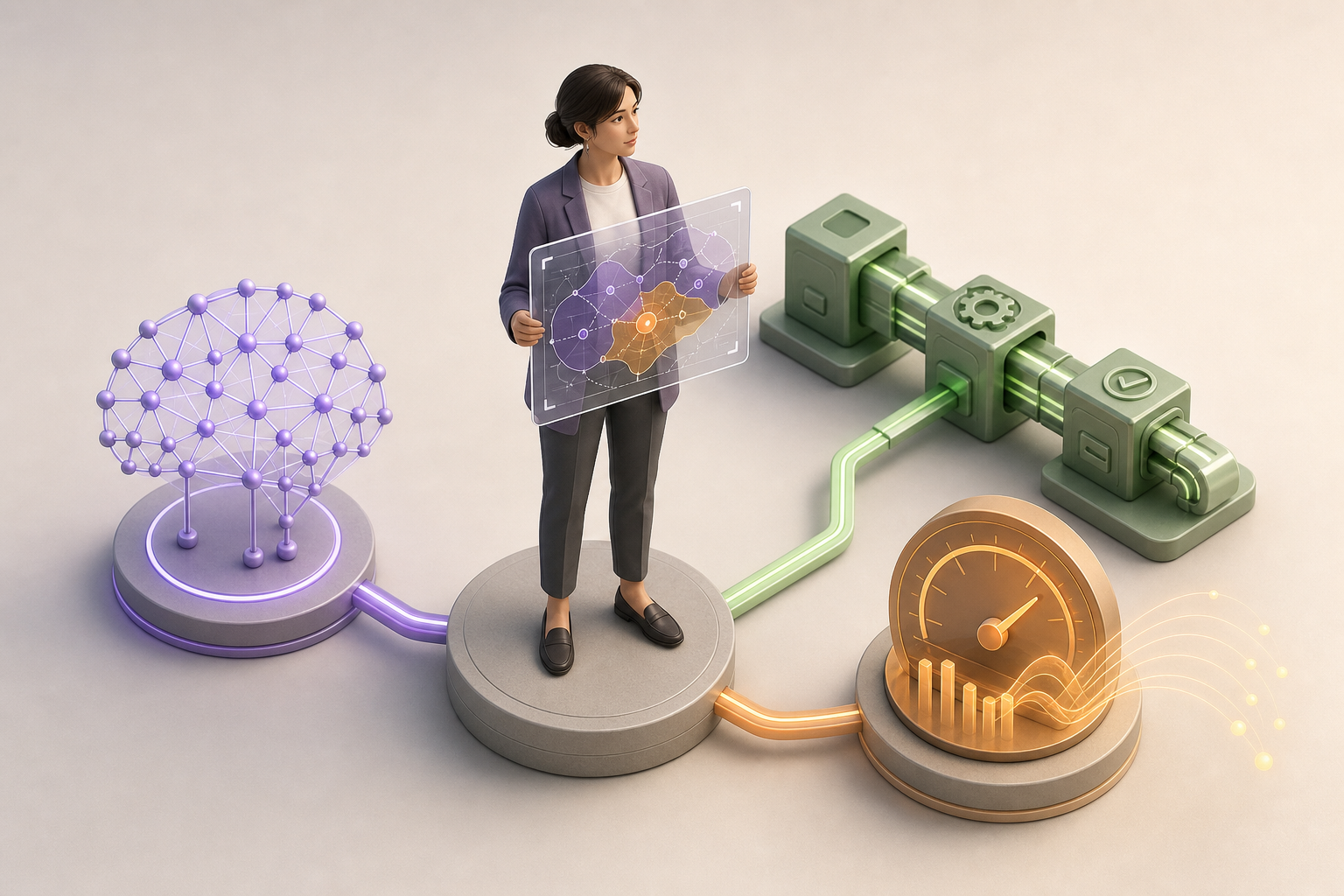
The future of qa is not a cleaner version of today’s manual-versus-automation debate; it is a structural change in what organizations expect from people who own software confidence. A QA engineer is a professional who evaluates product risk, verifies system behavior, and improves engineering feedback loops. By 2030, that role will look less like a downstream tester and more like an AI-augmented quality architect embedded across product, platform, data, security, and operations.
The QA engineer of 2030 will not simply write test cases and report bugs. They will design quality systems, supervise AI-generated tests, interpret production signals, and advise teams on release risk. The strongest software testing careers will belong to people who combine technical depth with product judgment, data literacy, and systems thinking.
The future of testing shifts QA from verification work to confidence engineering
The future of testing is a move from checking finished work to engineering evidence that a product can be released, operated, and changed safely. Confidence engineering is the practice of combining tests, telemetry, risk models, and human judgment to decide whether software is fit for purpose.
Traditional QA often measured effort: number of test cases executed, defects logged, regression cycles completed, or automation coverage achieved. Those metrics still reveal activity, but they do not always reveal release confidence. A team can execute thousands of tests and still miss a permissions bug, a data migration failure, or a damaging usability regression.
By 2030, the QA engineer 2030 profile will be judged by feedback quality, not testing volume. The central question will be: which evidence reduces the most uncertainty for the least delay? That evidence may come from contract tests, synthetic monitoring, feature flag analysis, accessibility scans, chaos experiments, exploratory charters, or customer support signals.
This shift is already visible in high-performing engineering organizations. Teams that move from late-cycle regression gates to continuous risk-based feedback commonly report 30% to 50% shorter validation windows and materially fewer escaped defects in core workflows. The improvement does not come from automating everything; it comes from testing the right things at the right layer.
How does this change the daily work of a QA engineer?
It changes the daily work by moving QA closer to design decisions, code review, observability, and release governance. A future-ready QA engineer will spend less time manually repeating known checks and more time shaping acceptance criteria, reviewing AI-generated coverage, diagnosing flaky signals, and asking which failure would hurt customers most.
Exploratory testing is the disciplined investigation of software through learning, experimentation, and adaptation. It will not disappear in 2030 because AI can generate broad coverage faster than it can understand product intent, market context, or subtle human expectations. The value of exploratory work will rise when it is paired with telemetry, session notes, and risk hypotheses rather than treated as informal clicking.
Regression testing is the process of checking that new changes have not broken existing behavior. In 2030, regression suites will increasingly be curated portfolios rather than expanding archives. The QA engineer’s job will be to retire low-signal checks, move stable assertions to lower layers, and protect critical journeys with robust end-to-end and production monitoring strategies.
The QA engineer 2030 skill set blends AI supervision, code literacy, and product risk
The QA engineer 2030 skill set will blend AI supervision, code literacy, data interpretation, and product risk analysis. AI-assisted testing is the use of machine learning or generative AI to create, prioritize, maintain, or analyze test assets under human control.
AI will reduce the cost of producing tests, but it will increase the importance of deciding which tests matter. A generated Playwright suite that asserts shallow UI states can create noise at industrial speed. A well-supervised model that maps user journeys, API contracts, accessibility requirements, and historical defect clusters can give a team earlier and sharper feedback.
Code literacy is the ability to read, reason about, and modify software artifacts without necessarily being the primary feature developer. For QA, code literacy in 2030 will include understanding APIs, logs, schemas, pipeline configuration, test fixtures, mocks, and deployment patterns. The expectation will not be that every QA engineer becomes a full-stack developer, but that every QA engineer can interrogate how the system actually behaves.
Product risk is the possibility that software behavior will harm users, revenue, compliance, trust, or operations. Future QA work will increasingly prioritize risks that matter commercially and ethically, not just defects that are easy to reproduce. A cosmetic issue in a low-traffic admin screen and a rare payment authorization failure should not compete equally for validation effort.
What AI skills will matter most for software testing careers?
The most valuable AI skills will be prompt design, model evaluation, test oracle design, data privacy awareness, and the ability to detect false confidence. A test oracle is the source of truth used to decide whether observed behavior is correct.
QA engineers will need to know when AI output is plausible but wrong. They will inspect generated assertions, compare model suggestions against specifications, and design guardrails for sensitive domains. In regulated environments, they will also document how AI-generated test artifacts were reviewed and approved.
Prompt design is the practice of instructing an AI system with enough context, constraints, and examples to produce useful output. In QA, a weak prompt asks for test cases; a strong prompt supplies user roles, business rules, historical incidents, non-functional risks, and target test layers. The difference can determine whether AI produces checklist noise or useful risk coverage.
Can non-coding testers still have strong QA careers in 2030?
Yes, non-coding testers can still have strong QA careers if they deepen domain expertise, exploratory skill, accessibility awareness, and risk communication. However, software testing careers with no technical fluency at all will narrow as routine execution becomes increasingly automated.
The practical target is not universal developer equivalence. It is enough technical literacy to understand logs, APIs, feature flags, data states, and automation results. A domain expert who can pair with AI tools, challenge assumptions, and explain risk clearly will remain valuable in insurance, healthcare, finance, logistics, public sector, and safety-critical software.
The least resilient profile is the tester who waits for completed stories, follows scripts literally, and treats automation as someone else’s concern. The most resilient profile is the quality professional who can move between user empathy, system behavior, and engineering trade-offs without losing precision.
Modern QA will compare evidence sources instead of worshipping automation coverage
Modern QA will compare evidence sources by speed, reliability, cost, and risk relevance rather than treating automation percentage as the main maturity signal. Automation coverage is the proportion of checks performed by tools, but it is not the same as quality coverage.
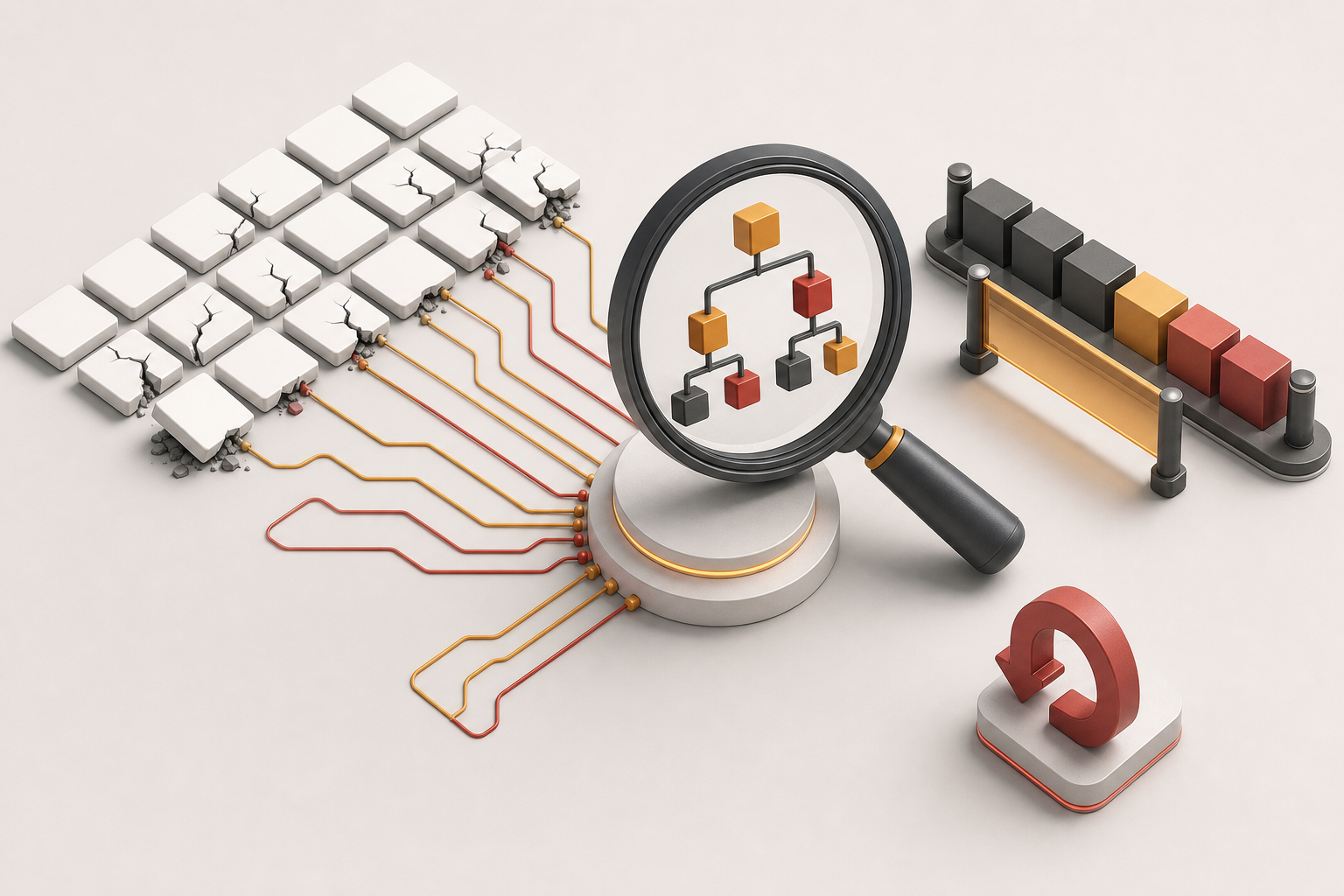
Many teams already have high automation coverage and low confidence. The usual cause is an unbalanced test portfolio: too many brittle end-to-end tests, too few contract tests, weak data strategy, and limited production observability. By 2030, sophisticated QA engineers will manage this portfolio the way security teams manage layered controls.
The following comparison shows how the future of testing will distribute confidence across layers rather than relying on one dominant approach.
| Evidence source | Best use in 2030 QA | Typical failure mode | QA engineer’s role |
|---|---|---|---|
| Unit and component tests | Fast feedback on logic, edge cases, and component behavior | High volume with weak business relevance | Review risk coverage and ensure critical rules are represented |
| API and contract tests | Protect service boundaries and integration assumptions | Contracts drift from real consumer behavior | Align contracts with production usage and consumer expectations |
| End-to-end tests | Validate critical user journeys across systems | Brittleness, slow pipelines, and false failures | Keep suites small, stable, and business-critical |
| Exploratory sessions | Find unknown risks, usability gaps, and ambiguous behavior | Unstructured notes that do not influence decisions | Run chartered sessions tied to explicit risk hypotheses |
| Production telemetry | Detect real-world failures, latency, adoption, and regressions | Dashboards without actionable thresholds | Define release health signals and escalation criteria |
| AI-generated test analysis | Suggest scenarios, gaps, and maintenance updates | Convincing but shallow or incorrect outputs | Validate, constrain, and continuously evaluate model usefulness |
A mature QA strategy in 2030 will look less like a pyramid poster and more like an evidence map. The map will show what each layer proves, what it cannot prove, who owns it, and what decision it informs. This is especially important for distributed systems where a passing test suite may say little about queue backlogs, third-party degradation, or data freshness.
Quality engineering practices will move deeper into pipelines and production
Quality engineering practices will move deeper into CI/CD pipelines, runtime monitoring, and release controls. Quality engineering is the discipline of building quality into software delivery systems rather than inspecting quality only after development.
Shift-left is the practice of moving quality activities earlier in the software lifecycle. Shift-right is the practice of validating software in production or production-like conditions after deployment. The QA engineer of 2030 will need both because early prevention and real-world detection solve different classes of problems.
Pipeline-native QA will include static analysis, dependency checks, contract verification, accessibility scans, performance smoke tests, and environment readiness checks. It will also include intelligent test selection that uses code changes, risk tags, and historical failures to decide what runs when. Teams adopting risk-based test selection often reduce pipeline validation time by 25% to 45% without increasing escaped defect rates when they maintain clear fallback rules.
TestOps is the operational management of test environments, test data, automation infrastructure, and feedback reliability. As systems become more distributed, TestOps will matter because slow, flaky, or unavailable test infrastructure can become the main blocker to release flow. Future QA leaders will treat test reliability as an engineering product with service-level objectives.
When should QA own production signals?
QA should own production signals when those signals directly measure release quality, user journey health, or regression risk. Ownership does not mean replacing SRE or product analytics; it means defining which signals prove that a release is behaving acceptably.
Synthetic monitoring is the automated execution of scripted user journeys against live or production-like environments to verify availability and behavior. For QA, synthetic journeys are useful when they mirror revenue-critical or trust-critical paths such as login, checkout, document upload, appointment booking, or role-based approval.
Observability is the ability to understand system behavior from outputs such as logs, metrics, traces, events, and user analytics. A QA engineer who can read traces and correlate them with test failures will resolve ambiguity faster than one who only attaches screenshots. This skill will become a differentiator as architectures depend on asynchronous workflows, event streams, and third-party APIs.
quality_gates:
  pull_request:
    required:
      - unit_tests
      - changed_area_contract_tests
      - accessibility_static_scan
    risk_based_selection:
      enabled: true
      include_when:
        - files_changed: "payments/**"
          run: ["payment_api_contracts", "checkout_e2e_smoke"]
        - files_changed: "auth/**"
          run: ["login_synthetic_journey", "session_security_checks"]
  pre_production:
    required:
      - critical_e2e_smoke
      - performance_budget_check
      - database_migration_dry_run
  production_canary:
    monitor_for_minutes: 30
    rollback_when:
      error_rate_percent: 1.0
      p95_latency_ms: 850
      checkout_completion_drop_percent: 5
This type of configuration illustrates the direction of future QA work. The value is not the YAML itself; the value is the risk model encoded into the delivery system. QA engineers will increasingly translate quality judgment into executable policy.
What teams commonly get wrong about the future of QA
Teams commonly get the future of QA wrong by assuming that tools will replace judgment or that AI will make quality ownership optional. The strongest organizations will use automation and AI to amplify expert reasoning, not to remove accountability.
The first mistake is equating more generated tests with better coverage. AI can create hundreds of cases from a requirement, but many will be duplicates, low-risk variations, or assertions without reliable oracles. Without ruthless curation, AI expands the maintenance surface faster than it expands confidence.
The second mistake is turning QA into pipeline janitors. If quality engineers spend most of their time rerunning flaky jobs, refreshing environments, and arguing about false negatives, the organization has automated waste. Flakiness above 2% to 3% in critical pipelines can erode trust quickly because engineers start ignoring failures or bypassing gates.
The third mistake is removing human exploration too aggressively. AI is effective at pattern generation, but it is weaker at recognizing product awkwardness, emotional friction, and domain-specific consequences. Teams that cut exploratory capacity often see defect reports decline before customer complaints rise, which creates a dangerous illusion of improvement.
The fourth mistake is measuring QA with legacy activity metrics. A QA organization can look productive while slowing delivery or missing high-severity risks. Better metrics include escaped defect severity, mean time to detect release regressions, flaky test rate, critical journey coverage, change failure rate, and feedback cycle time.
Why does AI sometimes increase testing risk?
AI increases testing risk when teams accept generated artifacts without review, context, or measurable effectiveness. The risk is false confidence: a large set of plausible tests can make coverage look strong while important business rules remain unverified.
There are also privacy and compliance concerns. Feeding production data, customer records, or proprietary requirements into unapproved AI tools can create governance exposure. Future QA leaders will need model usage policies, redaction workflows, review trails, and clear boundaries for sensitive domains.
AI can also normalize mediocre assertions. For example, a generated UI test may verify that a button is visible but not that the authorization logic, pricing calculation, or audit trail is correct. The QA engineer’s leverage is in forcing tests to connect to meaningful risks.
Software testing careers will split into sharper specialist and leadership tracks
Software testing careers will split into sharper specialist and leadership tracks as quality work becomes more technical and more strategic. The generalist tester will still exist, but the market will reward clear depth in areas that reduce business risk.
One track will be the quality engineer focused on automation architecture, test data, CI/CD reliability, and developer enablement. This role will pair closely with platform engineering and may own shared testing libraries, contract testing frameworks, and pipeline quality gates.
A second track will be the domain risk specialist. This person may work in fintech, medical software, retail operations, AI products, or enterprise workflow systems where correctness depends on nuanced business rules. Their differentiator will be the ability to uncover expensive failure modes that generic automation misses.
A third track will be the production quality analyst. This role will blend observability, incident analysis, experimentation, and customer signal interpretation. It will be especially valuable in SaaS products where releases are frequent and user behavior provides immediate feedback.
A fourth track will be quality leadership. Future QA leaders will design operating models, define release risk policy, coach teams on evidence quality, and negotiate trade-offs with product and engineering executives. The best leaders will speak in terms of risk appetite, customer impact, and engineering flow rather than test counts.
How should QA professionals prepare now for 2030 roles?
QA professionals should prepare by building a portfolio of skills that proves they can improve feedback quality, not just execute tests. The fastest path is to combine one technical depth area with one business-domain depth area.
A practical development plan might include API testing, SQL, JavaScript or Python automation, observability basics, accessibility standards, and AI-assisted test design. It should also include sharper communication: risk briefings, release recommendations, defect narratives, and post-incident analysis. In hiring conversations, examples of changed outcomes will matter more than tool lists.
QA professionals should also practice deleting tests. Removing low-value checks is a senior skill because it requires confidence, evidence, and stakeholder alignment. By 2030, lean, trustworthy suites will be more respected than bloated repositories with impressive counts.
The QA team structure of 2030 will be embedded, federated, and metric-driven
The QA team structure of 2030 will be embedded in product teams, federated through shared standards, and measured by quality outcomes. Federated QA is an operating model where quality specialists sit close to delivery teams while a central group maintains practices, platforms, and governance.
Pure centralization often creates bottlenecks because QA becomes a service queue. Pure embedding can create fragmentation because each team invents its own tools, naming conventions, environments, and thresholds. A federated model gives teams local context while preserving common quality language.
In this model, a quality enablement group may maintain automation frameworks, observability templates, test data services, accessibility tooling, and AI usage guardrails. Embedded QA engineers adapt those assets to product risks and coach developers on testability. Product managers contribute by defining risk tolerance and customer impact, not by throwing vague acceptance criteria over the wall.
Metrics will also become more balanced. High-performing teams will monitor leading indicators such as pull request feedback time, flaky test rate, critical path coverage, and unresolved risk age. They will pair those with lagging indicators such as escaped defect severity, incident frequency, support ticket trends, and customer journey abandonment.
The cultural change is significant. QA will not be the department that says no at the end. QA will be the discipline that helps the organization know what it is accepting when it says yes.
The human advantage in QA will be judgment under uncertainty
The human advantage in QA will be judgment under uncertainty, especially when requirements are incomplete, systems are complex, and business consequences are uneven. Judgment is the ability to make a reasoned quality decision when evidence is partial and time is constrained.
AI can accelerate discovery, but it does not own consequences. A model does not decide whether a payroll defect is acceptable on a Friday afternoon, whether an accessibility failure blocks launch, or whether a canary anomaly is serious enough to roll back. Those decisions require accountability, context, and ethical reasoning.
The QA engineer of 2030 will be credible because they can explain uncertainty clearly. They will say which risks are covered, which are untested, which signals are noisy, and what mitigation exists if the release proceeds. This is a higher-value conversation than declaring that testing is complete.
The future of QA belongs to professionals who can turn ambiguity into decision-quality evidence. That is not a smaller role than today’s tester; it is a broader and more demanding one. The title may remain familiar, but the work will be fundamentally different.
Key Takeaways
- The QA engineer of 2030 will focus on release confidence, product risk, and system evidence rather than manual execution volume.
- AI-assisted testing will increase QA leverage, but only when humans supervise prompts, assertions, coverage quality, and governance.
- Future software testing careers will reward code literacy, observability skills, domain expertise, and the ability to communicate risk clearly.
- Automation coverage is not quality coverage; mature teams will balance unit, contract, end-to-end, exploratory, telemetry, and AI-generated evidence.
- Shift-left and shift-right practices will converge as QA engineers encode risk models into pipelines and validate real production behavior.
- Teams that replace judgment with generated tests risk false confidence, flaky pipelines, privacy exposure, and weaker customer outcomes.
- The strongest QA organizations will be embedded, federated, and measured by feedback speed, release health, and escaped risk severity.