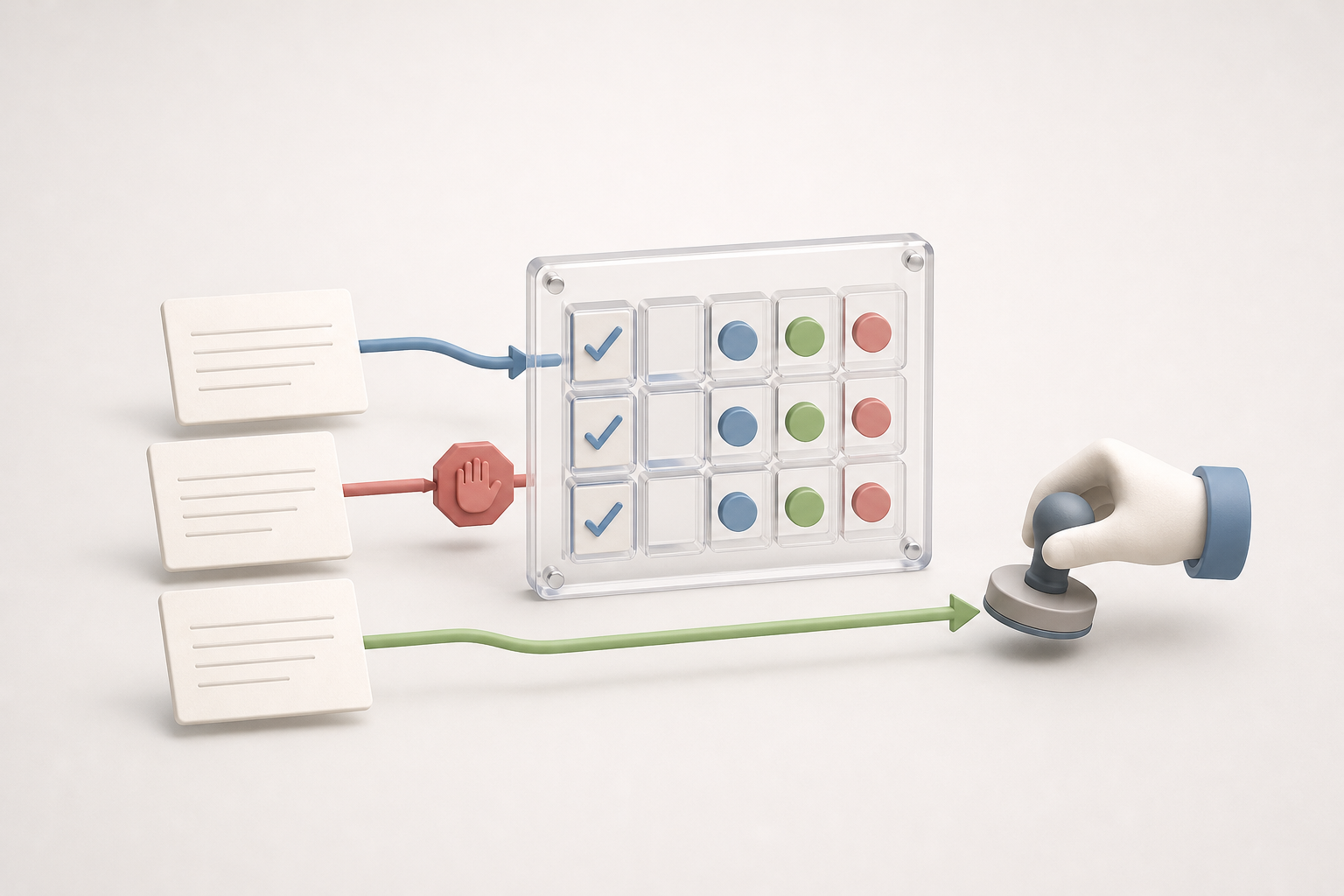
LLM evaluation prompts are prompts written to judge AI outputs, not to generate them. For QA teams, that distinction matters: an evaluator prompt is a measurement instrument, so it needs clear criteria, consistent scoring, edge-case handling, and a review path when the model cannot judge safely.
Better evaluator prompts use a structured rubric, explicit pass and fail conditions, calibrated examples, and a required output schema. They should separate observation from judgment, handle ambiguity with an “insufficient evidence” option, and route uncertain cases to human review. Treat them like test assets: version them, sample their failures, and recalibrate them when the product or policy changes.
Why Evaluator Prompts Need More Structure Than Ordinary Prompts
A generation prompt asks a model to create something. An evaluator prompt asks a model to make a quality decision about something already created. That makes the evaluator prompt closer to a test oracle: it decides whether an output satisfies a requirement, violates a policy, or ranks above another candidate.
Informal prompts such as “Is this answer good?” are too vague for repeatable QA evaluation. Different runs may emphasize different qualities, such as helpfulness, tone, completeness, safety, or formatting. The result can look authoritative while hiding inconsistent criteria.
The NIST TEVV-Athlon framework emphasizes structured, adaptable evaluation for AI systems. That is a useful mindset for prompt-based evaluation: the prompt should define what is being measured, under what conditions, and how results should be interpreted. A later NIST report on expanding the AI evaluation toolbox also highlights the need to account for uncertainty in benchmark evaluation, which is directly relevant when using an LLM as a judge.
In practice, prompt scaffolding gives the evaluator boundaries. It tells the model which role to play, what inputs to inspect, which criteria to apply, how to score, and when not to decide. Without that scaffold, the evaluator may reward eloquence over correctness or penalize harmless style differences as if they were defects.
Build a Rubric Before You Write the Prompt
A rubric prompt is only as good as the evaluation criteria behind it. Before writing the evaluator prompt, define the dimensions that matter for the product. Common dimensions include factual accuracy, requirement coverage, instruction following, risk handling, tone, localization, citation quality, and format compliance.
Each dimension should have observable evidence. For example, “professional tone” is weaker than “does not insult the user, does not use sarcasm, and keeps the response suitable for a business support context.” “Complete answer” is weaker than “answers all three requested sub-questions and includes the required next step.”
| Rubric element | Weak version | Stronger version |
|---|---|---|
| Criterion | Answer is useful | Answer directly resolves the user’s stated task or gives a clear next action if resolution is impossible |
| Score levels | Rate from 1 to 5 | 0 = absent, 1 = partially met with material gaps, 2 = fully met with no material gaps |
| Failure rule | Flag bad answers | Fail if the response contradicts the provided source, invents unavailable data, or ignores a safety constraint |
| Uncertainty rule | Use your judgment | Return “needs_human_review” if the evidence is missing, conflicting, or domain expertise is required |
For teams already using AI to create test cases, evaluator prompts require a different discipline from generation prompts. Test-generation prompts can be exploratory and creative; evaluation prompts should be constrained and auditable. If your team is still separating these workflows, SQAExperts has a related guide on AI prompt engineering for test case generation, which complements but should not replace evaluator design.
A Practical Evaluator Prompt Template
A strong evaluator prompt usually has six parts: role, task, input boundaries, rubric, decision rules, and output schema. The schema is important because it turns a free-form critique into machine-readable QA evidence that can be logged, compared, or routed for review.
You are an evaluator for customer-support AI responses.
Your task is to judge whether the candidate answer satisfies the user request and the policy excerpt.

Inputs:
- User request: <USER_REQUEST>
- Candidate answer: <CANDIDATE_ANSWER>
- Policy excerpt: <POLICY_EXCERPT>

Evaluate only the candidate answer. Do not add new advice for the user.
Use the rubric below.

Rubric:
1. Requirement coverage
   - 0: misses the user's main request
   - 1: addresses the main request but omits an important constraint or step
   - 2: fully addresses the request and all stated constraints
2. Policy compliance
   - 0: contradicts or bypasses the policy excerpt
   - 1: mostly follows policy but includes ambiguous or unsupported wording
   - 2: fully follows the policy excerpt
3. Clarity and tone
   - 0: confusing, rude, or unsuitable for support
   - 1: understandable but could be clearer or more concise
   - 2: clear, respectful, and suitable for support

Decision rules:
- Overall fail if any dimension scores 0.
- Return needs_human_review if the policy excerpt does not contain enough evidence to judge.
- Do not reward confident wording unless it is supported by the inputs.

Return valid JSON only:
{
  "requirement_coverage": 0,
  "policy_compliance": 0,
  "clarity_and_tone": 0,
  "overall_decision": "pass | fail | needs_human_review",
  "evidence": ["short quote or observation from candidate answer"],
  "reason": "one concise explanation"
}
This template intentionally prevents two common evaluator failures. First, it tells the judge not to solve the user’s problem again; it must inspect the candidate answer. Second, it gives the model a valid escape hatch when the evidence is insufficient. Forced binary pass/fail decisions can create false certainty.
How Should You Score LLM Outputs Consistently?
Consistent scoring starts with clear levels. Avoid open-ended numbers unless every point has a meaning. A 1-to-10 scale feels precise, but if the evaluator cannot distinguish a 6 from a 7 using written rules, the scale adds noise rather than insight.
For many QA evaluation tasks, three levels per dimension are enough: absent, partial, and complete. More mature teams may add weighted dimensions, but weights should reflect product risk. A medical advice assistant, a travel chatbot, and an internal code summarizer should not use the same scoring priorities.
Evaluator prompts should also separate dimension scores from the final decision. An answer might be clear and polite yet still fail because it violates a policy. Conversely, a slightly awkward answer may pass if it is accurate, safe, and complete enough for the intended use.
When scoring is used in dashboards or release gates, keep the evaluator’s raw evidence. Store the candidate answer, input context, rubric version, score, decision, and rationale. That audit trail helps diagnose whether a failure is caused by the application model, the evaluator prompt, unclear product requirements, or a changing policy.
Comparison and Ranking Prompts Need Extra Guardrails
Comparison prompts ask the evaluator to choose between two or more model outputs. They are useful when testing prompt variants, model versions, retrieval strategies, or response styles. However, ranking prompts can become biased by position, verbosity, or superficial polish.
Use anonymized candidates where possible, randomize order during evaluation, and require the evaluator to cite rubric-based reasons. Do not ask only “Which is better?” Ask which candidate better satisfies a defined purpose.
| Evaluation approach | Best use | Main risk | Prompt guardrail |
|---|---|---|---|
| Single-output scoring | Regression checks and pass/fail gates | Overconfidence on ambiguous cases | Add “needs_human_review” and evidence requirements |
| Pairwise comparison | Choosing between two prompt or model variants | Position and style bias | Randomize order and require rubric-based justification |
| Ranked list | Sorting several candidates for review | Weak separation between middle-ranked items | Ask for tied ranks when differences are not material |
| Checklist validation | Format, policy, and requirement compliance | Missing semantic quality issues | Combine checklist items with at least one qualitative criterion |
What Should a Pairwise Evaluator Prompt Include?
A pairwise evaluator prompt should include the same rubric used for single-output scoring, plus a comparison rule. For example, “Choose Candidate A only if it materially satisfies the rubric better than Candidate B; otherwise return tie.” This prevents the evaluator from inventing tiny distinctions just because it is asked to pick a winner.
It should also require independent notes before final selection. Ask the judge to evaluate each candidate against the rubric, then compare. If you only ask for the final winner, you lose the evidence needed to diagnose why one candidate won.
Handle Ambiguity and Nondeterminism Explicitly
LLM-based judges are nondeterministic unless your platform and settings make generation fully reproducible, and even then changes in model versions or context can shift outputs. QA teams should treat evaluator prompts as probabilistic aids, not infallible authorities.
Ambiguity appears in several forms: missing source material, vague user intent, conflicting requirements, domain-specific claims, and borderline policy cases. The evaluator prompt should identify these cases rather than smoothing them over.
- Add an uncertainty outcome: Use “needs_human_review,” “insufficient_evidence,” or a similar status instead of forcing a pass/fail judgment.
- Require input-grounded evidence: Ask the evaluator to quote or summarize the exact part of the candidate answer that supports the decision.
- Separate policy from preference: Make clear which issues are release blockers and which are style improvements.
- Sample repeated judgments: For high-risk gates, run periodic spot checks or multiple judgments to see where the evaluator is unstable.
Security-related evaluations need even more care because adversarial content can manipulate the judge itself. If your evaluator inspects malicious prompts or jailbreak attempts, pair it with controls from LLM security testing for prompt injection and jailbreak vulnerabilities, including clear separation between content being evaluated and instructions the evaluator must follow.
When Should the Evaluator Refuse to Decide?
The evaluator should refuse to decide when the available inputs do not contain enough evidence for the rubric. For example, it should not judge factual accuracy if no source text, expected answer, or domain reference is provided. It should also defer when the candidate answer contains specialized legal, medical, financial, or safety-critical claims outside the evaluator’s defined scope.
Refusal is not a failure of the evaluation system. It is a quality control mechanism. A reliable evaluator prompt knows when the task has exceeded the prompt’s evidence, domain, or policy boundaries.
Calibrate With Examples, Gold Sets, and Disagreement Review
Calibration turns a rubric from an intention into a working measurement tool. Start with a small gold set: examples where humans have already agreed on the expected score and decision. Include easy passes, obvious failures, edge cases, and cases where human review is the correct outcome.
Use examples inside or alongside the evaluator prompt when they clarify borderline distinctions. However, do not overload the prompt with dozens of examples if they distract from the rubric or exceed context limits. For repeatable automated evaluation, keep a separate versioned gold set and run it whenever the evaluator prompt changes.
Disagreement review is especially valuable. If the evaluator repeatedly disagrees with expert reviewers on the same kind of case, the issue may be an unclear rubric, missing evidence, or a prompt that overweights surface-level fluency. Update the rubric first, then the prompt. Do not patch the prompt with exceptions until the underlying criterion is clear.
Human Oversight and Review Workflow
LLM evaluation prompts work best as part of a review workflow, not as the entire workflow. The evaluator can triage large volumes of outputs, highlight likely defects, and provide structured evidence. Human reviewers should own final decisions for high-impact changes, policy updates, and uncertain categories.
A practical workflow looks like this: define the rubric, create a gold set, write the evaluator prompt, run calibration, review disagreements, set routing rules, and monitor drift. Drift can occur when the application prompt changes, the model changes, the retrieval corpus changes, or product policy changes.
For release gates, avoid relying on one aggregate score without inspecting failure distribution. A model can improve average clarity while introducing a small number of severe policy failures. QA evaluation should preserve both quantitative signals and defect examples so leads can make risk-aware decisions.
How Do You Know an Evaluator Prompt Is Ready?
An evaluator prompt is ready for limited use when it matches human judgment on representative gold-set examples often enough for its intended risk level, and when its disagreements are understood. It should produce valid structured output, use the rubric rather than personal preference, and route ambiguous cases to review.
It is not ready if it frequently changes its decision without a meaningful input difference, fails to follow the output schema, rewards unsupported claims, or cannot explain decisions using evidence from the candidate answer. Those are signs that the rubric, examples, or task boundaries need more work.
Common Pitfalls in LLM Evaluation Prompts
The first pitfall is using the same prompt to generate and judge. That creates conflicting objectives: the model is both creator and critic. Keep generation prompts, evaluator prompts, and remediation prompts separate so their behavior can be assessed independently.
The second pitfall is hiding requirements in prose. If a requirement matters, put it in the rubric or decision rules. Evaluators are more consistent when constraints are explicit and repeated in the structure they must apply.
The third pitfall is treating evaluator scores as absolute truth. LLM judges can be helpful, but they are still model outputs. Use them to increase review coverage, accelerate triage, and surface patterns; do not use them to bypass accountability for high-risk quality decisions.
The fourth pitfall is failing to version evaluation assets. The evaluator prompt, rubric, model version, application prompt, and gold set should be traceable. Without versioning, a score trend may reflect a changed judge rather than a changed product.
Key Takeaways
- LLM evaluation prompts should be designed as QA measurement instruments, not casual requests for opinions.
- A strong rubric defines observable criteria, score levels, failure rules, and an explicit uncertainty outcome.
- Structured output schemas make evaluator decisions easier to log, compare, review, and debug.
- Comparison prompts need guardrails against position bias, verbosity bias, and forced false distinctions.
- Gold sets and disagreement review are essential for calibrating evaluator prompts before release use.
- Human oversight remains necessary for ambiguous, high-risk, policy-sensitive, or domain-expert decisions.
- Version evaluator prompts, rubrics, examples, and model settings so score changes remain interpretable.