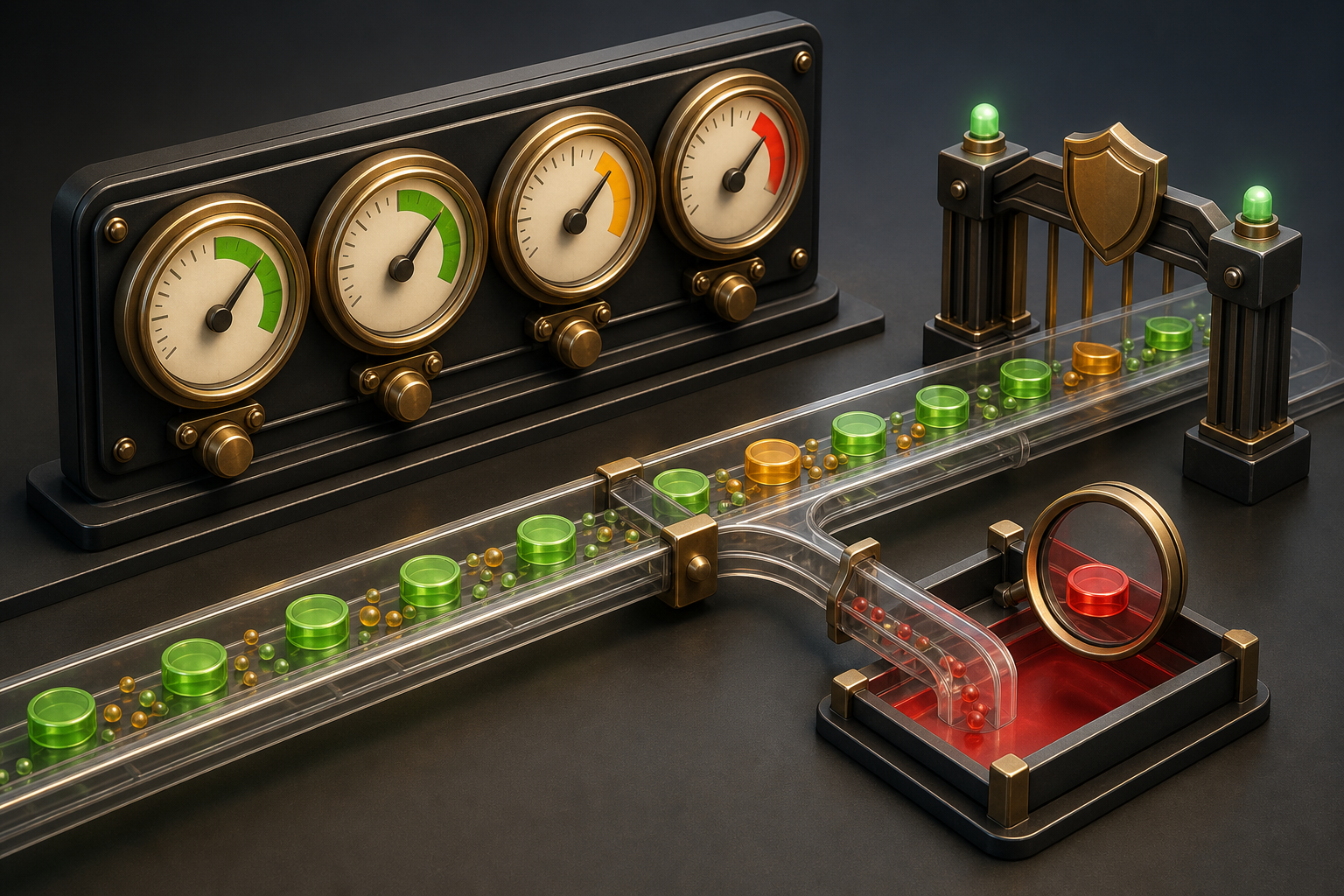
AI-augmented QA metrics should tell leaders whether the team made better quality decisions, not merely whether an AI assistant generated more tests, summaries, or defect hypotheses. When humans and AI share test design, execution, triage, and maintenance, the measurement system must separate useful quality signals from attractive activity counts.
Measure AI-augmented testing by tracking human review quality, defect containment, traceability, model-induced risk, and release decision accuracy. Output volume, such as generated test cases or automated runs, is useful context but should not be treated as proof of quality. The strongest dashboard shows where AI suggestions were accepted, changed, rejected, or missed by human reviewers.
Why Traditional QA Metrics Break When AI Joins the Workflow
Traditional quality engineering metrics often assume that work products are created by people or deterministic automation. AI assistants change that assumption. A team can now produce a large number of test ideas, synthetic data sets, bug summaries, and automation drafts in minutes, but many of those artifacts may be redundant, shallow, unreviewed, or misaligned with product risk.
This is why activity metrics become dangerous when they are promoted to quality metrics. Test count, automated execution count, prompt count, generated bug reports, and pass rate can all increase while real defect detection stays flat or while release risk rises. In an AI-augmented team, a metric is more valuable when it explains judgment: what humans reviewed, what they changed, what they challenged, and how those decisions affected customer-facing quality.
NIST’s announcement of its Artificial Intelligence Technology Evaluation program emphasizes evaluation in controlled environments, a useful framing for QA leaders because AI capability should be assessed through repeatable evidence rather than enthusiasm or output volume. That does not mean every software team needs a laboratory program, but it does mean QA metrics should make assumptions, review steps, and evidence visible. See NIST’s description of Artificial Intelligence Technology Evaluation for the broader evaluation principle.
If your organization already tracks conventional indicators, keep them, but reclassify them. A foundational set of QA metrics every tester should track can still help with defect trends and execution health. The difference is that AI-assisted work needs an additional layer showing whether those metrics came from thoughtful risk analysis or from unchecked machine output.
Separate Output Volume From Quality Signal
The first governance rule is simple: output is not outcome. Generated test cases are not the same as useful test coverage. Automated run volume is not the same as risk reduction. A polished AI triage summary is not the same as a verified reproduction path.
| Metric type | What it measures | AI-augmented risk if used alone | Better use |
|---|---|---|---|
| Output volume | Generated tests, scripts, summaries, prompts, or runs | Rewards production of artifacts whether or not they reduce risk | Use as capacity context, not as a quality score |
| Review quality | How often humans improve, reject, or validate AI suggestions | Can be hidden if dashboards only show final artifacts | Track acceptance with modification, rejection reasons, and review defects found |
| Effectiveness | Defects found, risk areas covered, escapes prevented, flaky tests removed | May be falsely attributed to AI without evidence | Connect findings to source, reviewer, risk area, and release decision |
| Governance | Traceability, auditability, policy compliance, ownership | Can become paperwork if not linked to release risk | Use to prove who approved critical AI-assisted artifacts and why |
A practical dashboard should display output volume beside effectiveness, not above it. For example, “120 generated test scenarios” is weak on its own. “120 generated scenarios, 38 retained after human review, 12 mapped to high-risk payment rules, 4 exposed defects, and 9 removed as duplicates” is a quality signal because it shows judgment, filtering, and impact.
Which metrics show human judgment rather than AI volume?
Start with review disposition. Every AI-assisted artifact that influences a release should have one of four outcomes: accepted unchanged, accepted with modification, rejected, or escalated for expert review. The goal is not to maximize acceptance. A mature team may reject many AI suggestions because reviewers understand the domain better than the model.
Track modification rate with context. If reviewers frequently edit AI-generated tests to add missing boundary values, accessibility checks, regulatory constraints, or concurrency conditions, that is evidence of human expertise. If reviewers accept everything unchanged, it may indicate a high-quality prompt and stable domain, but it may also indicate rubber-stamping.
Useful human-judgment metrics include reviewer challenge rate, duplicate removal rate, domain correction count, missing-risk additions, and review defects found before execution. These are not vanity metrics; they explain how human-in-the-loop QA improved the artifact before it affected release decisions.
False Confidence Is the Core Failure Mode
False confidence is the belief that an artifact is correct because it is fluent, complete-looking, or machine-generated. In AI-assisted testing, false confidence can appear in generated regression suites, impact analyses, bug summaries, acceptance criteria, and root-cause suggestions.
NIST’s AI technology program information highlights evaluation roles and adversarial testing structures, which map well to QA practice: someone should be responsible for challenging the AI-supported result, not just consuming it. The broader NIST AI technologies projects and programs page is a useful reference point for thinking about structured evaluation roles rather than ad hoc trust.
How do you detect false confidence before release?
Use metrics that look for confidence without evidence. Examples include high AI acceptance with low reviewer modification, high pass rates with low risk coverage, and AI-generated triage notes with no reproduction confirmation. None of these proves a problem by itself, but each should trigger review when it appears in a critical area.
Another useful signal is disagreement density: the rate at which human reviewers, domain experts, or production evidence contradict AI-generated assumptions. A sudden drop in disagreement may be good, but it may also mean reviewers stopped challenging outputs. Leaders should review sample artifacts, not just trend lines.
False-confidence indicators are especially important for teams that use AI to summarize incidents or turn messy reports into cleaner triage evidence. For teams refining that workflow, prompt engineering for test incident triage should still include human verification of reproduction steps, affected versions, and customer impact.
Measure Escapes, Containment, and Model-Induced Risk
Defect escape metrics remain essential, but AI changes the questions QA leaders should ask after an escape. Did AI generate a misleading test? Did a reviewer accept a shallow scenario? Did the model omit a risk area that humans also missed? Did automated maintenance remove an important assertion? These questions turn an escape from a blame exercise into a learning signal.
Defect containment should be measured across stages. A strong AI-augmented process catches weak AI suggestions during review, catches implementation defects during execution, and catches ambiguous requirements during collaborative analysis. If defects are only found late, the team may be using AI to accelerate downstream execution without strengthening upstream thinking.
Model-induced risk is any release risk introduced or amplified by AI assistance. It includes hallucinated requirements, incorrect test data assumptions, overfitted generated tests, brittle locators, misleading summaries, or unverified impact analysis. A NIST publication available as a publication PDF supports the broader principle that AI-generated artifacts should be validated rather than trusted blindly.
When should a metric trigger governance review?
A governance review should happen when an AI-assisted artifact influences a high-risk release decision and the evidence trail is weak. Triggers can include critical tests generated without reviewer notes, high-severity defects triaged without reproduction evidence, broad code-impact claims without traceability, or repeated escapes in areas where AI-generated coverage was reported as strong.
The trigger does not need to stop the release automatically. Instead, it should force a decision record: who reviewed the artifact, what evidence supported it, what uncertainty remained, and why the team accepted the risk. This is the difference between bureaucracy and QA governance.
Auditability and Traceability Metrics That Actually Help
Auditability means the team can reconstruct how a quality decision was made. Traceability means artifacts are connected across requirements, risks, tests, defects, reviews, and release decisions. In AI-augmented QA, these are not only compliance concerns; they are how teams learn whether AI assistance improved or degraded quality.
Track the percentage of critical AI-assisted artifacts with a named human owner, linked source context, review outcome, and release decision reference. Avoid treating this as a documentation quota. The real question is whether a future reviewer can understand why the team trusted a result.
For release operations, connect AI-augmented QA metrics with deployment telemetry and production signals. Teams that already use delivery metrics can combine them with test telemetry and release risk indicators to see whether AI-assisted changes correlate with safer or riskier release patterns.
A Practical Dashboard for AI-Augmented Quality Engineering
A useful dashboard should be small enough for weekly review and specific enough to drive action. It should not be a leaderboard for who generated the most artifacts. It should show where AI helped, where humans corrected it, and where quality outcomes changed.
ai_augmented_quality_dashboard:
  review_quality:
    ai_artifacts_reviewed: count
    accepted_unchanged: percent
    accepted_with_human_changes: percent
    rejected_or_escalated: percent
    common_correction_reasons:
      - missing_boundary_case
      - duplicate_scenario
      - unsupported_requirement
      - weak_oracle
  test_effectiveness:
    defects_found_by_ai_assisted_tests: count
    high_risk_requirements_with_reviewed_coverage: percent
    flaky_ai_generated_tests_removed: count
    escaped_defects_in_ai_covered_areas: count
  governance:
    critical_artifacts_with_named_owner: percent
    triage_summaries_with_repro_evidence: percent
    release_decisions_with_ai_usage_notes: percent
  false_confidence_watchlist:
    high_acceptance_low_modification: review_required
    high_pass_rate_low_risk_mapping: review_required
    broad_impact_claim_without_traceability: review_required
This example is not a universal standard. It is a starting point for discussion between QA managers, engineering leaders, product owners, and compliance stakeholders. Each metric should have an owner, an interpretation rule, and an action. If no one knows what decision a metric supports, remove it or redesign it.
Common Pitfalls When Measuring AI-Augmented QA
The first pitfall is rewarding speed without measuring rework. AI may help create tests quickly, but if those tests require heavy cleanup, introduce flakiness, or distract reviewers from higher-risk areas, the apparent productivity gain is misleading.
The second pitfall is hiding human expertise. If dashboards only show AI-generated outputs, they erase the reviewer who identified missing risk, challenged an assumption, or refined an oracle. Strong metrics make that judgment visible without turning people into surveillance targets.
The third pitfall is treating AI as a separate quality lane. AI-assisted work should flow through the same release governance as other work, with added traceability where uncertainty is higher. A separate AI dashboard that is disconnected from defects, release outcomes, and customer impact will quickly become noise.
The fourth pitfall is using metrics to prove that AI is good or bad. The better goal is operational: understand where AI improves coverage, where it needs human correction, and where it should not be trusted without expert review.
Key Takeaways
- AI-augmented QA metrics should measure judgment, evidence, and release impact, not just generated output.
- Output volume is useful context only when paired with review outcomes, risk coverage, and defect effectiveness.
- Human review disposition helps leaders see whether AI suggestions were accepted, changed, rejected, or escalated.
- False-confidence indicators are essential because polished AI artifacts can hide weak assumptions or missing evidence.
- Defect escapes should be analyzed for model-induced risk as well as ordinary process gaps.
- Auditability and traceability metrics help teams reconstruct why an AI-assisted quality decision was trusted.
- A practical dashboard should connect AI assistance to containment, release confidence, and continuous learning.