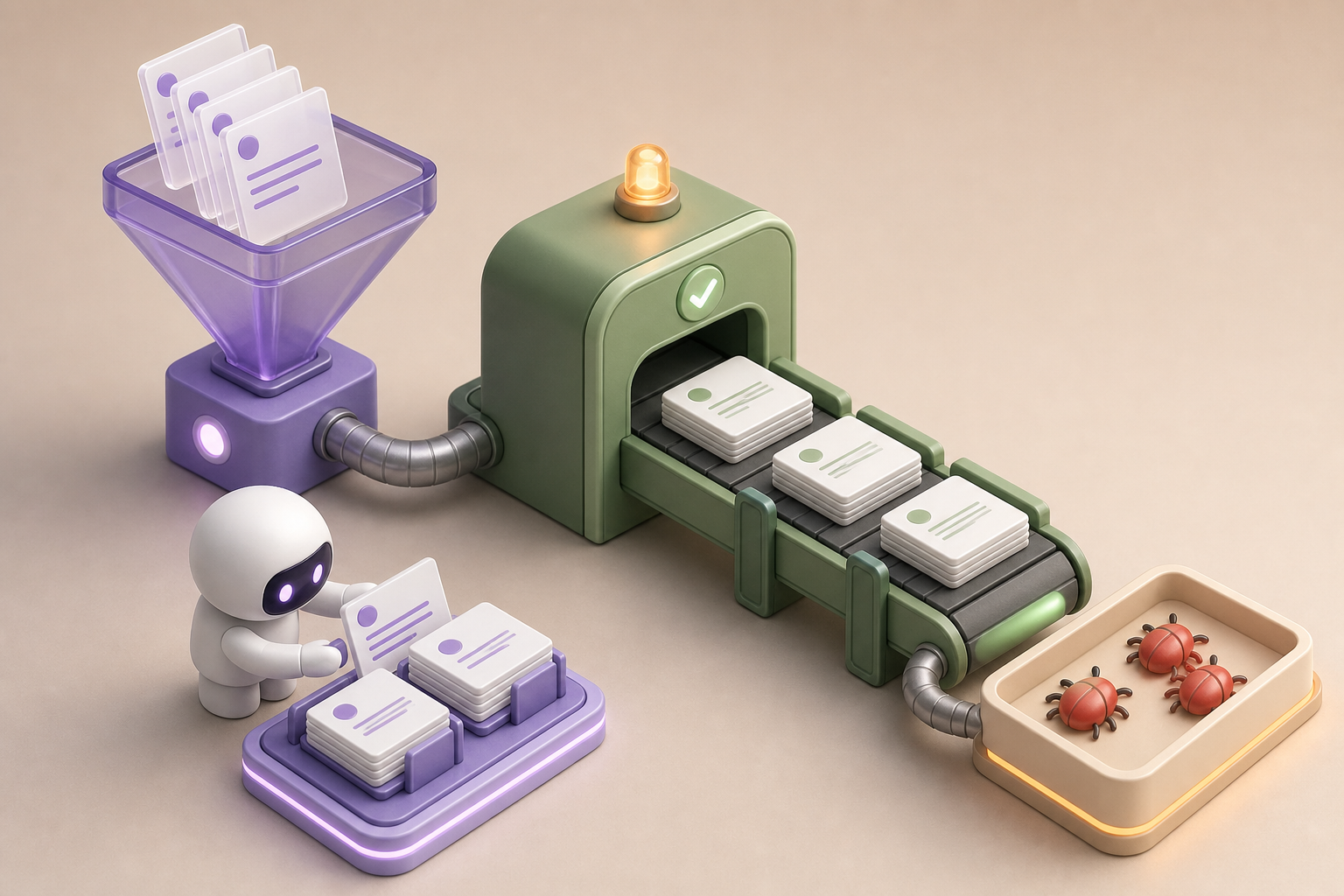
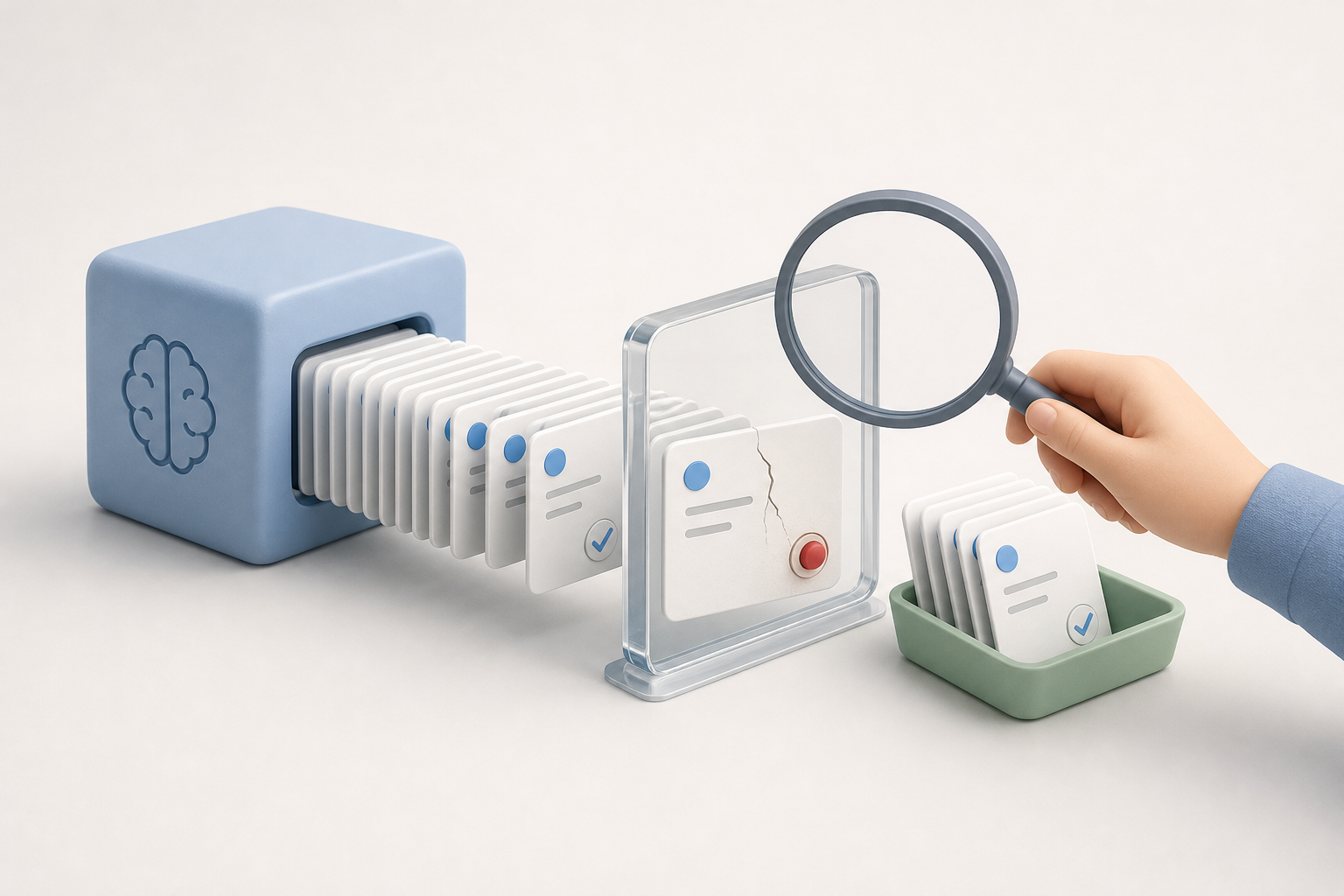
AI test generation can accelerate test creation, but the risky part is not usually whether the generated test looks professional. The risk is whether it exercises the right behavior, checks the right outcome and survives real execution conditions without hiding defects behind weak assertions or brittle setup.
AI-generated tests fail when they confuse syntax with intent: they may compile, follow framework conventions and appear comprehensive while checking the wrong behavior or no meaningful behavior at all. Teams catch these failures by executing every generated test, reviewing its oracle, validating data and environment assumptions, and measuring risk-based coverage instead of accepting line coverage as proof of quality.
Why Good-Looking AI Tests Still Fail
Large language models are strong pattern generators. They can infer naming conventions, imitate existing test style and produce plausible unit, API or UI automation quickly. That makes them useful assistants, but it also creates a credibility trap: reviewers see familiar structure and assume the test has tester-like intent.
The core issue is reliability. The SWE-Mutation paper on LLM-generated test suites frames this as a software engineering problem: generated suites must be evaluated for whether they detect meaningful defects, not merely whether they exist. A related concern appears in empirical work on ML-heavy systems, where testing practice must account for data, behavior and operational uncertainty, not just scripted execution.
For QA automation engineers and test architects, the useful question is not “Can AI write tests?” It can. The better question is “Which generated tests increase confidence, and which ones create false confidence?” That distinction determines whether AI improves the suite or quietly pollutes it.
Where AI Test Generation Tends to Hallucinate
In test generation, hallucination means the model invents assumptions that are not guaranteed by the application, the test framework or the product requirements. These hallucinations are often subtle because they look like ordinary test code.
- Invented APIs: The test calls a helper, endpoint, fixture or page object method that does not exist, or exists with different semantics.
- Imagined business rules: The assertion reflects what the model expects the feature to do, not what the product actually promises.
- Overconfident selectors: UI tests rely on text, DOM structure or generated IDs that change frequently.
- Convenient data assumptions: The test assumes a user, role, account balance, feature flag or locale is already available.
- Happy-path bias: The model writes tests for common paths but misses boundary conditions, authorization failures and state transitions.
A common example is an AI-generated API test that asserts a successful checkout returns status 200 and a non-empty order ID. That may look reasonable, but it does not prove pricing, tax, inventory reservation, fraud rules, currency handling or rollback behavior. The test confirms that a response existed, not that the business outcome was correct.
Coverage Illusions Versus Real Signal
Generated test suites often increase visible volume: more files, more scenarios, more assertions and sometimes more line coverage. Volume is not the same as signal. Signal means the test would fail for a defect that matters.
| Generated-test pattern | Why it looks useful | Hidden failure mode | Validation question |
|---|---|---|---|
| Snapshot of a rendered component | Captures many UI details quickly | Approves accidental structure while missing behavior | Which user decision or state change does this protect? |
| Status-code-only API test | Runs fast and appears stable | Passes despite incorrect payload, side effects or permissions | What incorrect implementation would this test catch? |
| Mock-heavy unit test | Isolated and deterministic | Recreates implementation details instead of validating behavior | Is the test checking a contract or mirroring code internals? |
| Broad happy-path E2E test | Demonstrates an end-to-end workflow | Fails intermittently or ignores edge cases where risk is higher | Is this the thinnest reliable path for this risk? |
This is where the test oracle problem becomes central. A test oracle is the mechanism that decides whether behavior is correct. In simple cases, the oracle is an assertion such as “the total equals 42.50.” In complex systems, the oracle may be a business rule, contract, property, approval workflow or comparison to a trusted source. AI can draft the assertion, but it cannot be assumed to know the correct oracle unless that oracle is explicit in the prompt, requirements or existing tests.
Execution Gaps That Break Generated Tests
A generated test must pass through the same execution gates as human-written automation. Many failures appear only after the test meets the real pipeline: databases, containers, credentials, clocks, queues, browsers, feature flags and CI timing.
What breaks first when AI-generated tests run in CI?
Environment assumptions usually break first. The model may write a test that depends on local ports, seeded data, browser state, default time zones or network access. In CI, these assumptions become missing fixtures, race conditions or failures that only reproduce under parallel execution.
Data is the next weak point. AI-generated tests often use simple literals such as a generic email, a fixed product ID or a hard-coded date. These values can collide with previous runs, expire, violate validation rules or behave differently across regions. Stable automated tests need explicit data ownership: create it, isolate it, clean it up or make it immutable.
Synchronization is another common gap. UI tests generated from examples may wait for visibility but not for the actual business condition, such as a background job completing or a cache invalidating. Distributed systems make this more pronounced; teams dealing with queues, retries and eventual consistency need resilient checks, as discussed in testing distributed systems.
Why do weak assertions pass even when the feature is wrong?
Weak assertions check symptoms rather than obligations. A test that asserts “success message is displayed” may pass even when the wrong account was updated. A test that asserts “array length is greater than zero” may pass when the array contains unauthorized or incorrectly sorted records.
Good assertions are specific enough to catch meaningful regression while avoiding brittle implementation details. They verify contracts, invariants and user-visible outcomes. For AI-generated tests, reviewers should ask whether each assertion would fail under at least one plausible bug. If the answer is unclear, the test probably needs a stronger oracle or should not be merged.
A Validation Checklist for AI-Generated Tests
Treat AI output as a draft, not as reviewed automation. The validation process should be lightweight enough to use regularly but strict enough to stop low-signal tests from entering the suite.
- Run the test before review: Do not review generated code that has never executed. Separate syntax errors from logic errors early.
- Map the test to a risk: Identify the requirement, defect class, contract or production failure the test is meant to guard against.
- Inspect the oracle: Confirm that assertions validate correctness, not just existence, status or visual presence.
- Check data control: Ensure the test creates, owns or safely references its required data.
- Remove invented assumptions: Verify APIs, helpers, selectors, fixtures, flags and permissions against the actual system.
- Prove failure sensitivity: Temporarily change the implementation, stub response or expected value to confirm the test can fail for the right reason.
- Classify suite placement: Decide whether the test belongs at unit, component, contract, API or end-to-end level.
- Tag generated origin: Track that AI assisted the draft so teams can audit patterns and improve prompts over time.
The “prove failure sensitivity” step is often the most revealing. If changing a critical business rule does not make the test fail, the generated test is decorative. Mutation testing, contract violations or controlled negative cases can expose this problem without waiting for a real bug.
Human Review Patterns That Catch Defects
Reviewing AI-generated tests requires a different stance from reviewing ordinary feature code. Instead of asking only “Is this code clean?” reviewers should ask “Does this test deserve to exist?” The best reviewers combine domain knowledge, automation design and skepticism about plausible-looking output.
What should reviewers look for beyond syntax?
Reviewers should look for a clear chain from risk to setup to action to oracle. If any link is vague, the test is not ready. The model may have produced a well-formatted test, but the reviewer must confirm that the scenario, data and expected result match product reality.
Useful review comments are specific. Instead of saying “make assertions stronger,” say “assert that the refund is linked to the original transaction and that inventory is not restocked for digital goods.” Specificity turns AI output into a focused test asset.
- Ask for the bug story: What defect would this test have caught in production?
- Look for copy-paste structure: Similar generated tests may repeat the same weak assertion across multiple scenarios.
- Challenge mocks: If every dependency is mocked, the test may only prove that the mock returns what the test configured.
- Prefer behavior language: Test names should describe user or system behavior, not just method calls.
- Watch for maintenance debt: Generated suites can expand faster than teams can debug them.
These patterns overlap with broader automation failure modes. If a suite already suffers from flaky infrastructure, unclear ownership or brittle selectors, generated tests can amplify those weaknesses. Teams can use the same maintenance lens described in why automation test suites fail, then add AI-specific controls for oracle quality and hallucinated assumptions.
A Practical Review Configuration Example
Teams do not need a large governance program to start. A simple repository rule can require generated tests to declare their risk, oracle and data strategy. The following example shows a lightweight metadata pattern that can be checked during code review or CI linting.
ai_generated_test_review:
  required_fields:
    - risk_covered
    - oracle_type
    - data_strategy
    - failure_sensitivity_checked
  accepted_oracle_types:
    - business_rule
    - api_contract
    - state_transition
    - invariant
    - accessibility_rule
  reject_if:
    assertion_only_checks:
      - status_code
      - element_exists
      - response_not_empty
    data_strategy:
      - shared_mutable_record
      - undocumented_seed_data
  reviewer_questions:
    - "What plausible defect makes this test fail?"
    - "Which requirement or contract defines the expected result?"
    - "Can this run safely in parallel CI?"
This kind of metadata should not become ceremony. Its purpose is to slow down the dangerous moment when a plausible generated test is merged because it looks familiar. The value is in the conversation it forces: intent, oracle, data and execution reliability.
Governance for Using AI in Test Creation
Engineering managers and test architects should define where AI is allowed to help and where human accountability remains mandatory. The policy does not need to ban generated tests. It should define acceptance criteria.
A useful governance model has four layers. First, establish approved use cases: drafting unit tests, generating edge-case ideas, converting manual scenarios into automation candidates or proposing negative cases. Second, require human review for risk interpretation and oracle approval. Third, track generated test outcomes, including flakiness, rejected reviews and defects caught. Fourth, improve prompts and templates based on what failed.
The article AI can write test cases, but can it think like a tester? explores the same boundary from the perspective of tester judgment. For generated automation, that boundary is concrete: AI can suggest, structure and accelerate, but testers still own risk selection and correctness criteria.
Governance also matters for security and privacy. Prompts should avoid leaking secrets, private customer data or proprietary code beyond approved environments. Generated tests should not introduce hidden dependencies on external services, unstable public data or credentials that are unavailable in CI.
When to Keep, Rewrite or Reject an AI-Generated Test
Not every weak generated test should be discarded. Some are useful drafts that need a better oracle or safer setup. Others are noise. A practical triage model keeps review efficient.
| Decision | Use when | Example action |
|---|---|---|
| Keep | The test maps to a real risk, executes reliably and has meaningful assertions | Merge after normal review and tag its origin if required |
| Rewrite | The scenario is valuable but setup, data or assertions are weak | Replace generic checks with contract or business-rule assertions |
| Move | The test is valid but sits at the wrong layer | Convert a slow UI path into an API or component test |
| Reject | The test has no clear risk, duplicates existing coverage or depends on false assumptions | Close the suggestion and record the pattern for prompt improvement |
The most mature teams will not measure AI test generation by how many tests it produces. They will measure it by how many reliable, maintainable, defect-sensitive checks survive review and continue to provide signal in CI.
Key Takeaways
- AI-generated tests can look credible while checking the wrong behavior or no meaningful behavior.
- The test oracle problem is the main quality risk: assertions must reflect real requirements, contracts or business rules.
- Line coverage and test count are weak evidence unless the suite can detect plausible defects.
- Execution validation must include environment, data ownership, synchronization and CI parallelism.
- Human review should focus on risk, oracle strength and failure sensitivity, not just code style.
- Governance should define approved AI use cases, review requirements and privacy boundaries.