
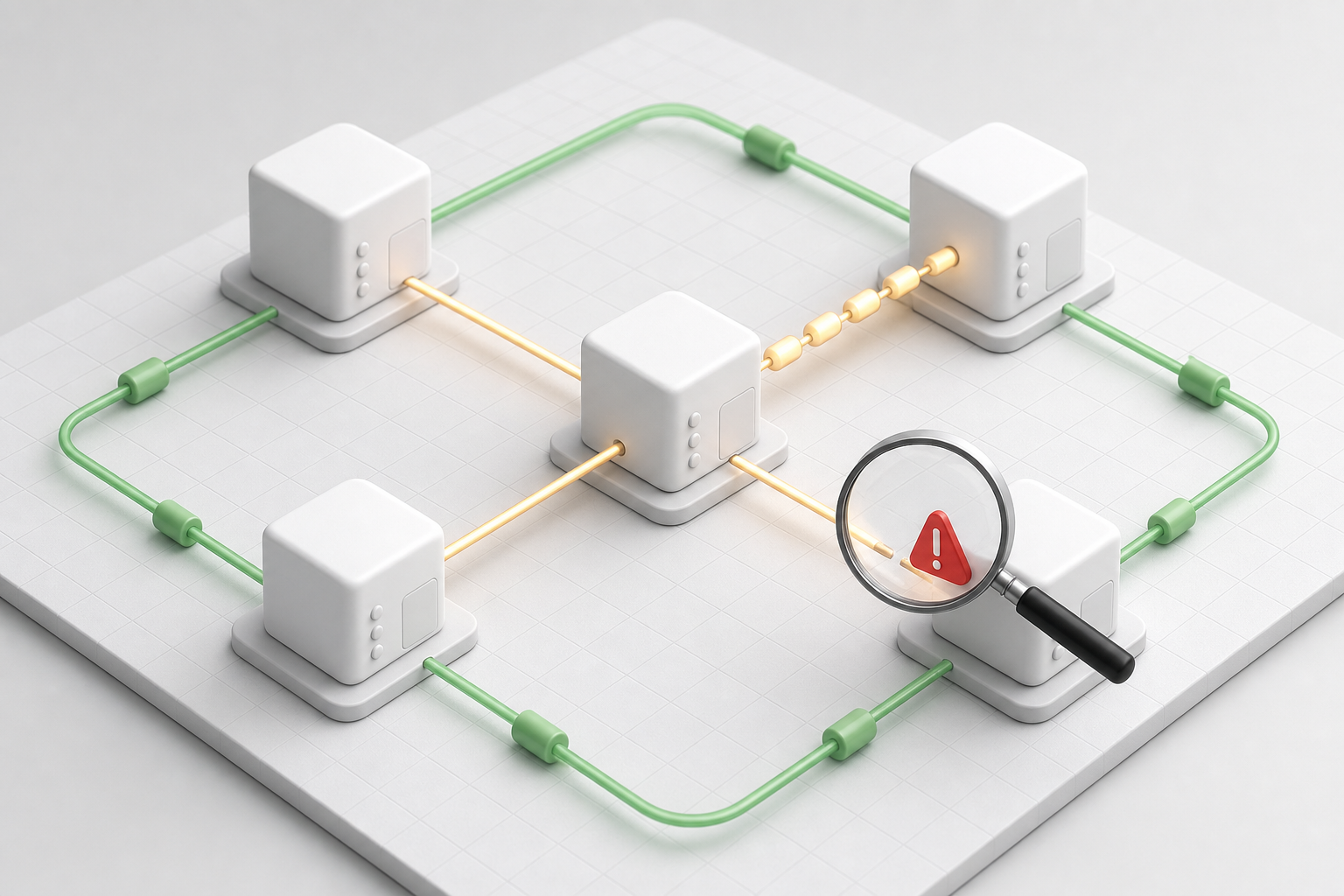
Distributed systems testing is the practice of validating software whose behavior emerges from multiple services, networks, databases, queues, and infrastructure components working together. The hard part is not only proving that each component works, but proving that the system stays correct when latency, retries, partial failure, and asynchronous workflows distort the order of events.
Automation suites fail in distributed systems because they assume stable timing, immediate consistency, and deterministic dependencies. Reliable tests are built by controlling test boundaries, verifying contracts, polling for observable outcomes, injecting realistic failure, and using traces and logs as test evidence rather than relying on sleeps or end-to-end UI checks alone.
Why distributed systems testing breaks conventional automation suites
Distributed systems testing breaks conventional automation because the system under test is rarely in one state at one time. A passing assertion can be false five milliseconds later, and a failing assertion can become true after a message consumer catches up.
An automation suite is a repeatable set of executable checks that evaluates software behavior against expected outcomes. In a monolith, the suite often talks to one process and one database, so the visible result is close to the committed state.
In a distributed system, a user action might call an API gateway, publish an event, update a read model, trigger a fraud service, and notify a billing worker. Each hop adds timing uncertainty, ownership boundaries, and failure modes that the test may not see directly.
The most common mistake is treating distributed workflows like synchronous CRUD operations. Teams click a button, wait a fixed number of seconds, query a database, and call the result reliable because it passed on a calm Tuesday.
Reliable distributed systems testing starts with a different mental model: the test does not control the system clock, message order, network health, or deployment topology. It must therefore assert on durable business outcomes, bounded invariants, and observable signals rather than incidental timing.
Distributed system testing challenges that make suites flaky
Distributed system testing challenges are the technical conditions that make a correct system appear broken or a broken system appear correct during automated validation. The dominant causes are nondeterministic timing, hidden coupling, inconsistent environments, and weak observability.
Industry teams commonly report that 15 percent to 35 percent of failures in large integration suites are not product defects but environment, timing, or dependency instability. Mature teams that redesign tests around contracts, polling, and controlled dependencies often reduce reruns by 30 percent to 50 percent within two release cycles.
How does eventual consistency affect assertions?
Eventual consistency is a data model where replicas, projections, or downstream systems become correct after a delay rather than at the exact moment of a write. Tests fail when they assert too early or assume the read path is updated synchronously.
A payment API may accept an order immediately while the reporting view updates after an event consumer processes a queue. A test that checks the report page instantly is not testing correctness; it is testing consumer speed under one transient load condition.
The better assertion is bounded and outcome oriented: the report must contain the paid order within a defined service-level window, and duplicate payment events must not create duplicate revenue. This turns timing from a hidden assumption into an explicit requirement.
Why do retries and idempotency create false confidence?
Retries are repeated attempts to complete an operation after a transient failure, and idempotency is the property that repeating an operation produces the same intended result. Tests that only verify the successful first attempt miss the failures that retries are designed to survive.
Retries can hide fragile behavior in happy-path automation. A flaky downstream call may pass after the third attempt, while the system silently creates duplicate records, sends multiple emails, or charges a customer twice.
A reliable suite verifies both the final result and the side-effect count. For example, it should prove that five identical payment callbacks produce one settled invoice, one ledger entry, and one customer notification.
When does service ownership become a test risk?
Service ownership becomes a test risk when one team’s automation depends on another team’s unstable interface, data seed, deployment schedule, or nonproduction environment. The failure looks like a test issue, but the root cause is unmanaged collaboration.
Microservices magnify this risk because service boundaries are organizational boundaries as much as technical ones. A schema field renamed by the profile team can break the checkout team’s integration suite before any production contract is violated.
The solution is not to remove integration tests; it is to make the integration explicit. Consumer-driven contracts, versioned test data, and shared observability standards convert informal dependency assumptions into executable agreements.
A reliable strategy matches tests to distributed system boundaries
Reliable distributed systems testing uses different test types for different risk boundaries instead of pushing every scenario into a slow end-to-end suite. The fastest stable strategy verifies local logic in isolation, contracts at service edges, integrations with controlled dependencies, and only the most valuable journeys across the full stack.
Microservices testing is the validation of independently deployable services and their collaborations through APIs, events, data stores, and infrastructure dependencies. It should not mean running every business rule through every live service on every commit.
| Test layer | Best use | Primary risk covered | Common failure pattern |
|---|---|---|---|
| Unit and component tests | Validate service logic with in-process dependencies | Business rules, mapping, validation, edge cases | Mocks drift from real integrations |
| Contract tests | Verify API and event compatibility between consumers and providers | Breaking interface changes | Contracts are too broad or not published in CI |
| Integration tests | Run one service against real databases, brokers, or selected dependencies | Serialization, persistence, infrastructure behavior | Shared environments create data collisions |
| End-to-end tests | Validate critical user and business journeys across deployed services | Cross-service orchestration and release confidence | Large suites become slow, flaky, and hard to diagnose |
| Resilience and chaos tests | Inject latency, faults, and dependency outages in controlled conditions | Graceful degradation and recovery behavior | Faults are run without clear invariants or rollback controls |
The practical distribution is usually closer to a test portfolio than a pyramid. High-change services may need dense component tests and contracts, while low-change orchestration flows may justify fewer but stronger end-to-end checks.
A benchmark for mature delivery groups is that commit-level feedback finishes in under 10 minutes, service-level integration feedback finishes in under 30 minutes, and broad environment validation runs asynchronously after merge. When every test blocks every commit, teams start ignoring the suite.
Async testing strategies for queues, events, and background workflows
Async testing strategies are techniques for validating behavior that completes outside the initiating request or on a different timeline. The core rule is to wait for evidence of completion, not for an arbitrary amount of time.
Fixed sleeps are the signature smell of weak distributed automation. They are too short under load, too long when the system is healthy, and blind to whether the expected state is actually progressing.
How should tests wait for asynchronous outcomes?
Tests should wait for asynchronous outcomes by polling an observable condition until it succeeds or a meaningful timeout expires. The condition should be a business-visible result, an event in a test sink, or a traceable state transition rather than a private implementation detail.
For example, after submitting a refund, the test can poll the refund status API until it reaches settled, rejected, or timed out. The timeout should reflect the system’s service-level objective, not a random number copied from another test.
import time
import requests

BASE_URL = "https://staging-payments.example.internal"
TIMEOUT_SECONDS = 45
POLL_INTERVAL_SECONDS = 2

def wait_for_refund_settlement(refund_id):
    deadline = time.time() + TIMEOUT_SECONDS
    last_payload = None

    while time.time() < deadline:
        response = requests.get(f"{BASE_URL}/refunds/{refund_id}", timeout=5)
        response.raise_for_status()
        last_payload = response.json()

        if last_payload["status"] in ["settled", "rejected"]:
            return last_payload

        time.sleep(POLL_INTERVAL_SECONDS)

    raise AssertionError(
        f"Refund {refund_id} did not reach a terminal state. Last response: {last_payload}"
    )
This pattern produces better diagnostics because the failure includes the last observed state. It also respects the fact that a slow but successful system is different from a system that never progresses.
When should tests inspect events directly?
Tests should inspect events directly when the event contract is the product behavior or when downstream state is not yet available through a stable public API. Event assertions are appropriate for integration points, audit requirements, and workflows where consumers depend on exact message semantics.
Direct event inspection should use a dedicated test topic, subscription, or broker namespace when possible. Reading from shared queues can steal messages from production-like consumers and create failures that automation itself caused.
Assertions should focus on schema, correlation identifiers, causality, and idempotency keys. Do not assert on broker offsets, partition placement, or incidental ordering unless those properties are explicit service guarantees.
How do you test ordering without overfitting?
You test ordering by asserting only the ordering guarantees the system claims to provide. Many distributed platforms guarantee ordering within a key or partition, not across the entire system.
If an order service promises that events for the same order ID are ordered, the test should generate several transitions for one order and verify the consumer sees them in sequence. It should not assume that events for different customers, regions, or partitions arrive in chronological order.
Overfitted ordering tests are a major source of false alarms after scaling changes. A harmless move from one consumer to four consumers can break tests that were really asserting on implementation, not behavior.
Microservices testing needs contracts, not fragile environment choreography
Microservices testing becomes reliable when service compatibility is verified before systems meet in a shared environment. Contract testing is the practice of defining and automatically checking the expectations between a consumer and a provider.
Consumer-driven contracts are especially useful when multiple teams deploy independently. The consumer records the fields, status codes, headers, and event shapes it relies on; the provider proves those expectations remain valid in CI.
Contracts should be narrow and behavior-focused. A contract that mirrors an entire OpenAPI document or every optional field becomes a second implementation of the provider and slows change without improving safety.
For event-driven systems, contracts must cover message schema, required metadata, versioning rules, and compatibility of new fields. A JSON field added as optional is usually safe; a type change from number to string is often a breaking change even if consumers are loosely typed.
Teams using contract gates commonly see faster feedback because provider compatibility checks run in minutes without deploying a full environment. They also reduce late-stage integration defects because interface breaks fail near the code change that introduced them.
Observability turns flaky failures into diagnosable evidence
Observability is the ability to understand system behavior from emitted signals such as logs, metrics, traces, and events. Without observability, distributed systems testing becomes guesswork because the test can see the symptom but not the path that produced it.
A trace is a linked record of a request or workflow as it moves across services and infrastructure. For testers, trace correlation is often the difference between a five-minute triage and a half-day argument about which service failed.
Every automated distributed test should create or capture a correlation ID and include it in failure output. The same ID should appear in API responses, logs, events, and traces so engineers can reconstruct the execution path.
Useful testability signals include queue lag, retry counts, dead-letter events, circuit breaker state, downstream latency, and state transition history. These are not only operational metrics; they are assertions waiting to be automated.
For example, a checkout test should not only assert that an order was confirmed. It can also assert that no payment message landed in the dead-letter queue, the inventory reservation completed within the service objective, and the trace contains no unexpected 5xx dependency spans.
What teams commonly get wrong in distributed systems testing
Teams get distributed systems testing wrong when they optimize for broad coverage before they optimize for controllability and diagnosis. A large suite that cannot explain its failures is not a quality signal; it is an expensive noise generator.
The first pitfall is excessive end-to-end automation. Full-stack tests are valuable for critical journeys, but they are poor tools for exploring every validation rule, timeout branch, and permission combination.
The second pitfall is shared mutable test data. When several pipelines reuse the same customer, account, tenant, or feature flag, tests become order-dependent and fail only under parallel execution.
The third pitfall is testing against unstable nonproduction environments without owning their health. If a staging dependency is down every Friday afternoon, the suite is measuring environment operations as much as product quality.
The fourth pitfall is mocking away the risks that matter. Mocking a payment gateway is sensible for service-level validation, but never testing gateway timeouts, duplicate callbacks, or malformed webhooks leaves production to perform the real experiment.
The fifth pitfall is treating flakes as isolated test bugs. Persistent flakiness often exposes missing idempotency, ambiguous ownership, weak contracts, underprovisioned environments, or unavailable observability.
A practical blueprint for reliable distributed systems testing
A reliable blueprint combines risk mapping, layered automation, deterministic data, asynchronous waiting, and production-like failure signals. The goal is not perfect determinism; it is controlled uncertainty with fast diagnosis.
How do you choose which distributed workflows deserve end-to-end coverage?
You choose end-to-end coverage for workflows where cross-service orchestration is the risk, not where a single service rule is the risk. Good candidates include checkout, onboarding, payment settlement, identity verification, subscription renewal, and recovery from failed fulfillment.
Limit these tests to journeys that would block a release or damage customers if broken. A healthy enterprise suite often has dozens of strong end-to-end tests, not thousands of brittle ones.
Every end-to-end test should name the business invariant it protects. If nobody can state the invariant, the test probably belongs at a lower layer or should be deleted.
How can test data stay deterministic in parallel pipelines?
Test data stays deterministic when each run owns isolated identifiers, tenants, accounts, and cleanup rules. Parallel distributed tests should never depend on a global customer record whose state can be changed by another job.
Use generated correlation-safe data with run IDs embedded in names, metadata, and idempotency keys. Prefer API-based setup over direct database mutation unless the database is the service boundary being tested.
For long-lived entities, build a data leasing mechanism that marks ownership and expiry. This is more reliable than hoping cleanup jobs always execute after failed pipelines.
When should controlled failure injection be part of the suite?
Controlled failure injection should be part of the suite when the system claims to tolerate latency, dependency outages, retries, failover, or message redelivery. If resilience is a requirement, it needs automated evidence.
Start with service-level resilience tests before environment-wide chaos. Inject a downstream 503, a slow broker consumer, a duplicate event, or a database timeout, then verify the user-facing behavior and recovery path.
Fault tests need guardrails: small blast radius, clear rollback, tagged traffic, and explicit pass criteria. Random breakage without an invariant is theater, not engineering.
Operational rules that keep automation suites trustworthy
Trustworthy automation suites have ownership, service-level objectives, and failure classification built into the workflow. A distributed test suite should be treated as a product with reliability targets, not as a folder of scripts.
Classify every failure into product defect, test defect, environment defect, dependency defect, or unknown. Teams that maintain this taxonomy often cut triage time by 25 percent to 40 percent because they stop debating categories from scratch.
Quarantine should be temporary and visible. A flaky test hidden for months communicates that the behavior is not important or that nobody owns the signal.
Track flake rate, median runtime, p95 runtime, rerun success rate, and defect escape correlation. A suite with a low pass rate but no production defect correlation is not strict; it is misaligned.
Finally, make failure output actionable. Include request IDs, correlation IDs, environment version, service versions, last observed payload, queue lag, and trace links where available.
Key Takeaways
- Distributed systems testing must verify durable outcomes and invariants because timing, ordering, and dependency health are inherently variable.
- Fixed sleeps are unreliable for asynchronous workflows; polling observable business conditions with meaningful timeouts produces stronger evidence.
- Microservices testing works best as a layered portfolio of component tests, contracts, focused integrations, and a small set of critical end-to-end journeys.
- Contract testing reduces late integration failures by making API and event expectations executable before services meet in a shared environment.
- Observability is a testing requirement in distributed systems because traces, logs, metrics, and correlation IDs turn flaky symptoms into diagnosable causes.
- Common automation failures often reveal system design issues such as missing idempotency, weak ownership boundaries, poor test data isolation, or inadequate resilience.
- Reliable suites are managed like products, with failure classification, flake-rate targets, runtime budgets, and clear ownership for every signal.