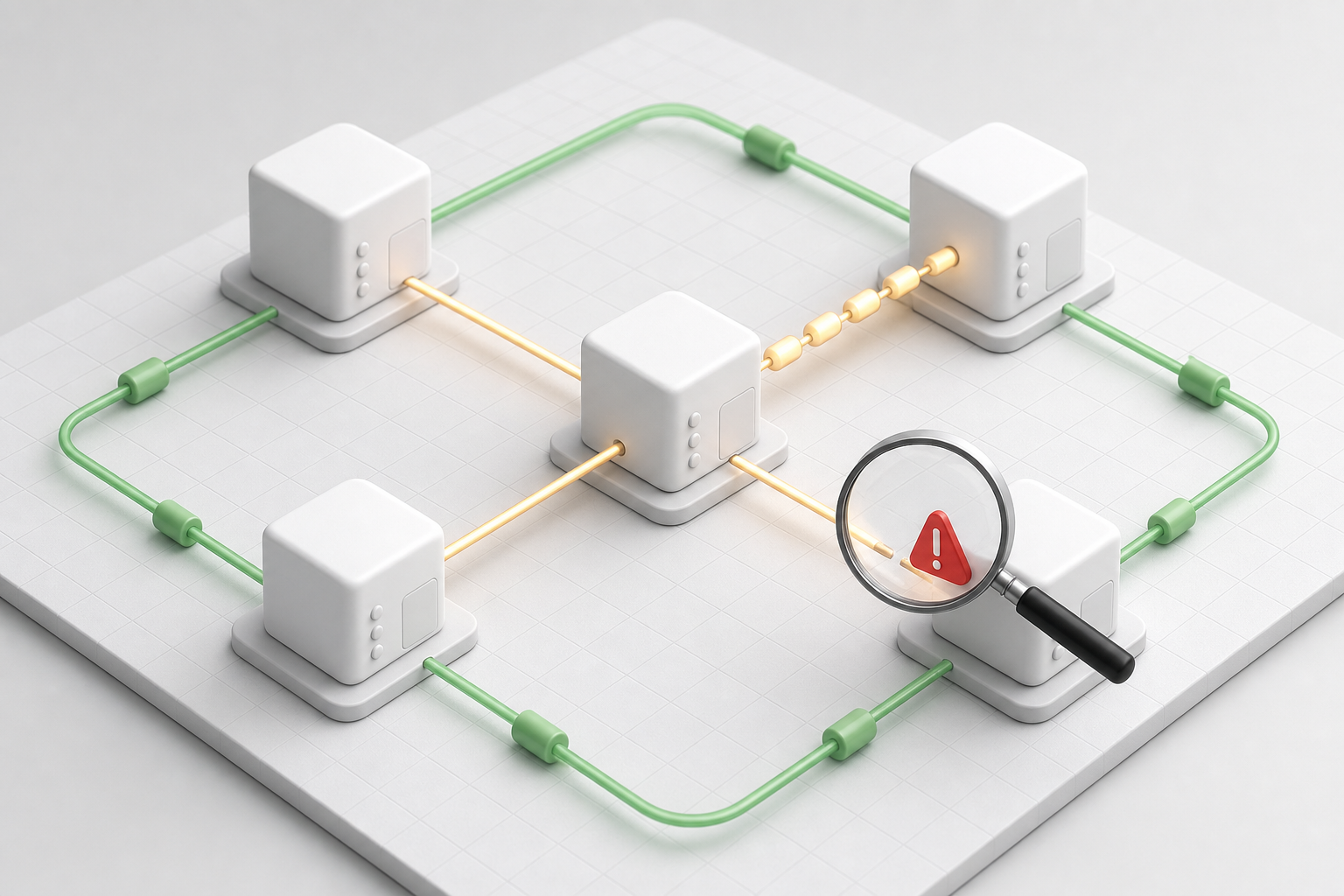

Product thinking for QA is the practice of testing features through the lens of user value, business intent, risk, and system impact before judging whether the software merely works. Strong testers still verify behavior, data, performance, and reliability, but they also ask whether the feature solves the right problem for the right user under realistic conditions.
Product-thinking helps QA prevent feature failures by exposing weak assumptions before code reaches users. Testers use product analysis to validate user intent, workflows, edge cases, risk signals, and success metrics, so a feature can be judged against outcomes instead of only requirements.
Product-thinking for QA reframes testing as product risk analysis
Product-thinking for QA reframes the tester from a requirement checker into a product risk analyst. The goal is to find where a feature can fail even when every written acceptance criterion passes.
Product knowledge testing is the use of domain, user, workflow, market, and operational knowledge to design better tests. It connects test ideas to the real reasons a feature exists, including revenue protection, customer retention, compliance, support reduction, or user productivity.
QA strategy is the deliberate plan for where, when, and how quality evidence will be collected across the product lifecycle. A product-aware QA strategy does not start with test cases; it starts with the feature bet, the user behavior expected to change, and the risks that could invalidate that bet.
Feature validation is the process of proving that a feature is valuable, usable, reliable, and safe enough to release for its intended audience. Functional correctness is necessary evidence, but it is not sufficient when the user problem is misunderstood, the workflow is fragmented, or the release creates downstream friction.
The practical shift is simple but demanding: testers stop asking only, Does this match the story? and start asking, What evidence would convince us that this feature should exist in this form? That question moves QA closer to product discovery, system thinking, and root cause analysis without turning testers into product managers.
Feature failures often come from bad assumptions, not broken code
Most severe feature failures are caused by invalid assumptions about users, data, dependencies, incentives, or operating conditions. Code defects matter, but product defects often survive because nobody tested the assumptions behind the feature.
A checkout discount may calculate correctly and still reduce margin because it stacks with a loyalty promotion. A notification feature may pass API tests and still create alert fatigue. A permissions change may satisfy the ticket and still break an admin workflow that was never documented.
In mature product organizations, post-release incidents frequently show a pattern: 30 percent to 45 percent of escaped feature issues are not traditional implementation bugs. They are requirement gaps, cross-system side effects, confusing flows, missing observability, migration oversights, or metric blind spots.
System thinking is the discipline of understanding how parts interact inside a larger product, business, and operational environment. For QA, system thinking makes feature validation less brittle because testers evaluate effects across journeys, roles, data states, integrations, and feedback loops.
Product knowledge testing strengthens feature validation before execution begins
Product knowledge testing strengthens feature validation by giving testers better models of user behavior and business impact before they design checks. When testers understand the product domain, they can challenge thin requirements without slowing delivery.
The highest leverage product knowledge usually comes from support tickets, analytics funnels, sales objections, customer interviews, feature flags, incident retrospectives, and billing or entitlement rules. These sources reveal how users actually behave, not just how stakeholders hoped they would behave.
Good testers convert this knowledge into risk questions. Which personas are most affected? Which existing workflows are touched? Which historical incidents resemble this change? Which customers will experience the feature first, and how will we know whether it worked?
Product knowledge also changes prioritization. A low-complexity UI change in a high-revenue renewal path may deserve deeper validation than a complex admin enhancement used by five internal operators. Without product context, teams often optimize test effort around technical complexity while ignoring commercial risk.
How does product context change acceptance criteria?
Product context changes acceptance criteria by making them measurable, audience-specific, and tied to the intended outcome. Instead of accepting User can export report, a product-minded tester asks which user, which report size, which permissions, which format, which downstream tool, and which success signal matter.
Strong acceptance criteria include constraints that users will encounter in production. They cover realistic data volume, account configuration, accessibility expectations, error recovery, localization, latency tolerance, and auditability where relevant.
This is not scope inflation. It is scope clarification that prevents teams from shipping a technically complete feature that fails in the first serious customer workflow.
When should testers challenge the product problem statement?
Testers should challenge the product problem statement when the feature describes a solution but not the user pain, success metric, or decision evidence. A vague problem statement usually produces vague validation and late arguments about whether the release is good enough.
Useful challenge questions include: who is blocked today, what workaround exists, what behavior should change, what trade-off is acceptable, and what negative side effect would make this feature a failure? These questions are not political objections; they are testability inputs.
If a team cannot answer them, QA can still test implementation quality, but it cannot confidently validate product quality. That limitation should be visible in the release risk assessment.
A practical product-analysis workflow turns ambiguity into testable risk
A practical product-analysis workflow turns product ambiguity into a prioritized set of risks, evidence, and release decisions. Testers can run this workflow during refinement, design review, or early development without creating a heavyweight process.
The workflow begins by identifying the product intent. The tester captures the target user, the job to be done, the current pain, the expected behavior change, and the metric that should move after release.
Next, the tester maps the feature into the current system. This includes upstream triggers, downstream consumers, permission boundaries, data migrations, pricing or entitlement rules, analytics events, and operational dashboards.
Then the tester converts assumptions into validation targets. An assumption such as users understand this new filter becomes usability evidence; the data is always available becomes resilience testing; only managers need this action becomes role and permission testing.
What user problem is this feature supposed to solve?
The user problem is the specific friction, delay, risk, cost, or unmet need the feature is intended to remove. If the team cannot state that problem in one sentence, feature validation will drift toward checking screens instead of validating usefulness.
For example, add saved filters is a solution. The user problem might be support supervisors lose time rebuilding the same queue views during peak incident periods. That framing leads QA toward time-to-task testing, saved-state persistence, permissions, high-volume queue behavior, and recovery when filter fields change.
Which assumptions can fail even if code passes?
Assumptions can fail when real users, data, integrations, timing, or incentives differ from the model used during planning. These failures often escape scripted tests because the scripts inherit the same assumptions as the requirements.
Testers should list assumptions in categories: user behavior, domain rules, data quality, integration stability, operational capacity, legal constraints, monetization impact, and support readiness. Each category should produce at least one falsifiable question.
feature_risk_model:
  feature: saved_filters_for_support_queues
  target_user: support_supervisor
  outcome_metric: reduce_queue_setup_time_by_40_percent
  core_assumptions:
    - supervisors_reuse_queue_views_daily
    - saved_filters_remain_valid_after_field_changes
    - restricted_queues_do_not_leak_between_roles
    - filter_load_time_stays_under_800_ms_at_peak_volume
  validation_evidence:
    - analytics_event_for_filter_created
    - role_matrix_tests_for_private_and_shared_filters
    - load_test_with_250000_open_cases
    - usability_session_with_three_supervisors
  release_guardrails:
    - feature_flag_enabled_for_beta_accounts
    - rollback_keeps_existing_queue_defaults
    - dashboard_tracks_error_rate_and_load_latency
This lightweight model gives QA, product, and engineering a shared language. It also makes missing evidence visible before the release meeting, when options are cheaper.
How should testers map product risk to validation evidence?
Testers should map product risk to the smallest credible evidence that can confirm or challenge the risk before release. Evidence can be a test result, prototype session, production metric, contract test, synthetic monitor, log assertion, or controlled rollout signal.
Not every risk needs a large test suite. A confusing label may need a five-person usability check, while a billing rule needs deterministic automated tests and reconciliation reports. A risky integration may need contract testing plus a feature flag rollback path.
Product-thinking changes QA strategy across the delivery lifecycle
Product-thinking changes QA strategy by shifting validation left into discovery and right into production learning. The tester designs quality evidence across the lifecycle instead of concentrating all effort after development.
During discovery, QA contributes risk questions and testability constraints. During refinement, QA improves acceptance criteria with domain examples and failure modes. During implementation, QA aligns automated checks with product risk rather than raw coverage targets.
During release, QA validates guardrails such as feature flags, logging, dashboards, user segmentation, and rollback. After release, QA compares expected outcomes with production signals to refine future test strategy.
Teams that apply this lifecycle model commonly report 20 percent to 35 percent fewer reopened stories because ambiguity is resolved earlier. They also tend to reduce escaped requirement defects by roughly 25 percent when testers participate in discovery and release instrumentation.
| Validation approach | Primary question | Typical evidence | Blind spot |
|---|---|---|---|
| Requirement-based testing | Does the feature match the written story? | Acceptance tests, exploratory sessions, regression checks | May miss whether the story solves the right problem |
| Risk-based testing | Where could failure cause the most harm? | Risk matrix, severity analysis, targeted automation | May focus on technical harm without product outcome context |
| Product-thinking for QA | Does the feature create the intended value safely? | User journey evidence, assumption tests, metrics, guardrails | Requires access to product context and decision makers |
| Production validation | Is the feature behaving as expected with real users? | Analytics, logs, alerts, cohort analysis, support trends | Can detect harm late if rollout controls are weak |
Strong product-minded testers use heuristics that expose hidden failure modes
Strong product-minded testers use repeatable heuristics to expose failure modes that ordinary happy-path validation misses. Heuristics make product analysis faster, especially when documentation is incomplete.
The first heuristic is outcome inversion. Ask what would make the feature a failure three weeks after release, then design validation around those negative outcomes.
The second heuristic is persona stress. Test the feature through power users, first-time users, admins, restricted users, high-value customers, and edge-case accounts instead of treating the default persona as universal.
The third heuristic is journey adjacency. Identify what users did immediately before and after the new feature, because friction often appears at handoffs rather than inside the feature itself.
The fourth heuristic is data realism. Seed environments with old records, partial data, duplicate entities, high-volume accounts, invalid states, migrated objects, and localization variants. Product failures frequently hide in data history, not current UI behavior.
The fifth heuristic is reversibility. Ask whether users and operators can undo, roll back, repair, retry, or recover. Irreversible features need stronger validation evidence than reversible enhancements.
How can QA validate feature value without owning product management?
QA can validate feature value by testing the evidence behind the product decision while leaving prioritization and roadmap ownership with product management. The tester’s role is to make uncertainty visible, not to become the final judge of strategy.
A healthy boundary sounds like this: Given the stated goal, here is the risk evidence we have, here is what remains unproven, and here is the release exposure. That framing improves decisions without creating role conflict.
Product managers own trade-offs. QA owns the integrity of the evidence used to make those trade-offs.
Common mistakes make product-thinking for QA performative
Product-thinking for QA becomes performative when teams add discovery language but keep the same late-stage validation habits. The most common mistake is talking about outcomes while measuring only story completion.
Another mistake is treating product knowledge as tribal knowledge. If only one senior tester understands the domain, the team has a resilience problem, not a testing advantage. Product assumptions should be documented in lightweight models, examples, decision logs, or risk notes that survive personnel changes.
Teams also overuse generic personas. A label like admin rarely carries enough testing meaning because admins may differ by region, subscription tier, permission template, data volume, audit obligation, and operational responsibility.
A fourth mistake is confusing stakeholder confidence with validation evidence. A confident product owner can still be wrong about user behavior. QA should respect expertise while asking for observable signals.
A fifth mistake is automating too early. Automation is powerful when the expected behavior is stable, but premature automation around uncertain product decisions can harden weak assumptions into expensive maintenance.
Product-analysis breaks down when teams ignore decision latency
Product-analysis breaks down when risk questions are raised too late for anyone to act on them. Decision latency is the delay between discovering a product risk and having the authority, time, and information needed to change course.
If QA finds a critical assumption gap two days before release, the team may label the concern as negativity because the delivery system has no room left for learning. The tester is then forced into a false choice between blocking the release or accepting risk without evidence.
The fix is not more meetings. The fix is earlier risk framing, explicit decision owners, thinner validation experiments, and release mechanisms that preserve options.
Feature flags are a practical example. A feature flag is a runtime control that allows teams to enable, disable, or target functionality without redeploying code. Product-minded QA uses flags not only for safer rollout but also for staged evidence collection across cohorts.
Observability is the ability to infer system behavior from outputs such as logs, metrics, traces, events, and alerts. Without observability, production validation becomes guesswork and feature validation ends at deployment, which is exactly where many product failures begin.
QA leads can operationalize product analysis without slowing teams
QA leads can operationalize product analysis by embedding a few high-value prompts into existing rituals instead of creating a separate governance layer. The best systems make product questions normal, fast, and visible.
Add a product-risk section to refinement templates. It should capture the target user, intended outcome, top assumptions, impacted journeys, data dependencies, and release guardrails. Keep it short enough that teams will actually use it.
Build a domain example library. Store realistic accounts, transaction histories, permissions, workflows, and edge cases that reflect production patterns. This library becomes a reusable asset for exploratory testing, automation, demos, and onboarding.
Align automation investment with risk durability. Stable domain rules, contractual integrations, and entitlement checks are good automation candidates. Volatile experience experiments may need exploratory evidence, analytics, or prototype testing before automation.
Give QA access to product analytics and support signals. Testers who can inspect funnel drop-off, search terms, incident tags, customer segments, and feature adoption curves produce sharper validation ideas than testers limited to tickets.
Finally, include QA in post-release learning. A release review should compare expected outcomes with actual signals, identify missed assumptions, and feed new heuristics into the QA strategy. This closes the loop between product analysis and continuous quality improvement.
Key Takeaways
- Product thinking for QA helps testers prevent feature failures by validating user value, assumptions, workflows, and release evidence, not just functional correctness.
- Product knowledge testing turns domain insight, analytics, support data, and user behavior into sharper test design and stronger feature validation.
- A mature QA strategy collects evidence across discovery, development, release, and production learning instead of concentrating quality decisions at the end.
- Many escaped feature issues come from weak assumptions about users, data, roles, integrations, or business rules rather than from broken code.
- Product-minded testers should map every major assumption to credible evidence such as exploratory tests, automation, usability checks, logs, metrics, or staged rollout signals.
- Feature flags and observability make product validation safer because teams can limit exposure, detect harm early, and learn from real usage.
- Product analysis fails when risk questions arrive too late, so QA must raise product uncertainty while decisions are still cheap to change.