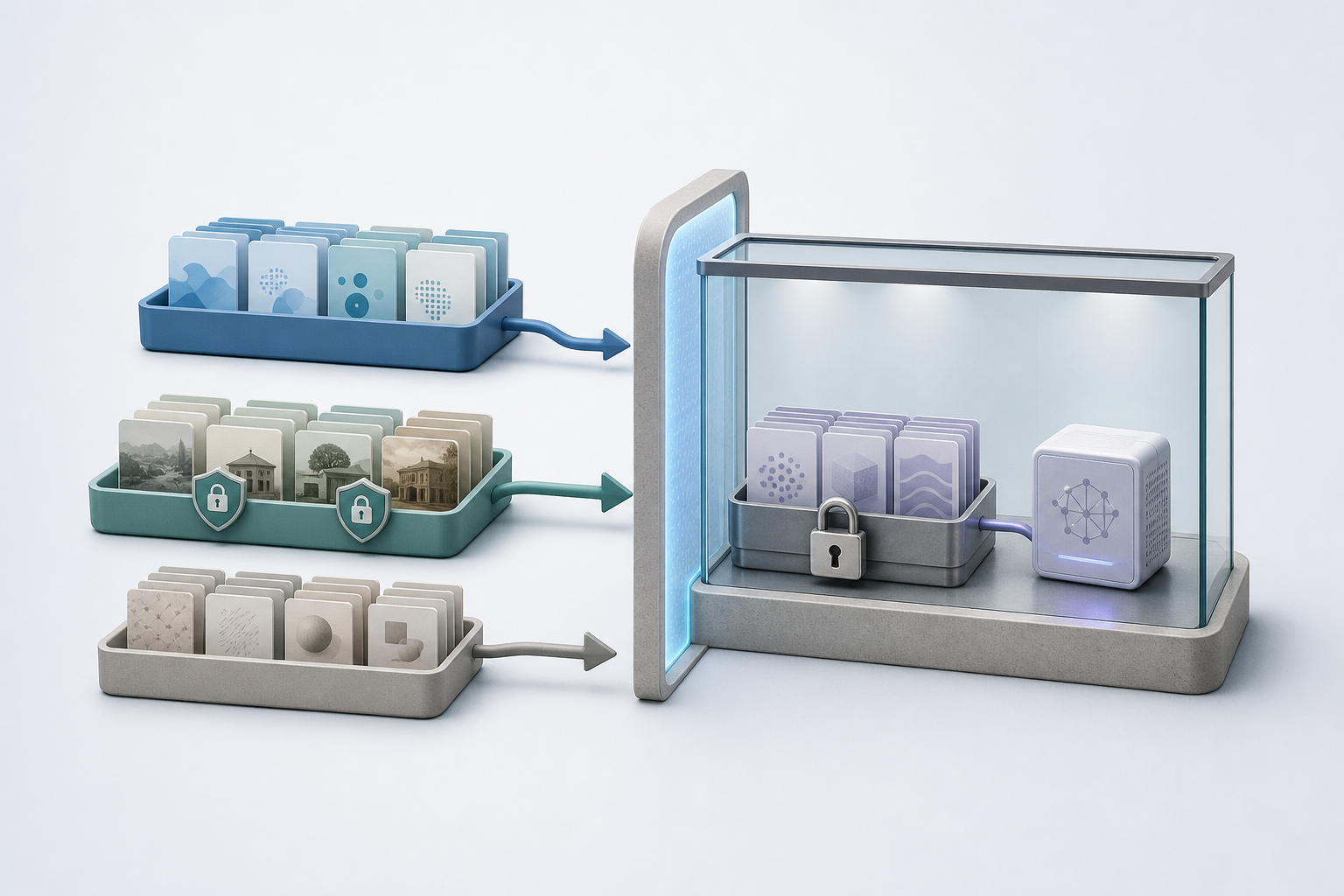
Synthetic test data is useful for AI feature testing, but it is not enough on its own. QA teams need a test-data strategy that separates generated examples, privacy-controlled real data, and sequestered evaluation inputs so model quality can be measured without contaminating the system being tested.
For safer QA of AI features, use synthetic data for broad coverage and privacy-safe exploration, real data for grounded product risk, and sequestered blind datasets for final evaluation. Keep evaluation inputs away from model training, prompt tuning, and day-to-day debugging. Pair every dataset with scoring rules, provenance, access controls, and contamination checks.
Why AI Test Data Is Different from Ordinary QA Data
Traditional application testing usually checks whether deterministic logic behaves as specified: a field rejects invalid input, a payment state changes correctly, or an API returns the expected schema. AI features add uncertainty. The same prompt can produce different outputs, semantically similar responses may both be acceptable, and small changes in retrieval context, safety instructions, or model version can change the result.
That uncertainty makes test data a quality-control asset rather than a simple fixture. A QA dataset for an AI feature must represent user intent, domain vocabulary, edge cases, privacy limits, safety boundaries, and expected evaluation behavior. It also needs lifecycle rules: who can see it, whether it may be used for debugging, whether it can influence training, and when it must be retired.
NIST’s Artificial Intelligence Technology Evaluation program describes evaluation approaches that include blind data and sequestered environments for AI assessment, which is a useful model for product QA teams building independent evaluation sets in the AITE announcement. Related NIST AI technology project materials also frame AI evaluation as infrastructure, not just a one-time test activity across AI technologies programs.
Synthetic, Real, and Sequestered Data Serve Different Jobs
A mature AI test-data program does not ask one dataset to do everything. Synthetic data, production-derived data, and sequestered evaluation data answer different questions and should be governed differently.
| Data type | Best use | Main risk | QA control |
|---|---|---|---|
| Synthetic test data | Expanding scenario coverage, generating rare cases, reducing exposure of personal or confidential data | Unrealistic distributions, hidden generator bias, or examples that are too easy | Validate against domain rules, sample real patterns, and mark all generated records clearly |
| Real or production-derived data | Testing realistic language, workflows, exceptions, and domain ambiguity | Privacy exposure, compliance gaps, and overfitting to known incidents | Minimize, mask, permission, and document provenance before use |
| Sequestered blind evaluation data | Independent release gates, regression checks, benchmark-style comparisons, vendor or model evaluation | Leakage into training, prompts, retrieval stores, or developer memory | Restrict access, keep immutable versions, and prohibit use for tuning |
Synthetic data is often the safest place to start. It lets teams create examples for prohibited content handling, boundary inputs, multiple languages, malformed documents, or difficult classification labels without copying sensitive customer data. For deeper practices around generative creation and privacy controls, see our guide to synthetic test data generation with generative AI.
Real data remains important because AI systems fail in the details: misspellings, unusual abbreviations, domain-specific phrasing, messy attachments, ambiguous requests, and adversarial user behavior. The goal is not to move raw production data into test systems by default. It is to create a controlled, justified subset that carries the risk profile of the product without unnecessary exposure.
What Makes an Evaluation Dataset Sequestered?
A sequestered dataset is intentionally isolated from the people and systems that could cause leakage into the model or application. In practical QA terms, that means the data is not used for prompt engineering, fine-tuning, retrieval indexing, developer demos, exploratory debugging, or sales proof-of-concept work.
Blind evaluation goes further: the team or system being evaluated does not know the specific inputs in advance. Blindness helps prevent accidental optimization for the test set instead of the product risk. It also makes comparisons across model versions, vendors, or prompt templates more credible because each candidate faces the same protected inputs.
How should teams decide what belongs in the blind set?
Start with product risks rather than convenience. If the AI feature summarizes medical records, triages support tickets, recommends financial actions, or classifies security events, the blind set should include the high-impact categories where a wrong answer would matter. Include normal cases as well, because a model that only performs well on dramatic edge cases may still fail everyday users.
A useful blind set usually contains representative scenarios, known hard cases, safety and refusal cases, format stressors, and regression examples from prior defects. Each item should have expected outcome criteria. For generated outputs, those criteria may be a rubric rather than one exact string.
Leakage and Contamination Are Test-Data Defects
In AI QA, contamination means evaluation data has influenced the system before the evaluation. Leakage can happen through training data, fine-tuning examples, retrieval indexes, prompt libraries, bug tickets, screenshots, shared spreadsheets, human memory, or automated analysis pipelines. Once a blind dataset leaks, high scores may reflect familiarity rather than real capability.
The NIST GenAI text-to-text generators specification discusses evaluation processing and test-data split constraints in an evaluation context, reinforcing the need to protect the separation between development and assessment inputs in the GenAI T2T specification. For product teams, the same principle applies even outside formal challenges: the release gate should not be trained into the product.
What contamination checks are practical for QA?
Practical contamination checks do not need to be exotic. Maintain a manifest of evaluation records, compare evaluation prompts against training and retrieval corpora, review whether examples appear in tickets or documentation, and prevent bulk export by default. If a model is supplied by a third party, ask whether customer-provided evaluation inputs may be retained or used to improve services.
Teams should also watch for semantic leakage. If the exact text is protected but a developer rewrites every blind example into a prompt-tuning spreadsheet, the dataset has still been compromised. Treat sequestered examples like credentials: limited access, logged use, rotation when exposed, and clear incident handling.
Scoring Design Comes Before the Test Run
AI feature testing fails when teams collect outputs first and decide what quality means afterward. Scoring rules should be defined before execution. They should describe acceptable, unacceptable, and borderline behavior in language that QA, product, legal, data, and engineering stakeholders can understand.
For classification systems, scoring may include label accuracy, severity weighting, false-positive tolerance, false-negative tolerance, and escalation rules. For generation systems, scoring may include factual grounding, completeness, tone, refusal behavior, citation behavior, schema compliance, and absence of prohibited content. For agentic workflows, scoring may include tool selection, safe stopping, permission checks, and recovery from failed tool calls.
Acceptance criteria should separate release blockers from improvement targets. A chatbot that slightly overexplains an answer may be acceptable; a model that exposes another customer’s data is not. A summarizer that misses a minor optional detail may be tolerable; a summarizer that invents an approval status is a product risk.
Governance and Privacy Controls for AI Test Data
AI test data should have ownership, classification, retention limits, and permitted-use rules. Without governance, a dataset created for safe QA can quietly become training material, demo content, or a shared troubleshooting corpus. That undermines both privacy and evaluation integrity.
For regulated or high-risk products, connect datasets to evidence: why the records exist, what requirement or risk they cover, who approved them, when they were executed, and what release decision they supported. This is especially important when auditability matters; evidence-linked practices can help teams maintain traceability from risk to result, as discussed in evidence-linked testing for regulated products.
Minimum governance metadata should include source type, creation method, sensitivity classification, consent or legal basis where applicable, masking method, owner, access group, intended use, expiration date, and whether the data is allowed for tuning. Synthetic records should still be labeled, because generated examples can encode sensitive patterns or be mistaken for real customer records.
A Practical QA Pipeline for AI Test Data
Operationalizing AI test data means building repeatable lanes. One lane supports exploration with synthetic and development-safe examples. Another supports regression testing with approved non-blind datasets. A third supports sequestered evaluation that only designated evaluators or automated evaluation jobs can access.
The following configuration illustrates how a team might encode those lanes in a test-data registry. It is not a universal standard, but it shows the level of explicitness needed to avoid accidental misuse.
datasets:
  synthetic_support_intents_v3:
    source_type: synthetic
    sensitivity: low
    allowed_uses:
      - exploratory_testing
      - regression_debugging
    prohibited_uses:
      - release_benchmark
    owner: qa-data-steward
    refresh_cycle: monthly

  production_derived_masked_cases_v2:
    source_type: production_derived
    masking: tokenized_identifiers_and_redacted_free_text
    sensitivity: restricted
    allowed_uses:
      - controlled_regression
    prohibited_uses:
      - prompt_tuning_without_approval
      - vendor_demo
    approval_required: true

  blind_release_eval_2026_q4:
    source_type: sequestered_evaluation
    sensitivity: confidential
    allowed_uses:
      - release_gate
      - model_comparison
    prohibited_uses:
      - training
      - fine_tuning
      - retrieval_indexing
      - developer_debugging
    access_group: evaluation-owners-only
    rotate_if_exposed: true
Automated pipelines should enforce these rules where possible. A CI job can run development regression tests on non-blind data, while a protected release workflow triggers blind evaluation in a separate environment. Results should be visible enough for release decisions but not so detailed that every protected prompt and expected answer is exposed to the full development organization.
When should synthetic data be retired or refreshed?
Refresh synthetic data when product behavior changes, real user patterns shift, new defect classes appear, or the generator that created the data is found to produce unrealistic examples. Synthetic datasets can become stale just like manual test cases. They should also be retired when they are no longer traceable to current requirements or risk models.
Sequestered datasets need a different refresh rule. Do not rotate them merely because a team wants new examples for debugging. Rotate them when they have leaked, when the product domain has materially changed, or when the evaluation set no longer represents current release risk.
Common Pitfalls to Avoid
The first pitfall is treating synthetic data as automatically safe. Generated records can still resemble real people, include sensitive combinations, or encode prohibited content. Review and classify synthetic data before broad use.
The second pitfall is using the blind evaluation set for root-cause analysis after every failure. Teams need enough diagnostic information to fix defects, but exposing all blind inputs turns the release gate into a training set. Use representative non-blind reproductions for debugging whenever possible, and reveal blind examples only through a controlled exception process.
The third pitfall is scoring only the model and ignoring the surrounding product. AI feature quality depends on prompts, retrieval sources, guardrails, tool permissions, fallback flows, UI framing, and monitoring. Test data should exercise the full feature path, not just the model endpoint.
The fourth pitfall is letting acceptance criteria drift after stakeholders see results. If the pass bar changes every time a preferred model underperforms, evaluation loses credibility. Define critical failures, severity weights, and release gates before the run.
Key Takeaways
- Synthetic test data is best for safe expansion of coverage, but it must be validated and labeled rather than trusted automatically.
- Real or production-derived inputs help reveal domain messiness, but they require minimization, masking, approval, and retention controls.
- Sequestered blind datasets protect release evaluation from leakage, overfitting, and unconscious optimization by development teams.
- Contamination can happen through tickets, prompts, retrieval indexes, screenshots, and debugging workflows, not only through formal model training.
- Scoring rubrics and acceptance criteria should be written before the test run and tied to product risk.
- AI test-data governance should define ownership, sensitivity, allowed uses, prohibited uses, access, rotation, and evidence requirements.
- A practical pipeline separates exploration, regression, and protected release evaluation into distinct data lanes.