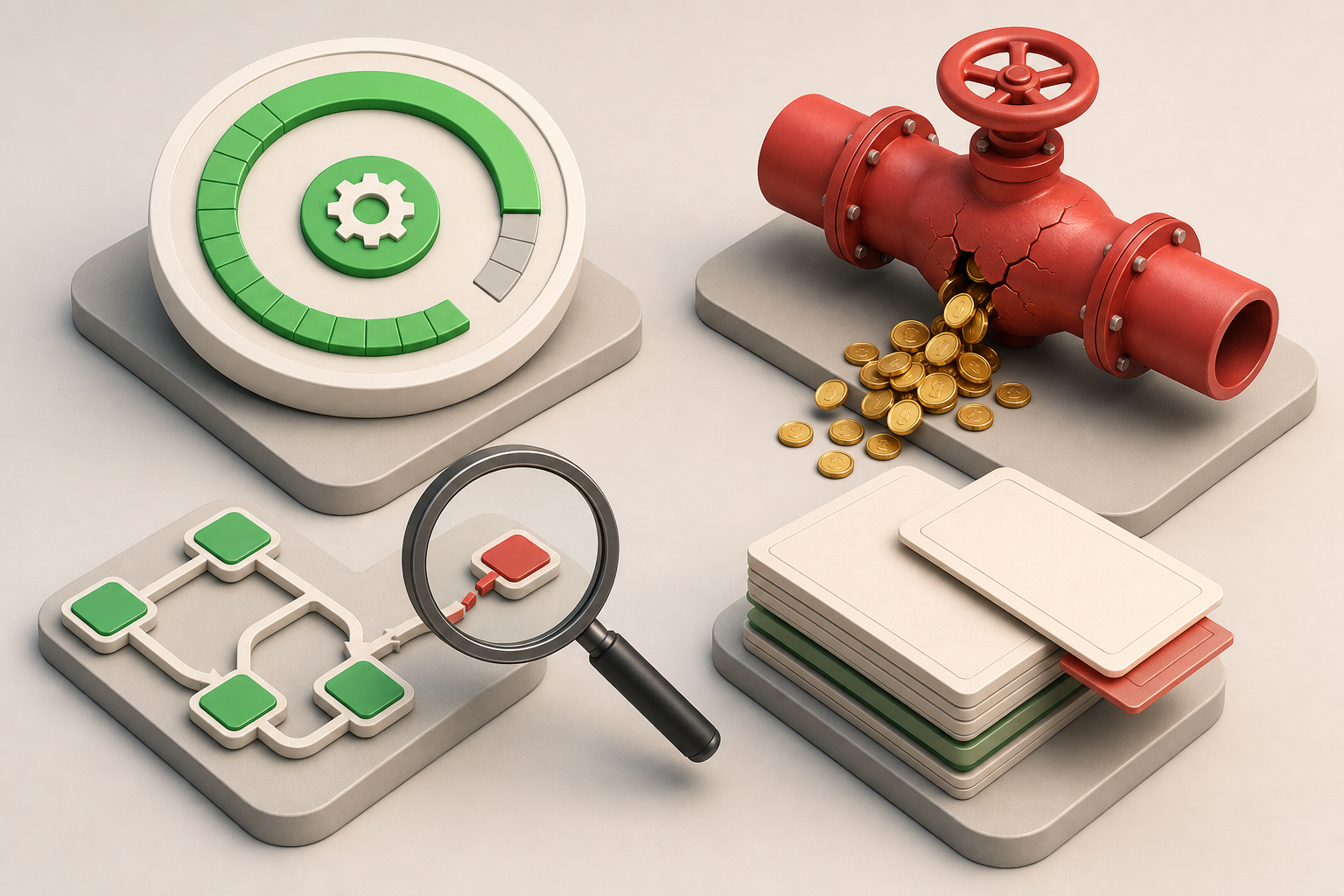

Manual testing is the human-led evaluation of software behavior, risk, usability, and context that cannot be fully reduced to scripts. AI augmentation is the use of machine intelligence to extend tester judgment rather than replace it. Exploratory testing is simultaneous learning, test design, and execution. Human-centric QA is a quality strategy that keeps human evidence, accountability, and user empathy at the center of release decisions.
Manual testing in AI-augmented workflows works best when AI handles acceleration tasks such as summarization, risk mapping, test idea generation, and evidence organization, while human testers retain judgment over risk, credibility, and user impact. The strongest teams use AI as a second brain, not as an oracle. They pair structured exploratory testing with clear governance, traceable prompts, and human review before any release decision.
Why Manual Testing Still Owns Judgment in AI-Augmented Delivery
Manual testing remains essential because quality risk is contextual, ambiguous, and often political. AI can surface patterns quickly, but testers decide whether those patterns matter to customers, regulators, support teams, and business stakeholders.
The most valuable manual testing work in 2026 is not repetitive screen checking. It is risk interpretation, behavior modeling, adversarial thinking, and evidence-based communication. Those activities improve when AI reduces clerical load and expands the tester's option space.
Teams that use AI augmentation well typically report 25% to 40% faster feedback loops for exploratory sessions, mainly from faster note consolidation, log interpretation, and defect drafting. The gain is real, but it comes from better tester leverage, not from removing testers from the loop.
The durable advantage of human-centric QA is that humans notice contradictions across product intent, user expectation, and implemented behavior. A model may flag a suspicious console error, but a skilled tester connects that error to a high-value customer journey, a confusing recovery path, or a release-blocking trust issue.
How does AI augmentation affect tester accountability?
AI augmentation increases tester accountability because it produces more suggestions that must be filtered, challenged, and documented. A tester who accepts model output without evaluation is not delegating work; they are importing unverified assumptions into the quality process.
In mature workflows, AI-generated ideas are treated like junior reviewer input. They can be useful, surprising, and fast, but they require confirmation through observation, reproduction, and risk analysis. This is especially important in regulated domains, payment flows, healthcare workflows, identity systems, and any product area where incorrect behavior has asymmetric impact.
How AI Augmentation Reshapes Exploratory Testing Without Replacing Testers
AI augmentation reshapes exploratory testing by compressing preparation and analysis time while preserving the human act of discovery. The tester still designs probes, interprets behavior, and decides when the product story no longer holds.
A strong exploratory workflow now starts with AI-assisted risk discovery. Testers can feed requirements, recent commits, production incidents, analytics notes, and support complaints into a controlled prompt to generate hypotheses. Those hypotheses become charters, not scripts.
For example, an AI assistant may suggest that a new discount engine creates risk around rounding, stacked promotions, expired coupons, and regional tax display. The tester then chooses which risks deserve live exploration and which can be handled by automated regression testing.
This division matters because exploratory testing becomes weaker when it turns into checklist execution. The point is to investigate uncertainty, not to mechanically confirm examples already understood by the team.
How should AI augmentation change exploratory testing charters?
AI augmentation should make exploratory testing charters sharper, narrower, and more risk-driven. Instead of asking AI for dozens of generic test cases, ask it to identify failure modes, missing assumptions, and user journeys that deserve human exploration.
A practical AI-assisted charter includes the target risk, the user role, the data shape, the environmental constraint, and the evidence needed for a release decision. This keeps the session bounded while leaving room for discovery. It also prevents the common failure mode where AI creates a bloated inventory of low-value checks.
When should exploratory testing stay fully human?
Exploratory testing should stay fully human when the product risk depends on emotion, trust, accessibility nuance, ethical judgment, or complex stakeholder interpretation. AI can help prepare these sessions, but the moment-to-moment evaluation should be led by a human tester.
Examples include evaluating whether a failed payment message feels accusatory, whether a cancellation flow is manipulative, or whether an accessibility workaround creates cognitive overload. These are not merely functional questions. They require empathy, product literacy, and a clear view of user harm.
A Practical Operating Model for Human-Centric QA in 2026
Human-centric QA works best as an operating model with explicit roles for AI, testers, developers, product owners, and release stakeholders. The goal is to make AI-assisted work traceable enough to trust and flexible enough to support real investigation.
Start by separating four categories of work: generation, execution, interpretation, and decision. AI is strong at generation and organization. Humans remain accountable for interpretation and decision, especially when evidence is incomplete or contradictory.
Many teams formalize this with session-based exploratory testing. Session-based testing is a structured approach that time-boxes exploration around a charter, captures notes, and produces reviewable evidence. AI can assist by drafting charters, clustering observations, and creating first-pass defect reports from raw session notes.
Pair this with risk-based testing. Risk-based testing is prioritizing test effort according to likelihood, impact, detectability, and business exposure. AI can calculate or suggest risk clusters, but the scoring model must reflect your product's reality.
| Workflow Area | AI-Augmented Practice | Human-Centric Control | Primary Risk Reduced |
|---|---|---|---|
| Charter design | Generate risk hypotheses from requirements, incidents, and code changes | Tester selects scope and rejects irrelevant ideas | Shallow or misdirected exploration |
| Session execution | Suggest data variations, edge cases, and observation prompts | Tester follows product behavior and adapts in real time | Over-scripted confirmation bias |
| Evidence capture | Summarize notes, logs, screenshots, and reproduction paths | Tester verifies accuracy and removes speculation | Poor defect reproducibility |
| Defect triage | Cluster similar failures and draft severity rationale | Team confirms user impact and release consequence | Inflated or inconsistent priority |
| Release review | Prepare risk digest and open-question list | Accountable humans make the go or no-go decision | False confidence from automation signals |
What does a strong AI-assisted charter look like?
A strong AI-assisted charter is specific enough to guide investigation and open enough to allow discovery. It should name the risk, product area, user persona, constraints, data patterns, and evidence expected at the end of the session.
{
  "session": "checkout-risk-safari-17",
  "mission": "Explore discount, tax, and payment recovery behavior for returning customers",
  "riskFocus": ["stacked promotions", "rounding drift", "expired wallet token", "regional tax display"],
  "personas": ["loyalty member", "guest converting to account"],
  "constraints": ["mobile viewport", "slow network", "stored address from previous region"],
  "aiAssistance": {
    "allowed": ["suggest edge cases", "summarize notes", "draft defect report"],
    "notAllowed": ["assign final severity", "approve release", "rewrite observed facts"]
  },
  "evidenceRequired": ["reproduction path", "observed impact", "supporting logs", "tester judgment"]
}
This format prevents AI from becoming a hidden decision-maker. It gives testers a repeatable artifact they can review in retrospectives, attach to release notes, and use for audit discussions.
Where AI-Assisted Manual Testing Breaks Down in Real Teams
AI-assisted manual testing breaks down when teams confuse velocity with validity. Faster ideas, faster notes, and faster defect drafts do not guarantee better evidence.
The first common mistake is asking broad prompts such as create all test cases for this feature. The result is usually a generic checklist that misses product-specific risk. Better prompts constrain the model with architecture, user roles, past incidents, known defect patterns, and release concerns.
The second mistake is letting AI flatten uncertainty. Model-generated summaries often sound more confident than the underlying evidence deserves. Testers should preserve uncertainty with phrases such as observed once, not reproduced, likely related, and requires product decision.
The third mistake is losing the tester's raw notes. If AI summaries replace original observations, teams lose the ability to challenge interpretation. Keep original notes, logs, screenshots, and session recordings attached to the summarized output.
The fourth mistake is over-relying on AI for severity. Severity is not just technical failure size; it is user harm, business timing, contractual exposure, and workaround quality. AI can draft a severity argument, but it cannot own the release consequence.
Why do AI-generated test cases often look better than they are?
AI-generated test cases often look better than they are because they are fluent, complete-looking, and organized around common patterns. Fluency can disguise weak domain grounding, duplicate coverage, missing preconditions, and unrealistic data assumptions.
Review AI output with the same skepticism applied to outsourced test assets. Ask which risks are unique to your system, which tests duplicate automation, which depend on unavailable data, and which outcomes would actually change a release decision.
Tooling Patterns and Prompt Workflows That Improve Tester Leverage
Effective tooling patterns put AI close to evidence while keeping it outside final authority. The best setup integrates AI with requirements, defect history, logs, analytics, and test management without allowing silent changes to source evidence.
Useful AI tools for manual testing fall into several categories. QA copilots help generate charters and test ideas. Log assistants summarize noisy traces. Browser inspection assistants identify client-side anomalies. Defect drafting tools turn session notes into structured bug reports.
The tool category matters less than the workflow contract. Every AI-supported artifact should show what input was used, what output was generated, who reviewed it, and what changed before publication. This is the practical baseline for trustworthy test documentation.
A high-leverage prompt workflow uses three stages. First, ask for risk hypotheses from defined context. Second, ask for charter options ranked by release impact. Third, after the session, ask for a defect or risk summary based only on observed notes.
Can AI help with defect triage without creating noise?
AI can help with defect triage when it clusters evidence and drafts rationale rather than assigning unquestioned priority. The tester or triage group should validate impact, duplication, reproduction confidence, and release timing.
Good triage prompts include the affected persona, environment, frequency, recovery path, and business process interrupted. Weak prompts only include the error message. The difference determines whether AI produces a useful triage brief or a polished guess.
Metrics That Prove AI-Augmented Manual Testing Is Working
AI-augmented manual testing is working when it improves decision quality, not merely output volume. Measure whether teams find important risks earlier, communicate evidence more clearly, and reduce avoidable rework.
Useful metrics include charter preparation time, session note completion rate, defect reproduction success, triage cycle time, escaped defect severity, and percentage of AI-generated suggestions accepted after review. These measures connect AI augmentation to real testing outcomes.
Benchmarks from mature QA groups show reasonable targets. Charter preparation time often drops by 30% after teams standardize AI-assisted risk prompts. Defect report drafting time can drop by 40% to 60%, while reproduction success improves when AI summaries are forced to include environment, data, and exact observed behavior.
Avoid vanity metrics such as number of AI-generated test cases. More test cases can increase maintenance load and obscure coverage gaps. A smaller set of high-signal charters usually produces better release intelligence than a large pile of generic checks.
How do you measure tester trust in AI output?
You measure tester trust in AI output by tracking review outcomes, correction rates, and downstream usefulness. If testers routinely rewrite AI summaries, reject suggested risks, or find hallucinated assumptions, the workflow needs better context and controls.
One practical signal is the accepted-after-review rate. If fewer than half of AI suggestions survive expert review, prompts are likely too broad or inputs are incomplete. If nearly all suggestions are accepted without edits, the team may not be reviewing critically enough.
Governance, Privacy, and Auditability for AI-Assisted QA
Governance makes AI-assisted QA safe enough for production organizations. Without clear rules for data use, prompt storage, review, and accountability, AI augmentation can create privacy exposure and untraceable release decisions.
Define which data may enter AI systems. Customer identifiers, production logs, payment details, healthcare data, and proprietary algorithms may require redaction, private models, or strict vendor controls. QA teams should align with security, legal, and platform engineering before scaling AI workflows.
Auditability is equally important. Auditability is the ability to reconstruct what was tested, what evidence was reviewed, what AI contributed, and who made the decision. This protects teams when a release causes customer impact or when a regulator asks how a risk was assessed.
Use a simple policy: AI may assist, humans attest. The tester attests to observations, the triage group attests to priority, and the release owner attests to acceptance of residual risk. That separation keeps human-centric QA intact even as tooling becomes more capable.
When should human-centric QA override an AI recommendation?
Human-centric QA should override an AI recommendation whenever the recommendation conflicts with observed behavior, domain knowledge, user harm, compliance obligations, or release context. The override should be documented as a professional judgment, not treated as resistance to automation.
Common override examples include downgrading a model-inflated severity, rejecting impossible test data, expanding exploration after an unexpected usability issue, or blocking release despite clean automated results. The tester's responsibility is to explain the risk in language stakeholders can act on.
Key Takeaways
- Manual testing remains critical in 2026 because humans own risk judgment, user empathy, and release accountability.
- AI augmentation is most valuable when it accelerates preparation, evidence organization, and defect drafting without making final decisions.
- Exploratory testing improves when AI-generated ideas become focused charters rather than bloated generic test case lists.
- Human-centric QA requires traceable prompts, preserved raw evidence, and explicit review of every AI-assisted artifact.
- Teams should measure AI-assisted manual testing by decision quality, reproduction success, triage speed, and escaped risk, not test case volume.
- AI recommendations should be overridden whenever they conflict with observed behavior, domain knowledge, compliance needs, or user impact.