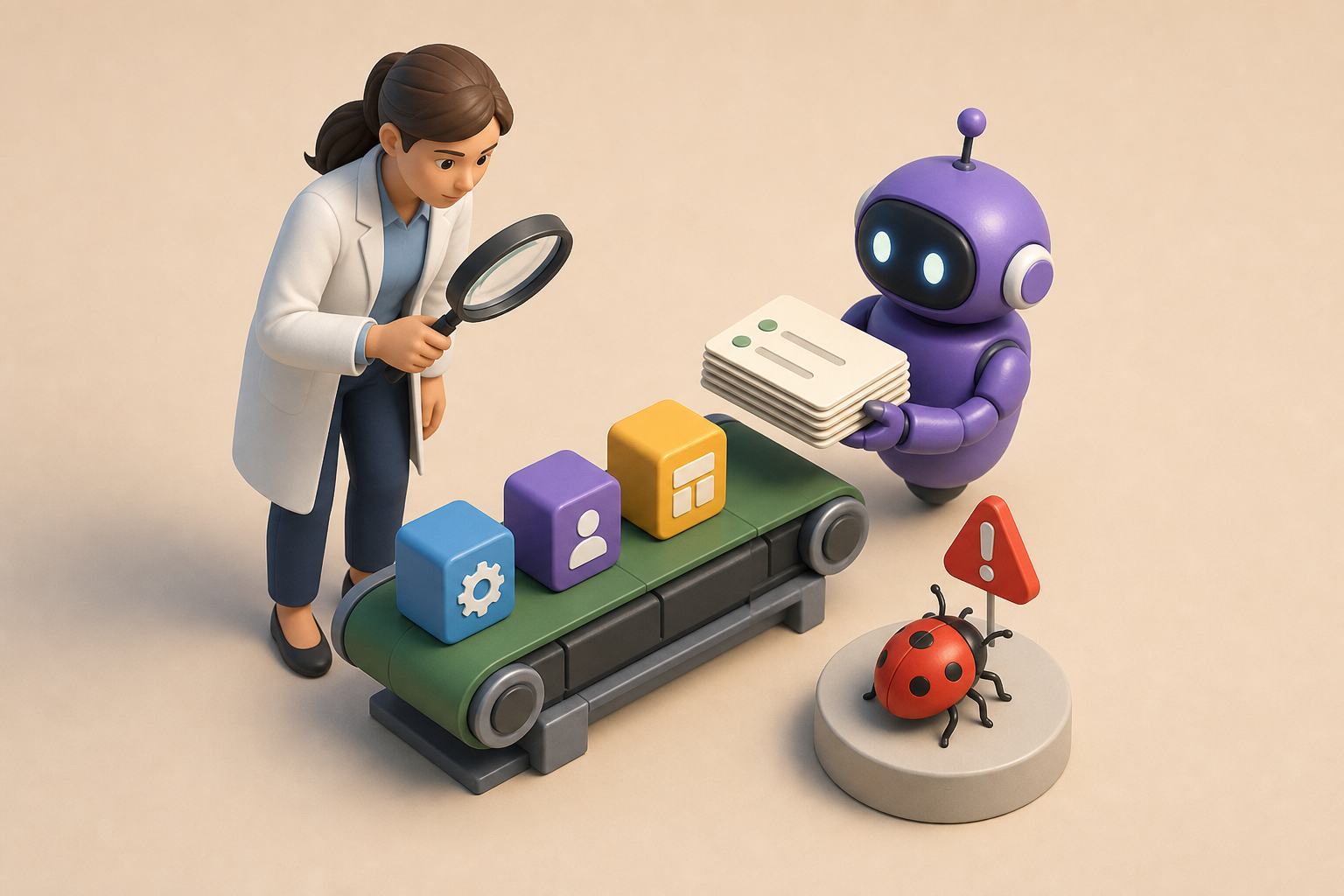
AI testing is the use of machine learning, generative AI, or intelligent automation to design, execute, analyse, or maintain software tests. I asked an AI system to behave like a QA engineer for a realistic release slice: understand a feature, identify risks, write tests, automate checks, review failures, and recommend a release decision. The result was useful, fast, occasionally impressive, and nowhere near ready to replace a strong tester.
AI did not replace the QA engineer; it replaced fragments of QA work. It drafted test ideas, generated automation scaffolds, summarised logs, and found obvious gaps quickly. It failed when judgment, product context, ambiguous requirements, hidden risk, and release accountability mattered most.
What Happened When an AI QA Engineer Took the Assignment
An AI QA engineer is an AI assisted system or agent that performs selected quality engineering tasks such as test design, script generation, defect analysis, and reporting. In this experiment, the AI completed many tactical tasks faster than a human, but it repeatedly needed human framing, correction, and risk prioritisation.
The test subject was a mid complexity web checkout flow with user authentication, promotional discounts, shipping rules, payment redirection, and order confirmation. That scope was deliberate because it contains both automation friendly paths and business rules that punish shallow understanding.
The AI received a product brief, acceptance criteria, a small API contract, three user personas, and access to representative logs. It did not receive institutional context, historical defect patterns, stakeholder politics, or the unwritten rule that finance defects are treated as release blockers even when the UI still looks healthy.
Within minutes, it produced a risk list, positive and negative scenarios, a regression checklist, and Playwright style automation skeletons. That first output looked like a competent starting point, not a release ready QA strategy.
The strongest value appeared in acceleration. A senior QA engineer could review and reshape the AI output in 20 to 30 minutes instead of spending 90 minutes building the first pass from scratch.
The weakest value appeared in accountability. The AI could state that a payment edge case was important, but it could not defend a go or no go call against customer impact, regulatory exposure, revenue leakage, and engineering trade offs.
How ChatGPT Testing Performed Across Real QA Activities
ChatGPT testing is the use of ChatGPT or similar large language models to support QA work by generating test ideas, scripts, data, reports, and analysis. It performed best as a QA copilot for structured tasks and worst as an autonomous decision maker.
The model was strongest when the input was narrow, explicit, and verifiable. It handled equivalence classes, boundary values, exploratory charters, and boilerplate automation well enough to reduce blank page time.
It struggled when the requirement relied on domain assumptions. For example, it treated a discount rounding discrepancy as a cosmetic display issue until prompted to reason about tax calculation, refund reconciliation, and customer support disputes.
That distinction matters because QA work is not just producing tests. Quality engineering is risk interpretation under incomplete information, and incomplete information is where generative AI becomes most confident at the exact moment it should become more cautious.
| QA activity | AI result | Human QA value still required | Practical verdict |
|---|---|---|---|
| Requirement analysis | Found missing acceptance criteria and ambiguous terms | Product context, domain constraints, stakeholder intent | Useful first pass |
| Test scenario design | Generated broad positive, negative, and boundary cases | Risk weighting, redundancy removal, coverage prioritisation | Strong with review |
| Exploratory testing ideas | Suggested charters and user flows | Observation, curiosity, environmental awareness | Good prompt amplifier |
| Automation scripting | Created runnable looking Playwright examples | Selector strategy, fixtures, stability, maintainability | Fast but fragile |
| Bug report drafting | Summarised logs and wrote clear reproduction steps | Severity judgement, duplicate detection, business impact | High value |
| Release recommendation | Produced a generic risk statement | Accountability, evidence synthesis, organisational judgement | Not autonomous |
How did ChatGPT testing change the test design workflow?
ChatGPT testing changed the workflow by moving the QA engineer from authoring every first draft to reviewing, challenging, and refining generated options. That shift was productive only when the tester treated the output as raw material rather than authority.
The best prompt included the feature goal, risk appetite, customer segment, architecture notes, and known defect history. When those details were missing, the AI defaulted to generic cases such as valid login, invalid coupon, and successful payment.
With context, it produced more useful scenarios, including abandoned payment recovery, expired promotion race conditions, guest checkout email mismatch, and order confirmation delays. Those were not surprising to an experienced tester, but they appeared quickly enough to improve workshop speed.
When should a QA team trust AI generated test cases?
A QA team should trust AI generated test cases only after they are reviewed against requirements, risk, architecture, and historical defects. The cases are suggestions, not evidence of coverage.
A practical rule is to classify AI generated tests into three buckets: obvious keepers, duplicates or low value checks, and risky assumptions requiring clarification. In this experiment, roughly 55 percent of generated scenarios were directly useful, 30 percent needed rewriting, and 15 percent were misleading or irrelevant.
Those numbers will vary by domain, but the pattern is consistent. AI increases option volume faster than it increases decision quality.
Where AI Automation Testing Helped More Than Expected
AI automation testing is the use of AI to create, repair, optimise, or analyse automated test assets and execution results. It helped most with scaffolding, selector alternatives, fixture ideas, and failure explanation, but it did not eliminate the need for disciplined automation architecture.
The AI generated Playwright tests that looked plausible within seconds. It used clear test names, expected page states, and data setup comments that were helpful during early implementation.
The first scripts were not production quality. They used brittle text selectors, assumed synchronous payment behaviour, hardcoded user data, and ignored cleanup for orders created during runs.
After adding project conventions, selector rules, fixture contracts, and retry limits to the prompt, the output improved substantially. This is the key pattern: AI automation quality tracks the quality of the engineering constraints you provide.
{
  "aiAutomationGuardrails": {
    "framework": "playwright",
    "selectorPolicy": "prefer dataTestId then role then stable accessible name",
    "testData": "create users through api fixture and delete orders after each run",
    "assertions": "verify business state through ui and api when payment status changes",
    "forbiddenPatterns": ["fixed waits", "shared user accounts", "hardcoded payment tokens"],
    "requiredOutput": ["test intent", "risk covered", "automation code", "maintenance notes"]
  }
}
This configuration style prompt changed the AI from a code generator into a constrained collaborator. It reduced rework because the output aligned with team standards before a human opened the editor.
Teams using AI assisted automation commonly report 25 to 45 percent faster first draft creation for routine UI and API tests. The gain drops sharply for complex asynchronous flows, legacy systems, and tests requiring deep fixture orchestration.
How does AI automation testing affect flaky test risk?
AI automation testing can increase flaky test risk when generated code optimises for apparent readability instead of deterministic execution. The model often writes tests that pass in a happy path demo but fail under CI timing, parallel execution, or unstable data.
In the checkout experiment, the AI initially used fixed waits after payment redirection. A senior automation engineer replaced them with event based assertions against order status and payment callback records.
The lesson is simple: generated automation must pass the same engineering review as human code. AI can speed creation, but it can also mass produce instability if reviewers accept scripts because they look syntactically correct.
What AI Missed That a Senior QA Engineer Caught
AI missed the risks that required product memory, system empathy, and scepticism about clean requirements. A senior QA engineer caught issues by asking why the feature existed, who would be harmed, and which failures would be expensive after release.
The most important miss involved discount and tax ordering. The acceptance criteria said the promotion applied before checkout completion, but did not clarify whether tax was calculated before or after discount application in all jurisdictions.
The AI generated tests for percentage discounts, expired coupons, and invalid coupon codes. It did not ask whether different tax regions, refund calculations, or invoice exports used the same pricing source of truth.
A human tester flagged the discrepancy because the team had seen a similar production incident eighteen months earlier. That memory was not in the prompt, and therefore it was not in the model output.
The AI also underweighted accessibility. It verified that the checkout error appeared, but did not initially ask whether the error was announced to assistive technologies after payment failure.
Finally, it assumed the payment provider sandbox behaved like production. A QA engineer challenged that assumption because sandbox callbacks often arrive in different sequences and can hide race conditions.
Why did the AI miss important business risk?
The AI missed important business risk because it reasoned from supplied text rather than lived product consequences. If revenue leakage, compliance exposure, customer trust, or support burden is not represented clearly in the prompt, the model may rank those risks too low.
Large language models are excellent pattern predictors, but QA risk analysis depends on context that is frequently undocumented. Senior testers carry incident memory, architectural suspicion, and stakeholder sensitivity that rarely appears in acceptance criteria.
This does not make AI useless. It means the best workflow is to make hidden context explicit, then ask the AI to challenge it, expand it, and look for contradictions.
Common Mistakes Teams Make When Replacing QA With AI
The biggest mistake is treating AI output as verification instead of hypothesis generation. AI can produce impressive artefacts, but artefacts are not evidence that the product works or that the release risk is acceptable.
The second mistake is measuring speed without measuring defect escape rate, flaky test growth, and maintenance cost. A team that doubles the number of automated tests but increases false failures has not improved quality.
The third mistake is asking vague prompts and blaming the tool for vague results. Prompts such as write test cases for checkout usually produce generic coverage because they omit risk, data, constraints, and architecture.
The fourth mistake is bypassing peer review. AI generated tests can contain false assertions, invalid API assumptions, insecure test data practices, and selectors that collapse after a minor UI change.
The fifth mistake is expecting AI to perform exploratory testing without observation. Exploratory testing is simultaneous learning, test design, execution, and interpretation; a text model can propose charters, but it cannot truly observe friction, surprise, or user hesitation in the product unless connected to reliable runtime signals.
- Do not count AI generated test cases as coverage until a QA engineer maps them to risks and requirements.
- Do not merge AI generated automation without the same code review, stability checks, and CI standards applied to human authored tests.
- Do not use sensitive production data in prompts unless your organisation has approved privacy, retention, and vendor controls.
- Do not let AI severity labels override human assessment of customer impact and release timing.
- Do not optimise only for test creation speed; optimise for trustworthy feedback loops.
A Better Operating Model for AI Assisted QA
The most effective model is not AI replacing QA, but QA engineers orchestrating AI across bounded, reviewable tasks. This creates leverage while preserving human responsibility for risk, evidence, and release confidence.
In practice, the QA engineer becomes a test strategist, prompt designer, reviewer, and evidence curator. That is not a downgrade; it is a shift from manual production of artefacts toward faster decision support.
A strong operating model starts with a risk brief. Before asking the AI for tests, provide customer impact, architectural dependencies, data rules, non functional expectations, and known failure modes.
Then ask for outputs that are easy to inspect. Good requests produce risk tables, traceable scenarios, assumptions, automation notes, and open questions instead of a long undifferentiated list of test cases.
Finally, close the loop with execution evidence. Feed back anonymised failure patterns, flaky test causes, escaped defects, and review comments so future prompts become more specific to the organisation.
Teams that use this model often see 30 to 40 percent faster feedback on routine regression planning and 20 to 35 percent reduction in time spent drafting repetitive test documentation. The bigger win is not fewer QA engineers; it is more QA attention available for high consequence risk.
What should remain human owned in an AI QA workflow?
Release risk should remain human owned because only accountable people can weigh evidence against business consequences. AI can recommend, but it cannot be responsible to customers, regulators, executives, or support teams.
Humans should own test strategy, risk acceptance, exploratory investigation, accessibility judgement, security escalation, privacy decisions, and final release recommendations. AI can support each of those areas by expanding options and summarising evidence.
The clean boundary is this: let AI accelerate reversible work, but keep humans in charge of irreversible decisions. A generated test can be edited; a damaged customer trust event cannot be undone as easily.
Practical Benchmarks From the Experiment
The experiment showed measurable acceleration in preparation work and modest improvement in defect discovery, but only with experienced review. Without review, the AI produced a larger test set that looked comprehensive while hiding important gaps.
For test ideation, the AI produced a usable first draft in under 10 minutes compared with roughly 45 minutes for a manual first pass. After review, the total time was about 30 minutes, still a meaningful saving.
For automation scaffolding, the AI reduced initial code writing time by around 35 percent. Review and stabilisation consumed much of the saved time on complex flows, especially payment redirection and cleanup logic.
For bug report drafting, the AI was consistently valuable. Given logs, screenshots described in text, and reproduction notes, it produced clear reports 50 to 60 percent faster than manual formatting.
For release recommendation, the AI added little beyond summarisation. It could list open defects and risks, but its recommendation was cautious, generic, and detached from the organisation's actual risk tolerance.
| Measured area | Observed improvement | Primary constraint | Recommendation |
|---|---|---|---|
| Initial test ideation | About 60 percent faster first draft | Generic output without domain context | Use AI early, then prune aggressively |
| Automation scaffolding | About 35 percent faster code start | Flakiness and fixture assumptions | Require engineering guardrails in prompts |
| Bug report writing | About 50 percent faster documentation | Severity and duplicate judgement | Use AI for drafting, not triage authority |
| Log analysis | About 40 percent faster pattern recognition | Incomplete telemetry and false correlation | Validate against source systems |
| Release decision support | Low direct improvement | Accountability and business context | Use AI as summariser only |
What This Means for QA Careers and Team Design
AI is unlikely to remove the need for QA engineers, but it will change what high performing QA engineers are expected to do. The market value shifts toward people who combine testing depth, automation literacy, systems thinking, and AI orchestration.
Junior QA roles built only around repetitive script execution are the most exposed. Those tasks are increasingly automated by conventional tooling, self healing platforms, and AI assisted workflows.
Senior QA roles become more important because someone must decide what matters. AI can create more tests than a team can maintain, and senior engineers must constrain that abundance into a reliable signal.
Test managers should redesign capacity planning around leverage rather than replacement. If AI saves 10 hours of documentation and scaffolding per sprint, reinvest that time into exploratory sessions, production observability, contract testing, accessibility, and risk review.
The healthiest teams will not ask whether they can replace a QA engineer with AI. They will ask which QA tasks should be automated, which should be augmented, and which must remain accountable human judgement.
Key Takeaways
- AI testing accelerates QA work, but it does not replace the judgment, accountability, and product context of a skilled QA engineer.
- ChatGPT testing is most useful for first drafts, scenario expansion, bug report drafting, log summarisation, and automation scaffolding.
- AI automation testing can create scripts quickly, but without guardrails it can also create brittle selectors, fixed waits, and flaky CI noise.
- Generated test cases are not coverage until a human maps them to risk, requirements, architecture, and historical defect patterns.
- The best AI QA workflow treats the model as a copilot for reversible tasks and keeps humans accountable for release decisions.
- Teams gain the most value when they measure feedback speed, defect escape rate, maintenance cost, and trust in test results together.
- AI will reshape QA careers toward strategy, risk analysis, automation design, prompt engineering, and evidence based release leadership.