
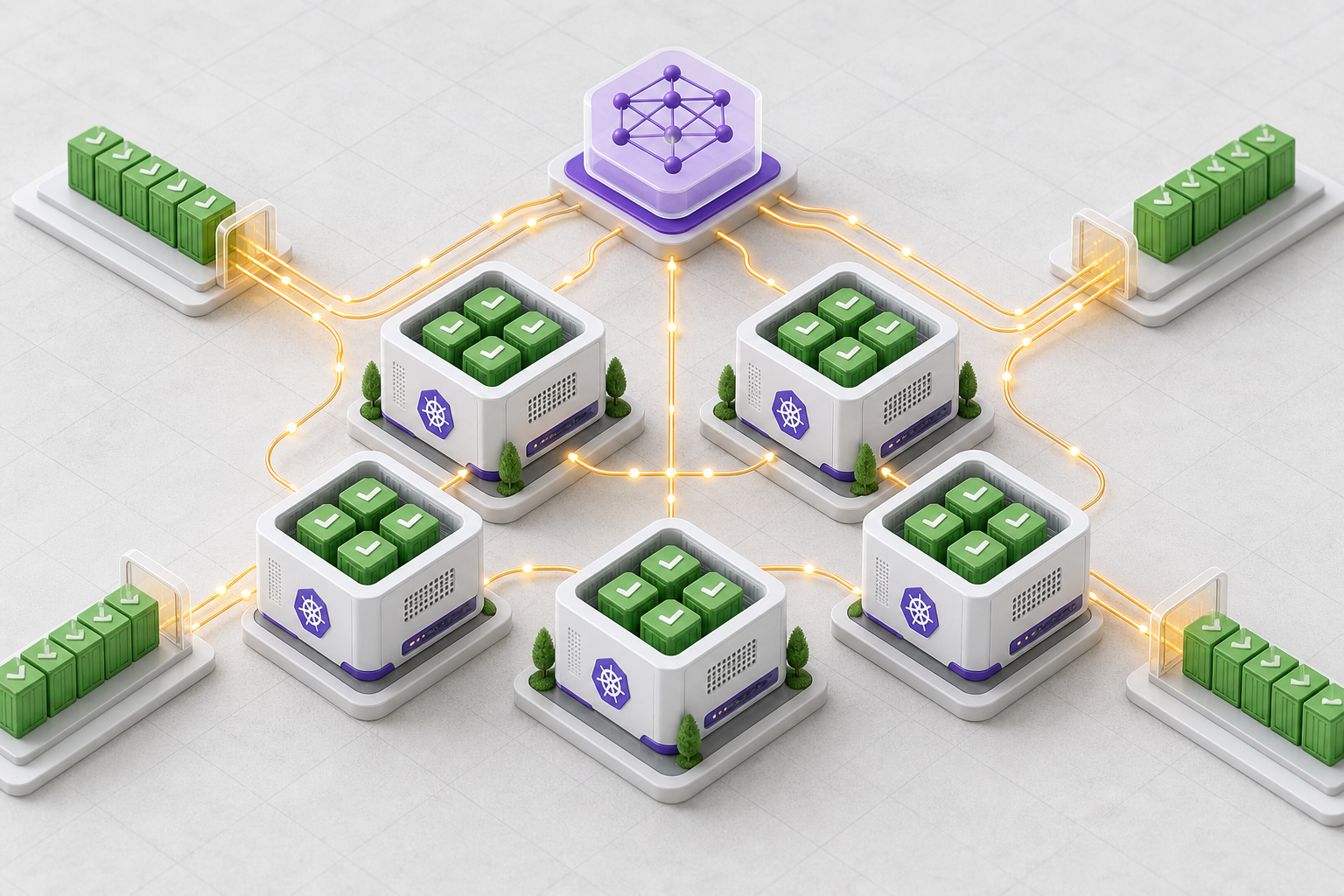
Test orchestration is the coordination of test execution, environments, data, dependencies, and reporting across distributed infrastructure. Kubernetes is a container orchestration platform that lets QA teams run elastic test workloads as pods instead of fixed machines. Auto-scaling is the automatic adjustment of compute capacity based on demand, and an AI scheduler is a decision engine that uses signals such as queue depth, flakiness, historical runtime, and risk to place tests intelligently.
AI test orchestration in Kubernetes lets QA teams run the right tests on the right compute at the right time. It reduces queue delays by scaling runners, browsers, devices, and service dependencies automatically while using AI-driven scheduling to prioritise high-risk feedback. The result is faster release confidence without permanently overprovisioning QA infrastructure.
Why Kubernetes Changes Test Orchestration Economics
Kubernetes makes test orchestration economically viable at scale because test capacity can expand and contract with pipeline demand. Instead of buying for peak load, teams can provision ephemeral execution capacity only when the quality signal is worth the spend.
Traditional QA infrastructure often fails in two opposing ways: too little capacity during release crunches and too much idle capacity overnight. A Kubernetes-native model treats UI grids, API test runners, contract-test workers, synthetic data services, and disposable environments as short-lived workloads. That shift is especially valuable for organisations practising continuous testing, where feedback must arrive while the code is still fresh.
In mature teams, the impact is measurable. Moving from static runners to auto-scaled Kubernetes test pools commonly reduces median CI wait time by 35% to 60%, cuts idle compute by 25% to 45%, and shortens pull-request feedback by 20% to 40%. The exact gain depends less on Kubernetes itself and more on how well scheduling decisions reflect test value, runtime variance, and infrastructure constraints.
The orchestration layer also becomes a control plane for quality economics. A low-risk documentation change should not consume the same browser grid budget as a checkout-flow refactor. A Kubernetes-backed AI scheduler can make that distinction continuously, not through a manually maintained CI matrix that decays every sprint.
Core Architecture for AI Test Orchestration on Kubernetes
A scalable architecture separates scheduling intelligence from execution infrastructure. The AI scheduler decides what should run, Kubernetes decides where it can run, and observability systems close the loop with evidence about cost, latency, and reliability.
The baseline pattern has five layers. The CI system emits an event, the AI scheduler scores candidate test suites, a queue service stores executable work, Kubernetes starts runners or browser pods, and a reporting layer merges results into a release signal. Each layer should be independently replaceable because test strategy changes faster than platform primitives.
For UI automation, Selenium Grid, Playwright workers, or browser containers usually sit behind a service that hides pod churn from test code. For API and component tests, lightweight runner pods can be created per shard. For performance testing, node pools should be isolated because noisy neighbours can invalidate latency measurements.
The AI scheduler is not a replacement for Kubernetes scheduling. Kubernetes knows about CPU, memory, taints, topology, and node availability. The AI scheduler knows about test history, product risk, changed files, flaky signatures, escaped defects, and business impact. Good systems let each scheduler do the job it is designed to do.
How does an AI scheduler decide which tests run first?
An AI scheduler prioritises tests by estimating the value of feedback per unit of time and cost. It typically combines static signals such as changed files and ownership maps with dynamic signals such as recent failures, flakiness, runtime distribution, and defect history.
A practical scoring model can start simple. Give higher priority to tests covering changed components, recently unstable areas, revenue-critical journeys, security-sensitive flows, and historically defect-prone modules. Penalise tests with low diagnostic value, high flakiness, or excessive duration unless the risk context justifies them.
More advanced teams use learning-to-rank models that compare prior scheduling decisions against actual defect discovery. The model should be explainable enough for QA leads to challenge it. A black-box scheduler that silently deprioritises important regression tests will lose trust quickly, even if its average metrics look attractive.
When should Kubernetes scale test infrastructure automatically?
Kubernetes should scale test infrastructure when queue delay, pending pod count, active browser sessions, or runner utilisation crosses a threshold tied to feedback service-level objectives. Scaling purely on CPU is usually insufficient because many test workloads are I/O-bound, browser-bound, or blocked on external dependencies.
For CI test farms, queue depth is often the best leading indicator. If 400 Playwright shards are waiting and only 20 browser pods exist, CPU may still look calm while developers wait 30 minutes for feedback. Event-driven auto-scaling with KEDA or custom metrics from the CI queue handles that pattern better than horizontal pod autoscaling alone.
Node provisioning matters too. Cluster Autoscaler, Karpenter, or a managed cloud equivalent should add nodes quickly enough that pods do not spend most of their lifetime pending. Teams targeting sub-10-minute pull-request feedback often need pre-warmed capacity for business hours and aggressive scale-down outside peak windows.
Auto-Scaling Strategies for QA Workloads in Kubernetes
Auto-scaling works best when each test workload has a scaling signal that reflects its bottleneck. Browser grids, API runners, mobile device proxies, and environment services do not scale well under the same rule.
Horizontal Pod Autoscaling is useful when runner pods are long-lived and resource utilisation correlates with work. Event-driven scaling is better when jobs are queued externally and pods should exist only while work is pending. Node auto-scaling is required when pod replicas cannot be scheduled because the cluster lacks capacity.
Teams often combine all three. KEDA scales runner deployments from CI queue metrics, Kubernetes schedules pods based on requests and limits, and Karpenter provisions the right instance types for CPU-heavy, memory-heavy, or browser-heavy workloads. The goal is not maximum scale; it is enough scale to meet the feedback objective with minimum waste.
| Approach | Best fit | Primary signal | Common risk |
|---|---|---|---|
| Horizontal Pod Autoscaler | Long-running runners and shared services | CPU, memory, or custom metrics | Misses queue pressure when pods are idle but demand is high |
| KEDA event-driven scaling | CI jobs, test queues, browser sessions, message-backed workloads | Queue depth, pending jobs, external metrics | Can thrash if cooldowns and max replicas are too aggressive |
| Cluster Autoscaler | General node capacity expansion | Unschedulable pods | May react too slowly for short-lived test bursts |
| Karpenter-style provisioning | Mixed workload clusters needing fast right-sized nodes | Pod scheduling requirements and constraints | Requires strong guardrails to control instance cost |
| Pre-warmed runner pools | High-volume teams with strict feedback SLAs | Time-of-day demand forecast | Can reintroduce idle spend if forecasts are stale |
Resource requests deserve special attention. Under-request CPU and browser tests become unstable; over-request memory and bin-packing collapses. For browser automation, teams often find that one Chromium instance needs 1.5 to 2.5 CPU cores and 2 to 4 GB of memory under realistic test loads, especially when video recording or tracing is enabled.
Scaling limits should be business decisions, not only platform settings. If the AI scheduler can launch 2,000 shards but the staging payment service can safely handle only 150 concurrent sessions, the scheduler must respect that limit. Treat downstream dependency capacity as part of the test orchestration contract.
A Reference Kubernetes Configuration for Elastic Test Runners
A useful Kubernetes configuration ties runner replicas to external test demand while protecting the cluster from runaway concurrency. The following example shows the shape of an event-driven setup rather than a vendor-specific production template.
This pattern uses a queue-backed scaler, explicit resource requests, node isolation, and environment variables that let each pod claim a shard. In production, secrets, network policies, and workload identity should be added according to your platform standards.
apiVersion: apps/v1
kind: Deployment
metadata:
  name: playwright-test-runner
  namespace: qa-execution
spec:
  replicas: 0
  selector:
    matchLabels:
      app: playwright-test-runner
  template:
    metadata:
      labels:
        app: playwright-test-runner
    spec:
      nodeSelector:
        workload: qa-browser
      tolerations:
        - key: qa-browser
          operator: Equal
          value: true
          effect: NoSchedule
      containers:
        - name: runner
          image: registry.example.com/qa/playwright-runner:2026.05
          resources:
            requests:
              cpu: 2
              memory: 3Gi
            limits:
              cpu: 3
              memory: 4Gi
          env:
            - name: TEST_QUEUE_URL
              valueFrom:
                secretKeyRef:
                  name: qa-queue
                  key: url
            - name: MAX_TEST_RETRIES
              value: 1
---
apiVersion: keda.sh/v1alpha1
kind: ScaledObject
metadata:
  name: playwright-runner-scaler
  namespace: qa-execution
spec:
  scaleTargetRef:
    name: playwright-test-runner
  minReplicaCount: 0
  maxReplicaCount: 250
  pollingInterval: 15
  cooldownPeriod: 180
  triggers:
    - type: prometheus
      metadata:
        serverAddress: http://prometheus.monitoring.svc:9090
        metricName: pending_high_value_test_shards
        threshold: 8
        query: sum(qa_test_queue_pending{priority='high',suite='playwright'})
The important design choice is the metric. Scaling on pending high-value shards gives the AI scheduler a way to influence capacity without bypassing Kubernetes. If the scheduler raises the priority of checkout regression tests after a payment code change, the scaler sees the queue pressure and expands execution capacity.
Cooldowns should reflect test duration. If most shards finish in 90 seconds, a 10-minute cooldown wastes money. If browser pods take two minutes to initialise and tests run for eight minutes, a short cooldown can terminate capacity just before the next wave of work arrives.
Scheduling Signals That Make AI Useful Instead of Decorative
AI improves test orchestration only when it receives reliable signals and has authority to change execution order, scope, or capacity class. Without those two conditions, it becomes a dashboard label rather than an operational capability.
The most valuable signal is change impact. Mapping commits to components, APIs, pages, contracts, database tables, and feature flags lets the scheduler run targeted suites before broad regression. This is where risk-based testing becomes executable rather than theoretical.
Runtime distribution is the second critical signal. Mean runtime is misleading because test suites often have long tails caused by retries, slow environments, and browser startup. Scheduling by p50, p90, and historical variance helps the system avoid placing too many long shards at the end of a pipeline.
Flakiness needs nuance. A flaky test should not always be deprioritised because it may still cover a critical flow. Instead, the scheduler should route flaky tests into quarantine lanes, require corroborating failures, or run them on more stable capacity while preserving their diagnostic value for regression testing.
Cost per signal is the underused metric. A suite that costs 500 CPU-minutes and finds one low-severity issue per quarter should not block every pull request. A five-minute contract suite that catches integration breaks weekly deserves premium scheduling priority.
How does test flakiness affect auto-scaling decisions?
Test flakiness increases infrastructure demand because retries, reruns, and manual investigations consume capacity without adding proportional confidence. An AI scheduler should model flakiness as a capacity tax, not merely as a pass-fail quality problem.
If a suite has a 6% false-failure rate and every failure triggers a rerun, peak demand can rise sharply during release windows. That creates a feedback loop where flaky suites delay reliable suites, developers retry pipelines, and auto-scaling expands the cluster to process noise. Quarantine policies, retry budgets, and flake-aware prioritisation prevent infrastructure from amplifying bad tests.
Can AI scheduling replace test selection rules?
AI scheduling should complement test selection rules, not replace deterministic guardrails. Mandatory smoke tests, compliance checks, security scans, and release gates should remain explicit because their absence is a governance risk.
The best model is layered. Hard rules define what must always run, risk rules define what should usually run, and AI ranking decides order, shard size, concurrency, and capacity class. This keeps the system auditable while still adapting to real execution data.
Where Teams Commonly Get Kubernetes Test Orchestration Wrong
Teams usually struggle when they treat Kubernetes as magic capacity instead of a constrained shared system. Test orchestration breaks down when scheduling logic ignores dependencies, observability, and the economics of failed feedback.
The first pitfall is scaling runners without scaling the systems under test. If 300 API test pods hit a staging environment sized for 30 users, failures will reflect environment saturation rather than product defects. Concurrency limits must be applied per dependency, not only per test framework.
The second pitfall is letting every test class share the same node pool. Browser automation, load generators, mock services, and database-heavy integration tests have different resource profiles. Separate node pools, taints, and priority classes reduce interference and make cost attribution possible.
The third pitfall is ignoring image startup time. Large runner images with browsers, SDKs, and test assets can add minutes before execution begins. Teams frequently gain more by slimming images and pre-pulling them than by increasing max replicas.
The fourth pitfall is weak result correlation. If a pod dies, a node is evicted, or a test is retried, the reporting system must preserve lineage from commit to shard to pod to artefact. Without this, root cause analysis becomes guesswork and AI feedback loops learn from corrupted labels.
The fifth pitfall is unbounded AI authority. A model that can skip suites, raise concurrency, and spend cloud budget needs policy constraints. Finance, security, and release governance should be encoded as hard limits that the scheduler cannot override.
Observability Metrics for Auto-Scaling QA Infrastructure
Effective observability measures feedback speed, signal quality, and infrastructure efficiency together. CPU utilisation alone cannot tell whether test orchestration is improving release confidence.
Start with pipeline-level metrics: queue wait time, time to first failure, time to full result, and percentage of feedback delivered within SLA. These metrics expose whether auto-scaling actually helps developers. A cluster that looks efficient but returns results after code context is lost is failing the QA mission.
Next, measure test-signal metrics: failure detection rate, false-failure rate, retry rate, quarantine growth, escaped defect correlation, and failure clustering by component. These show whether the AI scheduler is prioritising useful evidence. A common target is to deliver 80% of historically defect-finding tests within the first 20% to 30% of pipeline time.
Finally, track infrastructure metrics: pod pending time, node provisioning latency, image pull duration, cost per successful test minute, cost per actionable failure, and idle capacity by node pool. Cost per actionable failure is blunt but valuable. It forces teams to compare expensive suites against the defects they actually reveal.
Prometheus, OpenTelemetry, CI metadata, and test management data should converge into a single analytical model. The scheduler does not need every metric in real time, but it does need clean historical features. Bad labels, missing artefacts, and inconsistent suite names degrade AI scheduling faster than most model choices.
Security, Isolation, and Compliance in Elastic Test Clusters
Elastic test clusters need production-grade security because test workloads often touch credentials, customer-like data, internal APIs, and deployment systems. Auto-scaling increases the number of ephemeral execution points, so isolation must be designed before scale arrives.
Use namespaces to separate teams, products, and trust levels. Apply network policies so test pods can reach only the services they need. Use short-lived credentials and workload identity rather than static secrets baked into runner images.
Test data deserves the same discipline. Synthetic data is safer for broad parallel execution, while masked production snapshots require stricter access controls and auditability. If a scheduler can launch hundreds of pods, it can also amplify a data-handling mistake hundreds of times.
Supply-chain controls also matter. Runner images should be scanned, signed, and pinned by digest. Browser images and test utilities change frequently, so uncontrolled latest tags can turn a stable pipeline into a moving target overnight.
Adoption Roadmap for Scaling Without Losing Control
The safest adoption path starts with bounded automation and expands authority as evidence improves. Teams should prove that the scheduler can make reliable local decisions before allowing it to control broad regression scope or large cloud spend.
Phase one is instrumentation. Capture suite duration, shard duration, flakiness, retry causes, queue time, pod pending time, and dependency saturation. Do not introduce AI scheduling until these signals are trustworthy enough to support decisions.
Phase two is elastic execution for a narrow workload. A Playwright smoke suite or API contract suite is a good candidate because demand is visible and feedback value is high. Set conservative max replicas, isolate nodes, and compare feedback time against the previous static pool.
Phase three is priority-aware scheduling. Let the AI scheduler order tests but not skip mandatory suites. This stage usually exposes gaps in ownership maps, test metadata, and component tagging.
Phase four is cost-aware optimisation. Add budgets, concurrency ceilings, and workload classes such as fast smoke, high-risk regression, quarantine, nightly exhaustive, and release-candidate validation. At this point, the platform can make nuanced trade-offs between speed, risk, and cost.
Phase five is continuous learning. Review scheduler decisions after incidents, escaped defects, and major releases. The model should learn from outcomes, but QA leadership should still review policy changes that affect release gates.
Key Takeaways
- AI test orchestration in Kubernetes works best when AI ranks test value while Kubernetes handles resource placement and scaling mechanics.
- Queue depth, pending shards, browser sessions, and dependency capacity are usually better scaling signals for QA workloads than CPU alone.
- Auto-scaling reduces waste only when resource requests, node pools, cooldowns, and concurrency limits match real test behaviour.
- Flaky tests create a capacity tax, so schedulers must account for retries and false failures instead of blindly scaling around them.
- Risk-based scheduling should be layered with deterministic release gates to keep AI decisions auditable and safe.
- Observability must connect test results, pod lifecycle, cost, and defect outcomes so the scheduler learns from valid evidence.
- The most reliable adoption path is incremental: instrument first, scale one workload, add priority-aware scheduling, then optimise for cost and risk.