
Shift-right testing is the practice of extending quality validation into production using telemetry, controlled exposure, user behavior signals, and operational feedback. For QA teams in 2026, it does not replace shift-left testing; it closes the gap between what pre-production tests predict and what distributed systems actually do under real traffic, real data, real devices, and real failure modes.
Shift-right testing means testing and validating software after release by using observability, production monitoring, synthetic checks, feature flags, and live user signals. It helps QA teams detect defects that only appear in production, reduce mean time to detection, and feed real evidence back into CI/CD quality gates.
Shift-Right Testing Extends QA Into Real Production Behavior
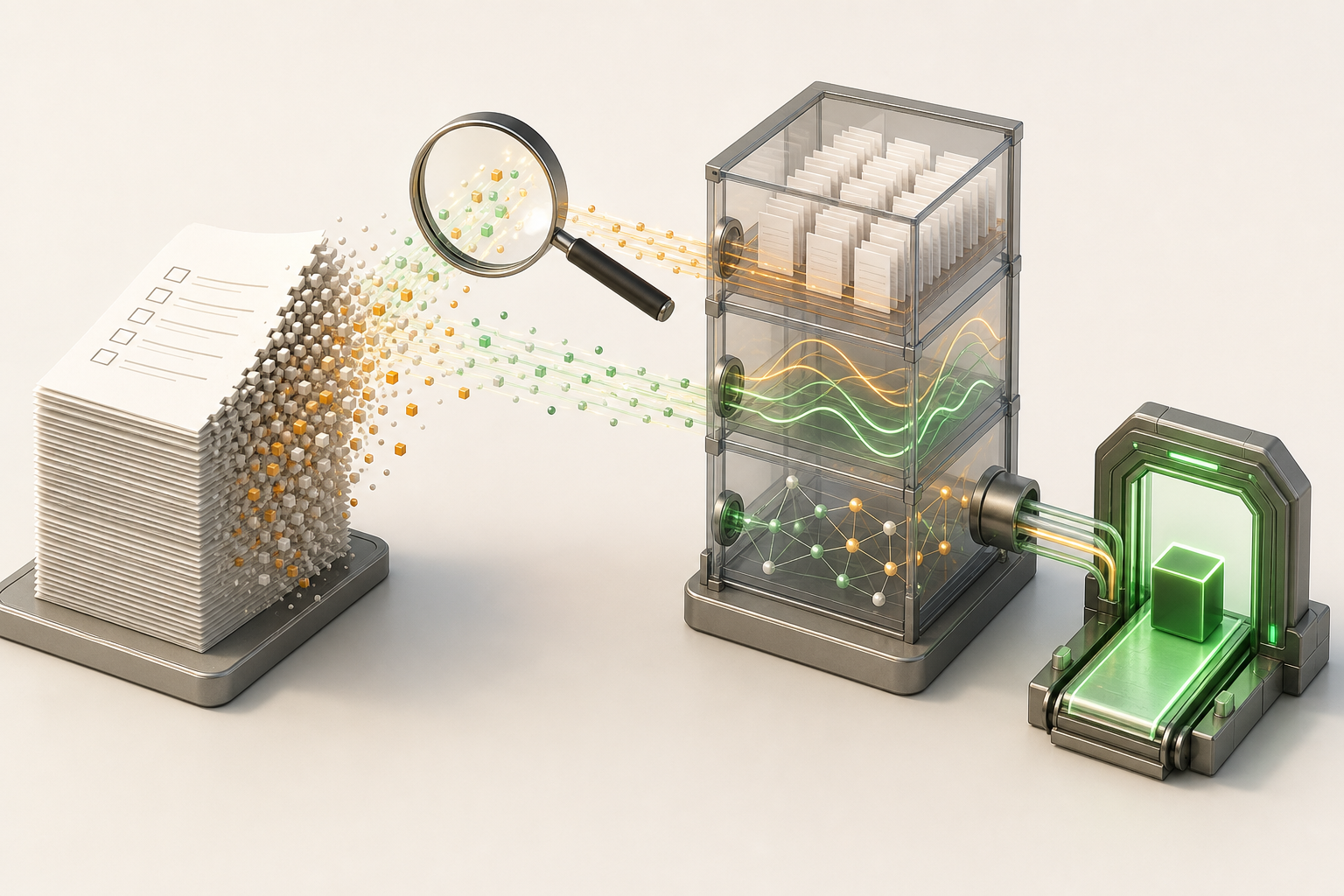
Shift-right testing works because production exposes combinations that staging cannot fully reproduce. It turns production from a passive risk zone into an active quality signal source.
Shift-left testing is the practice of moving validation earlier in the delivery lifecycle through unit tests, contract tests, static analysis, and automated checks in CI/CD. It is still essential, but it is bounded by assumptions about data shape, infrastructure parity, third-party dependencies, browser diversity, and user behavior.
Observability testing is the practice of validating whether a system can explain its state through logs, metrics, traces, events, and user experience signals. In mature teams, QA does not merely ask whether a feature passed a test; QA asks whether the released feature can be diagnosed when it fails for one customer segment, one geography, or one dependency path.
The shift-right mindset changes the QA question from “Did it pass before deployment?” to “Can we prove it is behaving correctly after deployment?” That distinction matters in microservices, mobile backends, AI-assisted workflows, payment flows, and high-traffic SaaS platforms where hidden defects may surface only after exposure.
Observability Testing Makes Production Quality Measurable
Observability testing makes production quality measurable by ensuring that quality signals are designed, instrumented, and reviewed before incidents occur. Without observability, production monitoring becomes a collection of alerts rather than a QA feedback system.
Production monitoring is the continuous collection and evaluation of live system health, performance, availability, and user-impact signals. Continuous monitoring QA is the discipline of using those production signals as part of ongoing quality assurance, release validation, regression detection, and risk management.
A strong observability testing strategy covers three layers. The first layer is service health, including latency, error rate, saturation, and availability. The second layer is business correctness, including checkout success, search relevance, entitlement checks, and message delivery completion.
The third layer is user experience, including Core Web Vitals, mobile crash-free sessions, rage clicks, session abandonment, and client-side exceptions. QA teams often miss this layer because traditional test suites focus on server behavior, while the user experiences the full chain of client, network, API, authentication, rendering, and third-party scripts.
How does observability testing differ from traditional test automation?
Observability testing differs from traditional test automation because it validates diagnosability and production behavior, not only expected outputs in controlled environments. A Selenium or API test may prove that a checkout flow works in staging, while observability testing proves that production exposes the right traces, metrics, and alerts when checkout degrades for a subset of users.
Traditional automation is deterministic by design. Observability-driven QA accepts that production systems are probabilistic, distributed, and affected by variable traffic patterns.
The best teams connect both worlds. A failed production SLO should generate a hypothesis, a reproducible test, and eventually a stronger pre-production quality gate.
When should QA validate telemetry before release?
QA should validate telemetry before release whenever a feature changes user journeys, service dependencies, performance risk, data integrity, or incident response expectations. Telemetry is part of the acceptance criteria, not an afterthought for operations.
For a new payment workflow, for example, QA should verify that traces include gateway calls, retry attempts, idempotency keys, and failure classifications. For a personalization feature, QA should check that experiment exposure, model fallback, and segment-level outcomes can be observed without leaking sensitive data.
A practical rule is simple: if a defect would require a production investigation, the release should include the signals needed for that investigation. Otherwise, the team is choosing longer outages and weaker root cause analysis.
Shift-Right and Shift-Left Solve Different Quality Risks
Shift-right and shift-left are complementary because they address different categories of quality risk. Shift-left reduces preventable defects before release, while shift-right reduces unknowns after release.
High-performing teams use shift-left to catch deterministic failures and shift-right to detect emergent behavior. A contract test can catch a breaking API schema, but only production telemetry may reveal that a downstream partner times out under month-end traffic.
| Approach | Primary QA Purpose | Best Signals | Common Weakness |
|---|---|---|---|
| Shift-left testing | Prevent defects before deployment | Unit tests, API tests, contract tests, static analysis, CI results | Can miss production-only data, load, dependency, and configuration issues |
| Shift-right testing | Validate behavior after controlled release | Metrics, traces, logs, synthetic checks, RUM, feature flag outcomes | Can become reactive if not tied to release gates and ownership |
| Continuous monitoring QA | Turn live signals into ongoing quality evidence | SLOs, error budgets, anomaly detection, business KPIs, incident trends | Can create alert fatigue if signals are noisy or poorly prioritized |
| Chaos and resilience validation | Expose failure handling under controlled disruption | Recovery time, fallback usage, queue depth, retry storms, customer impact | Can be risky without blast-radius controls and rollback mechanisms |
In practice, the boundary between approaches should be porous. A production incident should create regression tests, contract checks, alert improvements, and release policy changes.
Teams that treat shift-right testing as a substitute for pre-release discipline usually increase production risk. Teams that treat it as a feedback amplifier typically shorten defect escape cycles by 25 percent to 45 percent and reduce mean time to detection from hours to minutes.
Production Monitoring Becomes QA Evidence When It Uses SLOs
Production monitoring becomes QA evidence when it is mapped to service-level objectives and user outcomes. Raw dashboards are useful, but SLOs define whether the product is good enough for real users.
A service-level objective is a target reliability or performance threshold that expresses acceptable user experience, such as 99.9 percent successful API responses under 300 milliseconds. An error budget is the allowable amount of unreliability within an SLO window.
QA teams should participate in SLO design because many SLOs encode quality decisions. A system can be technically available while still failing quality expectations if users cannot complete purchases, upload documents, or receive one-time passwords within the expected window.
Good SLOs are user-centered, measurable, and actionable. A weak SLO says “CPU should stay below 80 percent,” while a strong SLO says “99.5 percent of authenticated search requests should return relevant results within one second over a rolling seven-day window.”
How do SLOs improve release decisions?
SLOs improve release decisions by giving QA, engineering, and operations a shared threshold for acceptable production behavior. Instead of debating whether a dashboard “looks normal,” the team can decide whether the release is burning error budget too quickly.
For canary releases, SLOs provide objective promotion or rollback criteria. If the canary cohort shows a 2 percent increase in checkout failures or a 20 percent increase in p95 latency, QA can stop the rollout with evidence rather than opinion.
In mature pipelines, SLO status becomes a release gate. A deployment may pass automated tests but still be blocked if the target service is already consuming too much error budget.
Release Strategies That Make Shift-Right Testing Safer
Shift-right testing is safest when production exposure is controlled, reversible, and measurable. The goal is not to test recklessly in production; the goal is to reduce uncertainty without exposing all users to avoidable risk.
A feature flag is a runtime control that enables or disables functionality without redeploying code. A canary release is a deployment strategy that exposes a change to a small subset of traffic before broader rollout. A blue-green deployment is a release approach that shifts traffic between two production environments to reduce downtime and rollback complexity.
QA should influence how these strategies are used. A flag with no telemetry is only a switch. A canary with no acceptance thresholds is only a partial release.
| Technique | Best Use Case | QA Validation Focus | Rollback Trigger |
|---|---|---|---|
| Feature flags | Gradual enablement by cohort, tenant, geography, or role | Flag state correctness, exposure logging, fallback behavior, stale flag cleanup | Business KPI drop, elevated exceptions, support spikes, segment-specific failures |
| Canary release | Low-risk validation of a new build under limited live traffic | Canary versus baseline comparison, latency, error rate, conversion impact | SLO breach, anomaly detection, higher incident severity than baseline |
| Blue-green deployment | Fast cutover with simple rollback for environment-level changes | Environment parity, database compatibility, session continuity, cache behavior | Health check failure, migration conflict, authentication or routing issue |
| Shadow traffic | Testing new services with copied production requests | Response divergence, performance, scaling behavior, data safety controls | Resource saturation, sensitive data exposure risk, unacceptable divergence |
Most organizations already use some of these techniques, but QA involvement is uneven. The practical improvement is to define release hypotheses before rollout and map each hypothesis to a monitor, trace, log event, or user metric.
An Observability-Driven QA Pipeline Needs Explicit Quality Gates
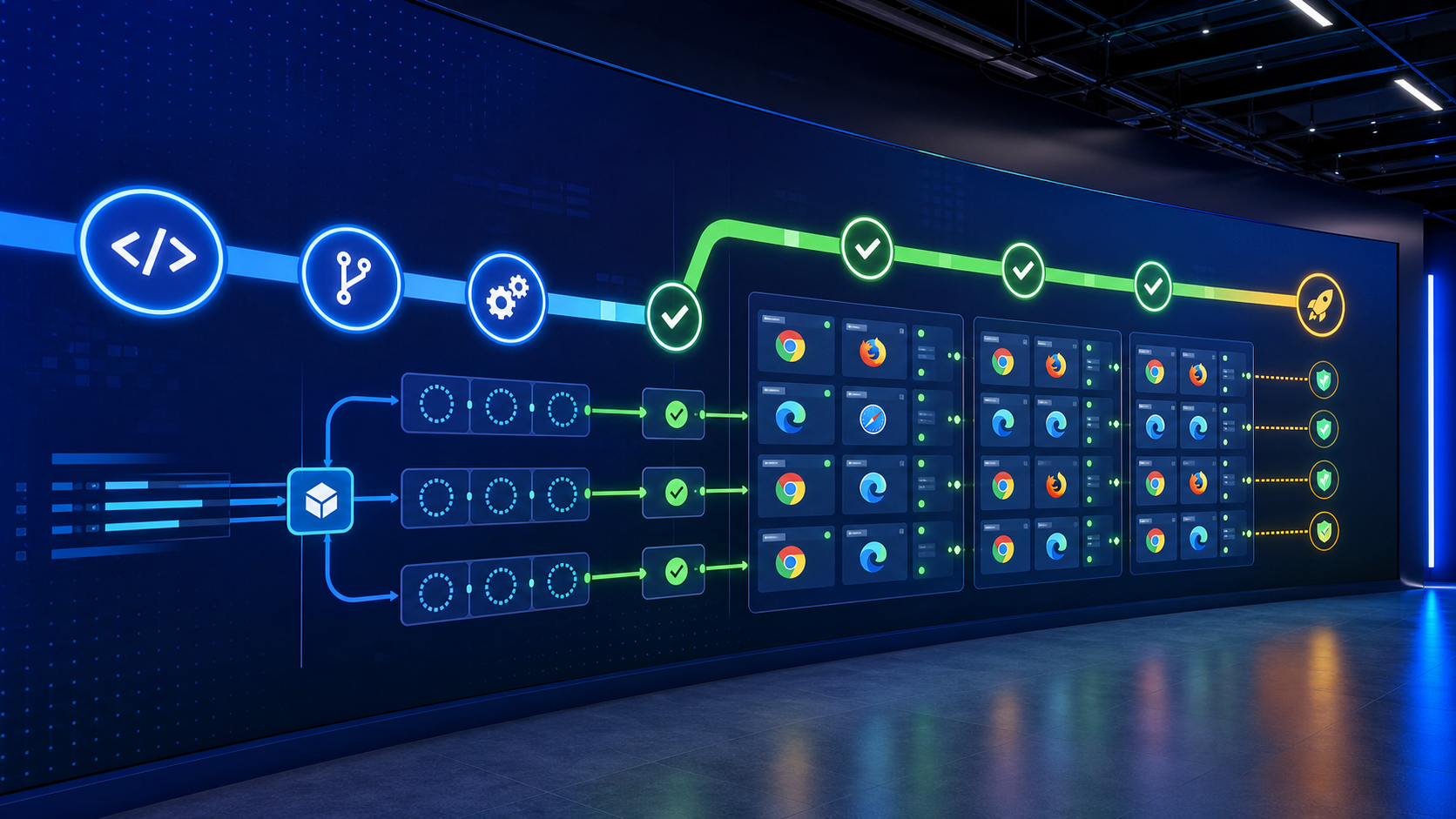
An observability-driven QA pipeline needs explicit quality gates that connect CI/CD results to production health. Without those gates, production data remains informative but not operationally decisive.
A quality gate is a rule that determines whether a release can progress, pause, roll back, or require human review. In shift-right testing, quality gates include both pre-release checks and post-release production conditions.
A practical pipeline might run unit tests, contract tests, security scans, and API regression tests before deployment. After deployment, it may run synthetic monitoring, compare canary telemetry against baseline, check SLO burn rate, and inspect critical business metrics before widening exposure.
The following example shows a simplified GitHub Actions job that validates production canary health before approving a wider rollout. It treats monitoring data as a release input rather than a dashboard someone may or may not inspect.
name: production-canary-quality-gate
on:
  workflow_dispatch:

jobs:
  verify-canary:
    runs-on: ubuntu-latest
    steps:
      - name: Check canary SLO burn rate
        run: |
          RESPONSE=$(curl -sS "https://observability.example.com/api/slo/canary-checkout?window=30m")
          ERROR_BUDGET_BURN=$(echo "$RESPONSE" | jq -r '.errorBudgetBurn')
          P95_LATENCY_MS=$(echo "$RESPONSE" | jq -r '.p95LatencyMs')
          CHECKOUT_FAILURE_RATE=$(echo "$RESPONSE" | jq -r '.checkoutFailureRate')

          if (( $(echo "$ERROR_BUDGET_BURN > 2.0" | bc -l) )); then
            echo "Canary failed: error budget burn too high"
            exit 1
          fi

          if (( $(echo "$P95_LATENCY_MS > 750" | bc -l) )); then
            echo "Canary failed: p95 latency exceeds threshold"
            exit 1
          fi

          if (( $(echo "$CHECKOUT_FAILURE_RATE > 0.015" | bc -l) )); then
            echo "Canary failed: checkout failures exceed threshold"
            exit 1
          fi

          echo "Canary quality gate passed"
The exact tooling can vary. Teams may use OpenTelemetry, Prometheus, Grafana, Datadog, New Relic, Honeycomb, Splunk, Elastic, or cloud-native monitoring stacks.
The architectural principle is stable across tools: every release should generate observable evidence, and that evidence should have an owner, a threshold, and an automated consequence where possible.
What Teams Commonly Get Wrong With Shift-Right Testing
Teams commonly get shift-right testing wrong by confusing production visibility with production quality control. Seeing a problem faster is valuable, but preventing blast radius and closing the feedback loop are what make the practice strategic.
The first mistake is instrumenting only technical health. CPU, memory, pod restarts, and HTTP 500s matter, but they rarely tell the full customer story. A release can show normal infrastructure metrics while silently reducing form completion or increasing payment declines.
The second mistake is creating noisy alerts that train teams to ignore production signals. Alert fatigue is a QA risk because critical regressions get buried under low-action notifications. In many organizations, more than 35 percent of alerts are never investigated because they lack clear ownership or user impact.
The third mistake is using production users as unpaid testers without guardrails. Ethical shift-right testing requires small blast radius, fast rollback, privacy controls, and clear limits on experiments that affect customer outcomes.
The fourth mistake is failing to convert incidents into tests. If a production incident does not result in a stronger contract test, synthetic journey, SLO, runbook, or data validation rule, the team has learned operationally but not improved systemically.
Why does alert fatigue undermine continuous monitoring QA?
Alert fatigue undermines continuous monitoring QA because it reduces trust in the signals that should guide release safety. When alerts are noisy, duplicated, or unactionable, teams delay response and production monitoring becomes background noise.
QA leaders should push for alert quality metrics, including alert precision, time to acknowledge, false-positive rate, and percentage of alerts tied to user impact. A smaller set of high-confidence alerts usually outperforms a broad dashboard wall.
Runbooks also matter. An alert that cannot tell an on-call engineer what changed, who owns the service, and what rollback option exists is not a quality gate.
Metrics That Prove Shift-Right Testing Is Working
Shift-right testing is working when production defects are detected earlier, contained faster, and converted into stronger pre-production controls. Vanity dashboard counts do not prove maturity.
The most useful metrics connect quality, delivery, and operations. Mean time to detection measures how quickly the team discovers an issue. Mean time to recovery measures how quickly service is restored or customer impact is mitigated.
Defect escape rate remains relevant, but it should be segmented by severity and detection source. A severe defect found by a synthetic journey within three minutes is very different from a severe defect reported by customers after four hours.
Teams using mature canary analysis and SLO-based gates commonly report 30 percent to 50 percent faster rollback decisions. Teams that instrument critical user journeys often reduce customer-reported incidents by 20 percent to 35 percent because internal monitors detect degradation first.
- Mean time to detection: the time from defect introduction to reliable detection by telemetry, synthetic checks, or human report.
- Canary promotion accuracy: the percentage of canary decisions later confirmed by stable production behavior.
- SLO burn rate during releases: the speed at which a release consumes the agreed reliability budget.
- Synthetic journey pass rate: the health of critical workflows such as login, search, checkout, upload, and notification delivery.
- Incident-to-test conversion: the percentage of production incidents that produce a new automated test, monitor, or quality gate.
- Rollback time: the time needed to disable a flag, revert traffic, or restore a known-good build.
Where Shift-Right Testing Breaks Down
Shift-right testing breaks down when systems lack safe rollout controls, reliable telemetry, ownership, or privacy discipline. It is not a maturity shortcut for unstable delivery practices.
Highly regulated systems may limit the scope of live experiments, especially where financial, medical, or safety outcomes are involved. In those contexts, shift-right should emphasize passive observability, synthetic monitoring, shadow validation, and controlled internal cohorts rather than broad production experimentation.
Legacy systems can also constrain observability. If correlation IDs, structured logs, and service boundaries are absent, QA may need to start with transaction tracing around the most critical flows before expecting SLO-driven release automation.
Data privacy is another hard boundary. Observability should never expose secrets, personal data, payment information, health records, or sensitive tenant identifiers in logs or traces. QA should include telemetry redaction and retention checks in release readiness reviews.
The approach also fails culturally when QA is invited only after deployment. Shift-right testing requires QA to influence instrumentation, rollout plans, alert thresholds, and incident reviews before the release begins.
A Practical 2026 Maturity Model for Shift-Right QA
A practical shift-right maturity model helps teams improve without pretending they can implement full observability-driven QA in one sprint. The path usually moves from visibility, to controlled release, to automated decisioning.
At level one, teams have basic production monitoring and manual dashboard review. QA may inspect logs or metrics after incidents, but production signals rarely influence release decisions.
At level two, teams define critical user journeys and add synthetic monitoring, real user monitoring, and structured error tracking. QA starts using production data to prioritize regression coverage and risk-based testing.
At level three, teams adopt feature flags, canaries, SLOs, and release-specific health checks. Production monitoring becomes part of release acceptance, and rollback decisions are based on agreed thresholds.
At level four, observability data feeds automated quality gates, anomaly detection, and incident-to-test workflows. This is where continuous monitoring QA becomes a closed loop rather than a collection of dashboards.
At level five, teams use production learning to optimize architecture, test strategy, customer segmentation, and resilience engineering. QA becomes an evidence function across the software lifecycle, not a phase or a sign-off activity.
Can shift-right testing work without full observability maturity?
Shift-right testing can work without full observability maturity if the team starts with a narrow, high-value production journey. A checkout flow, authentication flow, claims submission, or document upload pipeline can produce enough signal to justify the practice.
The minimum viable setup includes a synthetic check, a user-impact metric, structured error tracking, a rollback mechanism, and an owner. That is enough to reduce blind spots while the broader observability platform evolves.
Trying to instrument everything at once often delays value. Mature teams pick the flows where a production defect would be expensive, visible, or hard to reproduce.
How QA Teams Should Operationalize Shift-Right Testing
QA teams should operationalize shift-right testing by making production evidence part of planning, release criteria, and retrospectives. The work starts before code reaches production.
During refinement, QA should ask what production signals will prove the feature is working. During test design, QA should identify which defects are likely to escape staging and how they would be detected in live traffic.
During release planning, QA should define the blast radius, rollout stages, synthetic journeys, SLO thresholds, and rollback triggers. During post-release review, QA should compare expected behavior with observed behavior and update the test strategy.
This creates a durable feedback loop. Production does not become a place where quality is guessed; it becomes a source of continuously validated evidence.
Key Takeaways
- Shift-right testing extends QA into production so teams can validate real user behavior, dependency behavior, and operational risk that staging cannot fully reproduce.
- Observability testing is most valuable when telemetry is treated as release acceptance criteria, not as an optional operations concern after deployment.
- Production monitoring becomes QA evidence when it is mapped to SLOs, critical user journeys, business correctness, and rollback thresholds.
- Feature flags, canary releases, shadow traffic, and blue-green deployments make production validation safer by limiting blast radius and enabling fast reversal.
- Continuous monitoring QA fails when alerts are noisy, ownership is unclear, privacy is ignored, or incidents do not produce stronger tests and quality gates.
- The strongest shift-right programs close the loop by turning production incidents into automated regressions, synthetic checks, SLO improvements, and pipeline gates.