
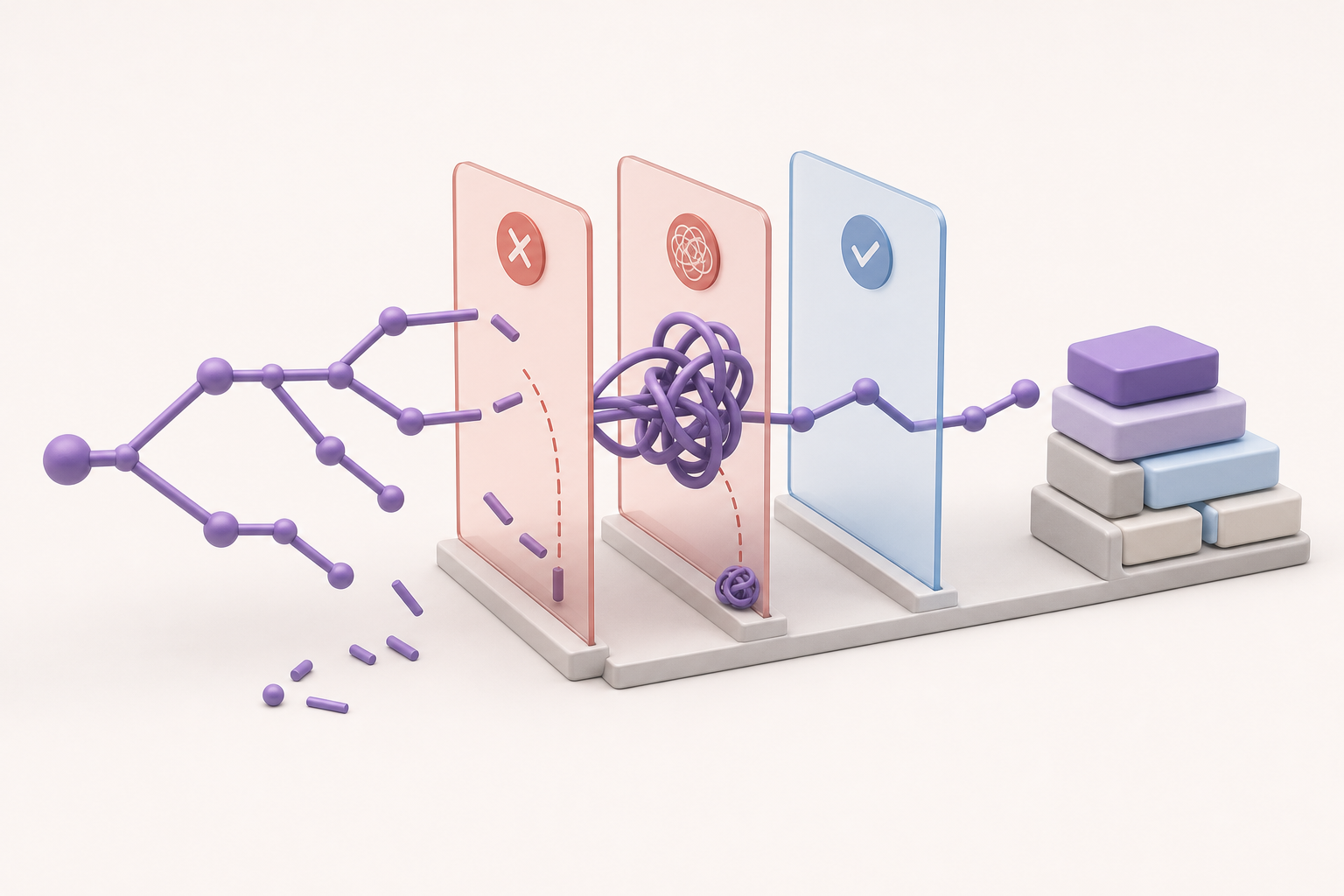
GraphQL validation is where API testing moves from “does the normal query return data?” to “does the API reject, limit, and explain unsafe or malformed requests predictably?” For QA automation engineers and API developers, that means testing syntax, schema rules, variables, fragments, response shape, and failure behavior before users or attackers discover the edge cases.
Happy path GraphQL tests prove that valid operations can return expected data. Robust query validation tests prove that invalid operations fail early, excessive operations are constrained, and partial failures preserve a trustworthy response shape. The goal is not only correctness, but safe and debuggable failure.
Why Query Validation Needs Its Own Test Layer
GraphQL lets clients ask for the exact fields they need, and the response generally mirrors the structure of the query. The official GraphQL learning material describes how queries are composed from fields, arguments, aliases, fragments, and variables, which is why tests should assert not just status codes but the requested selection set and returned shape near the query under test: GraphQL Queries. A single endpoint can expose many operation shapes, so endpoint-level smoke tests miss important risks.
Query validation sits between schema governance and resolver correctness. Schema governance asks whether the contract changed safely; resolver tests ask whether a field fetches the right data. Query validation asks whether a client request is structurally legal, bounded, authorized, and represented correctly in the response. If your team is also controlling schema drift and release gates, pair this layer with GraphQL contract testing for release gates.
A useful mental model is: parse, validate, authorize, execute, shape, and observe. Some errors should be rejected before execution. Others should produce partial data with clear field-level errors. Your test suite should know the difference.
GraphQL Validation Rules Testers Should Know
Begin with the rules that prevent invalid requests from reaching business logic. These are the checks most likely to catch broken clients, generated-query bugs, and careless refactors.
- Syntax validity: braces, parentheses, string quoting, operation declarations, and document structure must parse correctly.
- Schema validity: requested fields must exist on the selected type, arguments must be valid for that field, and scalar/object selections must be appropriate.
- Variable validity: required variables must be provided, types must match, default values must behave as expected, and unused variables should be rejected according to the server’s validation behavior.
- Fragment validity: fragments must reference valid types, include possible type conditions, and avoid cycles or impossible spreads.
- Operation validity: documents with multiple operations must provide an operation name, and operation names should be unique.
- Execution constraints: depth, breadth, cost, timeout, batching, and rate limits should prevent expensive queries from degrading service.
GraphQL is implementation-agnostic: different servers and resolvers can connect to different data sources and enforcement layers. The GraphQL FAQ highlights that implementations vary by language and backend architecture, so QA teams should align expected failures with the server stack rather than assume every framework exposes identical error text: GraphQL Getting Started FAQ.
A Practical Test Matrix for Query Failure Modes
Organize tests by the failure mode you want to prove. This keeps the suite readable and helps reviewers understand whether a test is protecting the parser, schema validator, authorization rules, or response contract.
| Area | Example test | Expected result | Common pitfall |
|---|---|---|---|
| Malformed document | Missing closing brace or invalid token | Request is rejected with no business data | Asserting only HTTP status and ignoring error body |
| Unknown field | Request a field removed from the schema | Validation error identifies the invalid field | Letting generated clients hide the negative case |
| Wrong variable type | Send a string where an ID or input object is required | Validation error before resolver side effects | Testing variables only with valid fixtures |
| Fragment misuse | Spread a fragment on an incompatible type | Validation error or empty type-safe branch, depending on query | Testing fragments only through UI flows |
| Over-fetching | Request deeply nested or broad selections | Complexity, depth, rate, or timeout control activates | Confusing functional success with operational safety |
| Partial resolver failure | Make one nullable field fail while siblings succeed | Stable data shape with clear errors for failed path | Treating every error as total request failure |
What should fail before a resolver runs?
Anything that is syntactically invalid or violates the schema should normally fail before resolver code performs business work. This matters because resolver execution may trigger database calls, side effects, or downstream service requests. Tests should verify that invalid requests do not create records, call mutation dependencies, or emit success events.
For mutations, add state checks around invalid inputs. If an invalid mutation returns an error but still changes data, the API is not safely validating at the boundary. This is especially important when clients send nested input objects, optional fields, and null values that can mean different things in business logic.
How should partial GraphQL errors be asserted?
GraphQL APIs can return useful data even when one field fails, depending on nullability and execution behavior. Tests should assert the presence, path, and message category of errors while also checking that unaffected fields remain correct. Avoid brittle assertions against full human-readable error strings unless your API treats them as a stable contract.
For response-shape integrity, validate three things together: the requested data fields, the error paths, and the absence of unexpected fields. A response that contains extra sensitive fields is a defect even if the requested values are correct.
Examples of Negative Query Tests
The following examples show the kinds of cases a CI suite can run against a test environment. They are illustrative; adjust field names, expected messages, and status-code policy to your implementation.
[
  {
    "name": "unknown field is rejected",
    "query": "query GetUser($id: ID!) { user(id: $id) { id email internalRiskScore } }",
    "variables": { "id": "user-123" },
    "expect": {
      "data": null,
      "errorsContain": ["Cannot query field", "internalRiskScore"]
    }
  },
  {
    "name": "required variable is missing",
    "query": "query GetUser($id: ID!) { user(id: $id) { id email } }",
    "variables": {},
    "expect": {
      "data": null,
      "errorsContain": ["Variable", "id"]
    }
  },
  {
    "name": "excessive nesting is blocked",
    "query": "query DeepOrg { organization { teams { members { manager { teams { members { id } } } } } } }",
    "variables": {},
    "expect": {
      "errorsContain": ["complexity"],
      "sideEffects": "none"
    }
  }
]
Do not hard-code exact wording unless it is part of the API contract. Instead, combine stable checks: error category, path, extension code, and no unintended data mutation. If your platform exposes machine-readable error codes, prefer them over localized or framework-generated text.
Testing Variables, Inputs, and Fragments
Variables are a major source of query errors because they are often built separately from the query document. Test missing required variables, null values, wrong scalar types, unexpected input fields, boundary values, and arrays containing invalid members. For custom scalars such as DateTime, Email, or Money, test format rejection as well as accepted canonical values.
Input object tests should include both structural and semantic cases. Structural validation asks whether the object matches the declared type. Semantic validation asks whether the values make business sense, such as a date range with an end date before a start date. Keep these separated in test names so failures point to the right owner.
Fragments deserve dedicated tests because they are reused across operations and can fail silently in client-side assumptions. Validate named fragments, inline fragments, type conditions, duplicated fragment names, unused fragments, and fragment cycles. When interfaces or unions are involved, include one test for each concrete type that should satisfy the fragment and one that should not.
Security-Minded GraphQL Validation
Security testing at the query layer is not limited to authentication. A correctly authenticated user can still send an expensive, broad, or introspective request that exposes too much or consumes too much. Treat query abuse as a validation risk and add it to pre-release checks.
- Over-fetching: verify users cannot request sensitive fields merely by naming them in a selection set.
- Deep nesting: confirm depth limits or complexity rules reject recursive-looking query shapes.
- Batching and aliases: test many aliased fields in one request to ensure rate limits are not bypassed.
- Introspection exposure: assert the environment-specific policy. Some teams allow introspection in development but restrict it in production-like environments.
- Authorization by field: test that object-level access does not automatically grant access to every nested field.
For broader API failure patterns that include GraphQL, REST, and release readiness, see API testing failures that cause production outages. Query validation is one layer in that defense, not a substitute for observability, contract checks, or secure design review.
CI and Pre-Release Coverage Strategy
A practical pipeline does not need thousands of negative GraphQL tests. It needs a small, risk-based suite that runs reliably on every change, plus deeper security and complexity checks before major releases. Keep fast validation tests close to the API build and run expensive abuse scenarios in controlled environments.
- Commit stage: parse and validate a curated set of positive and negative operations against the current schema.
- Integration stage: execute variable, fragment, authorization, and partial-error cases against real resolvers and test data.
- Pre-release stage: run complexity, batching, introspection, and abuse checks with monitoring enabled.
- Post-deploy smoke: verify critical queries, expected rejection behavior, and error-code stability in the deployed environment.
If your team uses Postman, Apollo tooling, or generated clients for everyday GraphQL API testing, keep manual exploratory cases alongside automated checks. Tooling can validate the schema quickly, but humans are better at inventing strange query combinations that mimic broken clients and malicious curiosity. For a tool-oriented workflow, compare your approach with GraphQL API testing with Postman and Apollo Studio.
Common Pitfalls That Weaken GraphQL QA
The most common mistake is treating GraphQL like a single REST endpoint and checking only that the endpoint returns 200. Many GraphQL servers use a successful transport status for requests that contain application-level errors, so the body is the primary evidence. Always assert both transport behavior and GraphQL-level data and errors.
Another pitfall is relying only on generated client queries. Generated clients are valuable for normal usage, but they usually avoid invalid structures by design. Negative testing requires deliberately malformed documents, incorrect variables, unauthorized selections, and abusive shapes that generated clients may never produce.
Finally, avoid hiding all failures behind snapshots. Snapshot tests are useful for detecting accidental response changes, but they can make intent hard to read. For validation scenarios, name the rule under test and assert the specific invariant: no side effects, no sensitive field, error path present, depth limit enforced, or response shape preserved.
Key Takeaways
- GraphQL validation should test malformed documents, schema violations, variables, fragments, complexity, and response integrity.
- Many important GraphQL failures appear in the response body, so status-code-only assertions are insufficient.
- Negative query tests should prove unsafe requests fail before resolver side effects occur.
- Partial-response testing must assert both valid returned data and precise error paths.
- Security-minded validation includes over-fetching, aliases, batching, introspection policy, and field-level authorization.
- A lean CI matrix with risk-based pre-release abuse tests is more maintainable than an unfocused collection of snapshots.