
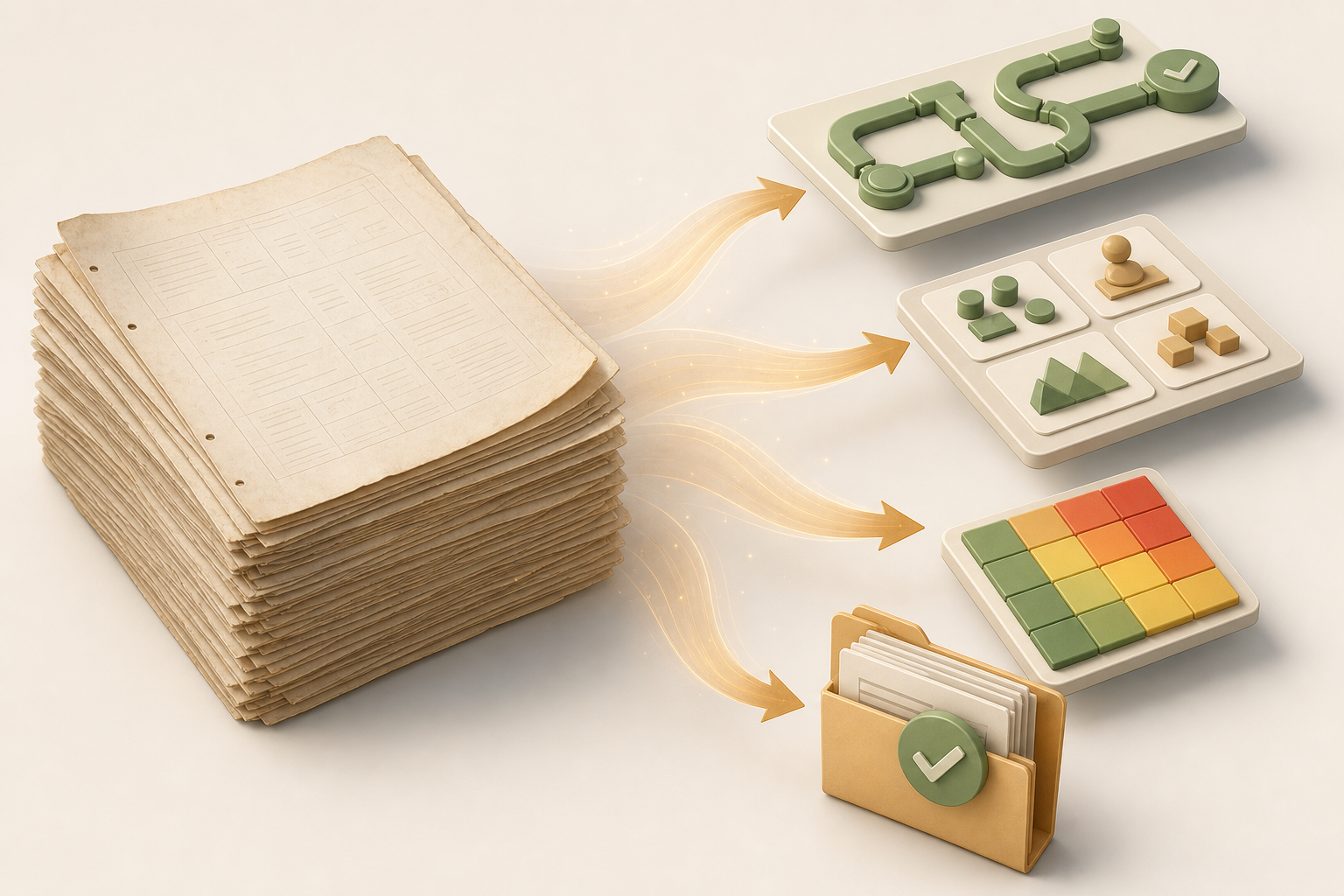
Modern test documentation is the practice of documenting testing through living specifications, executable checks, exploratory evidence, risk models, and decision records instead of relying only on step-by-step test case artifacts. Mature QA teams are not abandoning documentation; they are moving it closer to the work, making it easier to maintain, and tying it to product behavior, risk, and delivery flow.
Modern QA teams document testing without traditional test cases by using living BDD specifications, test charters, automated test reports, risk coverage maps, lightweight decision records, and defect learning notes. The goal is to preserve intent, coverage, and evidence while avoiding brittle procedural scripts that become outdated faster than the product changes.
Why Modern Test Documentation Is Replacing Step-by-Step Test Case Repositories
Modern test documentation is replacing large manual test case repositories because static procedural artifacts are expensive to maintain and often fail to describe the real risk being tested. Teams keep the useful parts of documentation, such as intent, coverage, and evidence, while removing low-value duplication.
A traditional test case is a scripted artifact that usually contains preconditions, numbered steps, expected results, test data, priority, and execution status. That format is still useful for regulated validation, repeatable manual checks, and outsourced execution, but it becomes costly when product behavior changes weekly or daily.
The core failure mode is not the existence of test cases; it is treating them as the primary source of testing knowledge. In many organizations, the test case management system becomes a parallel product model that drifts away from user stories, production behavior, automation, and actual tester learning.
High-performing teams increasingly document the question behind the test instead of every click used to answer it. For example, a checkout test may be documented as a risk around payment authorization, order idempotency, tax calculation, and recovery behavior rather than as thirty screens of procedural instructions.
Internal benchmarks from QA organizations commonly show that teams maintaining large scripted suites spend 25 to 40 percent of regression cycle effort updating obsolete steps. Teams that shift to executable specifications and risk-based notes often report 30 to 50 percent faster feedback loops because documentation changes with code, acceptance criteria, and automation output.
What Counts as Documentation When There Are No Traditional Test Cases
Documentation still exists when test cases disappear; it simply becomes distributed across artifacts that each serve a narrower purpose. The strongest teams design a documentation system rather than forcing every testing need into one template.
A living specification is a product behavior description that remains current because it is reviewed, versioned, or executed as part of the delivery workflow. Living specifications may be written in Gherkin, markdown-like product notes, API examples, contract tests, or acceptance criteria linked to automation.
A test charter is a concise mission statement for an exploratory testing session that defines scope, risk, data, constraints, and learning goals. It documents the intent of human investigation without pretending that valuable exploration can be reduced to a fixed script.
Automation evidence is machine-produced proof of checks, failures, logs, coverage, environments, and build context. It becomes documentation when it is readable, retained long enough for audit and debugging, and linked to the behavior or risk it validates.
A risk coverage map is a visual or structured representation of which product risks are addressed by which tests, monitors, reviews, or controls. This gives stakeholders better visibility than a pass count because it explains whether the right problems are being watched.
| Documentation artifact | Primary purpose | Best used for | Common owner |
|---|---|---|---|
| BDD scenario | Describe expected behavior in business-readable form | Acceptance behavior, regression automation, shared understanding | Product, QA, engineering |
| Exploratory test charter | Guide investigative testing around risk | Ambiguous features, usability flows, integration risk | QA engineer or quality coach |
| Automation report | Show execution evidence and failure context | CI gates, regression confidence, release review | Engineering and QA |
| Risk coverage map | Expose coverage by risk instead of by script count | Release readiness, test strategy, stakeholder reporting | QA lead or quality engineer |
| Decision record | Preserve why a test approach was chosen | Trade-offs, test depth, scope exclusions, audit trail | Team leads and architects |
| Defect learning note | Capture what escaped and how coverage changed | Post-release learning, regression improvement, incident prevention | QA, support, engineering |
How Behavior-Driven Testing Turns Examples Into Living Documentation
Behavior-driven testing is a collaborative testing and specification practice where examples are used to define expected system behavior before or during implementation. It works as documentation because the examples become a shared language between product, engineering, QA, and support.
BDD documentation is the living record produced by behavior-driven development practices, usually in the form of scenarios, examples, rules, and executable specifications. Its value depends less on the Gherkin syntax and more on whether the scenarios express business behavior clearly enough to survive implementation changes.
A strong BDD scenario describes an observable outcome, not an internal implementation detail. It should clarify rules such as eligibility, state transitions, edge conditions, permissions, and error handling.
Weak BDD documentation often becomes disguised UI scripting. If a scenario says click this button, open that menu, and verify this label, it is usually documenting workflow mechanics rather than behavior.
How does BDD documentation avoid becoming another test case repository?
BDD documentation avoids becoming another test case repository when scenarios are written around rules, examples, and outcomes rather than procedural interaction steps. The team should treat scenarios as product specifications that automation can verify, not as an exhaustive inventory of manual instructions.
A useful rule is to write scenarios at the level where a product manager can review the behavior without caring which browser, selector, or service call is used. Technical implementation details belong in step definitions, API tests, page objects, fixtures, or contract tests.
Teams also need active pruning. Duplicate examples, overly similar edge cases, and historic scenarios that no longer represent risk should be deleted or consolidated during backlog refinement and release hardening.
Feature: Account lockout after failed sign-in attempts

  Rule: A customer account is temporarily locked after repeated failed attempts

  Scenario: Lock an account after five failed password attempts
    Given an active customer account exists
    And the customer has entered an incorrect password four times
    When the customer enters an incorrect password again
    Then the account is locked for fifteen minutes
    And the customer is shown a recovery option

  Scenario: Allow sign-in after the lockout window expires
    Given a customer account was locked more than fifteen minutes ago
    When the customer signs in with the correct password
    Then access is granted
    And the failed attempt counter is reset
This example documents a security rule, recovery expectation, and state reset behavior without embedding browser steps. It gives automation engineers enough direction while preserving readability for risk and product review.
Test Documentation Best Practices for Teams Without Scripted Cases
Test documentation best practices in modern QA focus on traceability, intent, maintainability, and evidence rather than exhaustive procedural detail. The standard is not whether every test has a numbered script; it is whether a competent team can understand what was tested, why it mattered, and what evidence supports the result.
First, document at the right abstraction level. A release-critical payment flow deserves clearer behavior examples, risk notes, data conditions, and failure evidence than a low-risk cosmetic setting.
Second, separate specification from execution mechanics. Product rules, acceptance examples, and risk decisions should not be buried inside framework code or tool-specific step files that non-engineers cannot review.
Third, make documentation versioned and reviewable. Storing living specs near code or linking them to pull requests helps teams review behavior changes alongside implementation changes.
Fourth, document exclusions as deliberately as coverage. A short note explaining that load testing was deferred because traffic is feature-flagged to 2 percent of users is more useful than a green dashboard that hides the trade-off.
Fifth, keep evidence accessible beyond the immediate build. Retaining reports, screenshots, traces, logs, contract verification output, and environment metadata for a defined period supports debugging, compliance, and incident review.
When should QA teams still write traditional test cases?
QA teams should still write traditional test cases when repeatability, compliance, auditability, or handoff precision matters more than documentation speed. Scripted cases remain valuable for regulated validation, high-risk manual procedures, offshore execution, acceptance sign-off, and rare workflows that must be reproduced exactly.
The decision should be risk-based, not ideological. A medical device workflow, payroll calculation approval, or migration rollback procedure may need procedural evidence even if the rest of the product uses charters and automation reports.
A pragmatic hybrid model often works best. Keep a small, curated set of formal test cases for audit-critical flows, then use BDD documentation, exploratory notes, automation evidence, and risk maps for faster-moving product areas.
How to Build a Lightweight Documentation System Around Risk and Evidence
A lightweight documentation system works when each artifact has a clear job and a clear maintenance trigger. The system should answer four questions: what behavior matters, what risk is covered, what evidence exists, and what changed after learning.
Start with a product risk taxonomy. Categories such as money movement, authentication, privacy, accessibility, performance, data integrity, compatibility, and operational recovery create a stable structure that survives UI redesigns.
Map each risk category to at least one source of confidence. Confidence may come from automated checks, exploratory charters, observability, code review, contract tests, accessibility scans, synthetic monitoring, or production feature flags.
Define a maintenance trigger for every documentation type. BDD scenarios change when a business rule changes; charters change when risk or scope changes; decision records change when trade-offs change; automation reports are produced by every relevant pipeline run.
A minimum viable documentation set for a modern product team usually includes acceptance examples for user-facing rules, exploratory charters for ambiguous areas, automation reports from CI, a release risk note, and a defect learning log. This is often enough to support release decisions without maintaining hundreds of brittle test scripts.
How can teams measure whether modern test documentation is working?
Teams can measure modern test documentation by tracking decision quality, maintenance cost, defect learning, and feedback speed. Useful metrics include documentation update lead time, percentage of critical risks with explicit coverage, escaped defect recurrence, flaky documentation-linked tests, and time spent in release readiness meetings.
Vanity metrics are dangerous here. A count of 4,000 test cases or 900 BDD scenarios says little unless those artifacts are current, trusted, and mapped to risk.
Healthy teams often see fewer artifacts but stronger confidence signals. A mature team may reduce formal test cases by 60 percent while improving release explainability because each remaining artifact has a clearer purpose.
Tooling Patterns That Support Living Test Documentation
Tooling should make documentation easier to update than ignore. The best toolchain connects requirements, executable checks, exploratory notes, CI evidence, and release decisions without forcing testers to duplicate the same information in multiple systems.
Gherkin and Cucumber can support behavior-driven testing when scenarios remain business-readable and the automation layer absorbs technical details. Jira, Azure DevOps, Linear, or similar planning tools can hold acceptance examples and risk notes, but they should not become dumping grounds for stale procedural text.
Test management platforms still have a place when they provide traceability, reporting, and compliance evidence. The mistake is using them as a warehouse for low-value scripts that nobody trusts during a release call.
Exploratory testing tools, session notes, screen recordings, logs, and lightweight templates can capture human investigation. These artifacts are strongest when linked to risks, defects, and follow-up automation rather than stored as isolated attachments.
CI and reporting tools turn automation into credible documentation. A passing check is more meaningful when the report shows environment, data setup, service versions, test owner, failure history, and links to the rule or risk being verified.
name: qa-documentation-evidence

on:
  pull_request:
    paths:
      - features/**
      - tests/**
      - src/**

jobs:
  verify-living-specs:
    runs-on: ubuntu-latest
    steps:
      - uses: actions/checkout@v4
      - uses: actions/setup-node@v4
        with:
          node-version: 22
      - run: npm ci
      - run: npm run test:bdd
      - run: npm run test:contracts
      - run: npm run docs:coverage-map
      - uses: actions/upload-artifact@v4
        with:
          name: qa-evidence
          path: reports/qa-evidence/
This pipeline treats BDD scenarios, contract tests, and coverage mapping as release evidence. The documentation is not a separate afterthought; it is generated, checked, and archived as part of the same delivery path as the code.
Where Teams Get Modern Test Documentation Wrong
Modern documentation fails when teams remove test cases without replacing the information those cases used to provide. Less documentation is not automatically better; better documentation is more targeted, easier to maintain, and more useful during decisions.
The first common mistake is converting every old test case into Gherkin. This creates bloated BDD documentation that is harder to read than the original repository because it combines business syntax with procedural noise.
The second mistake is hiding all quality knowledge in automation code. Code is excellent execution logic, but product managers, support teams, auditors, and new testers often need behavior and risk expressed outside framework internals.
The third mistake is treating exploratory testing as undocumented intuition. Skilled exploration should produce charters, notes, evidence, questions, and follow-up actions, even if it does not produce a step-by-step script.
The fourth mistake is failing to assign ownership. Living documentation becomes dead documentation when nobody is accountable for pruning stale scenarios, updating risk maps, or reviewing release evidence.
The fifth mistake is ignoring compliance and organizational context. Some industries require traceable approval records, controlled evidence, or formal validation, and a modern approach must meet those requirements rather than dismiss them.
Why do some teams lose confidence after deleting test cases?
Teams lose confidence after deleting test cases when the deletion removes visible coverage without introducing better signals. Stakeholders may not miss the scripts themselves, but they do miss the reassurance that someone has thought through critical risks.
The fix is to migrate coverage, not merely remove artifacts. Before retiring a test case set, map its intent to living specs, automation, charters, monitoring, or formal cases that remain necessary.
A safe migration uses staged retirement. Archive low-value duplicates first, preserve audit-critical scripts, and review escaped defects for three to six release cycles to confirm that the new documentation model is not creating blind spots.
A Practical Operating Model for Documentation Without Traditional Test Cases
A practical operating model defines which documentation is created at discovery, build, test, release, and post-release learning. This prevents the team from debating documentation format during every feature and makes quality evidence predictable.
During discovery, capture examples, risks, open questions, and acceptance boundaries. This is where behavior-driven testing has the highest leverage because examples clarify requirements before code and tests diverge.
During build, keep executable checks close to implementation while preserving business-readable intent. Pull requests should show whether behavior examples changed, whether risk coverage changed, and whether new exclusions were accepted.
During test execution, use charters for human investigation and automation reports for repeatable checks. Each defect should link back to a risk, scenario, missing assertion, data condition, or monitoring gap.
During release review, replace pass-count theater with risk-based evidence. A strong release note says which critical risks are covered, which are partially covered, what changed since the last release, and which mitigations are in place.
After release, update documentation based on production learning. Incidents, support tickets, analytics anomalies, and customer complaints should create new examples, charters, monitors, or regression checks only when they represent repeatable risk.
Governance, Audit, and Traceability Without Bloated Test Artifacts
Governance does not require bloated test cases; it requires trustworthy traceability from requirement to risk, verification activity, evidence, and decision. Modern test documentation can satisfy audits when it is controlled, linked, and retained intentionally.
Traceability is the ability to connect a requirement, risk, or change to the tests, reviews, evidence, and decisions that address it. In modern QA, traceability may be implemented through issue links, version control history, CI artifacts, release records, and signed approvals rather than a single test case repository.
Auditors and stakeholders usually need to know what was required, how it was verified, who reviewed it, what evidence exists, and what exceptions were accepted. None of those answers require every test to be a procedural script.
For regulated teams, the pattern is controlled flexibility. Use formal cases where the regulation or validation plan demands exact procedure, then use living documentation for areas where the standard allows risk-based verification evidence.
A useful governance rule is to classify documentation by criticality. Critical controls may require approval workflows and retention; medium-risk product behavior may use BDD documentation and CI evidence; low-risk changes may need only peer review and monitoring.
Key Takeaways
- Modern test documentation preserves intent, risk coverage, and evidence without forcing every testing activity into a brittle step-by-step test case.
- Behavior-driven testing is most valuable when scenarios describe business rules and outcomes rather than UI procedures disguised as Gherkin.
- BDD documentation, exploratory charters, automation reports, risk coverage maps, and decision records work best as a connected system.
- Traditional test cases still belong in regulated, repeatable, handoff-heavy, or audit-critical workflows where exact procedure matters.
- Teams should retire test cases by migrating their intent to better artifacts, not by deleting visible coverage and hoping automation fills the gap.
- The strongest documentation metric is decision usefulness: whether the team can explain what was tested, why it mattered, and what evidence supports release confidence.
- Living documentation requires ownership, pruning, version control, and CI integration; otherwise it becomes stale faster than the scripts it replaced.